
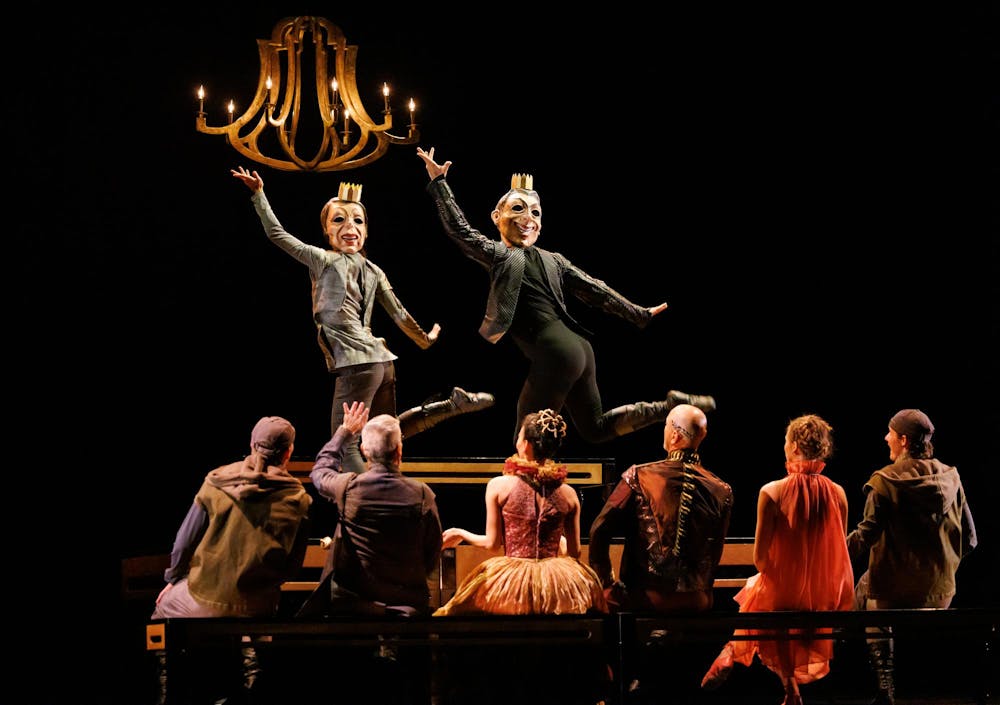
“The Tragedy of Hamlet, Prince of Denmark,” a new and original dance adaptation of the classic Shakespearean play, is coming to IU at 7:30 p.m. Oct. 14 at the IU Auditorium. Tickets start at $22.50 and can be purchased online through the IU Auditorium website until Oct. 14, or in person at the IU Auditorium box office.
Before the performance, Anisa Tejpar, the associate producer of Côté Danse, will lead a discussion about the behind-the-scenes of the show and how it was put together. Additionally, there will be a post-show discussion with dancer and choreographer Guillaume Côté where ticket holders can learn about his creative process and inspiration behind the production.
The Canadian companies Côté Danse and Ex Machina brought this production to the stage, led by Guillaume Côté and Robert Lepage. Côté founded Côté Danse in 2021 to work on independent projects aimed at a new generation of dance and theater goers. Prior to founding the group, he was a principal dancer in The National Ballet of Canada. Lepage is a multidisciplinary artist who has written plays, acted and directed for film and the stage.
Tejpar said that the pair worked together in the past on a dance production called “Frame by Frame.” After this collaboration, they were inspired to bring their love of Shakespeare together and challenge themselves to create an adaptation of the play without words.
“People still are always asking that; ‘Why would you make a ‘Hamlet’ without words?,’” Tejpar said. “But for us, we felt that the core of the story was one that could be told through the body and through emotion.”
Tejpar said it took two years to create the production. The cast and technical crew would meet up every few months and have a couple weeks of workshopping until the production fully came together.
Lepage’s experience staging several versions of “Hamlet” in the past helped facilitate the adaptation of a text-heavy work into one without words. He knew the play inside and out which helped the cast establish scenes. From this, they developed the storytelling segment by segment, trying to find how their movement could propel the story forward.
The type of dance used to convey the story also adds a distinct feature to the production. While the production mostly consists of contemporary dance, it also leans heavily on classical ballet from Côté’s background. However, the different backgrounds of the cast also informed the types of dance used.
Greta Hodgkinson is a former principal dancer for The National Ballet of Canada and plays Queen Gertrude in this production of “Hamlet.”
“We’re all coming from different backgrounds and yet we’re all doing the same steps, and we’re all embracing this movement and choreography,” Hodgkinson said.
While adapting a Shakespearean play into a medium that has no words might seem unconventional, it is actually a powerful tool that promotes the universality of the piece by surpassing language barriers.
“It’s made it more accessible to audiences that maybe, you know, aren’t familiar with Shakespeare's work, feel intimidated by the language itself, or maybe are ESL or from a different part of the world who don’t necessarily speak English,” Tejpar said. “This work is able to transcend language, because the body tells a story that everyone can understand.”
Sarah Johnson, an assistant professor of dramaturgy at IU, said that the combination of dance and theater has been around for a long time and that this continued experimentation with the art can open pathways for new ways of storytelling.
Tejpar said audiences attending the performance can expect high levels of technical skill all around, from the performers to the scenography and music. Hodgkinson describes it as the perfect meeting of theater and dance, since this production relies so heavily on both, and excels at both.
“I think it’s just a really wonderful way to experience theater with other people. There’s nothing like live theater,” Hodgkinson said. “I encourage everyone to, you know, to just really be open and come and check it out.”


