
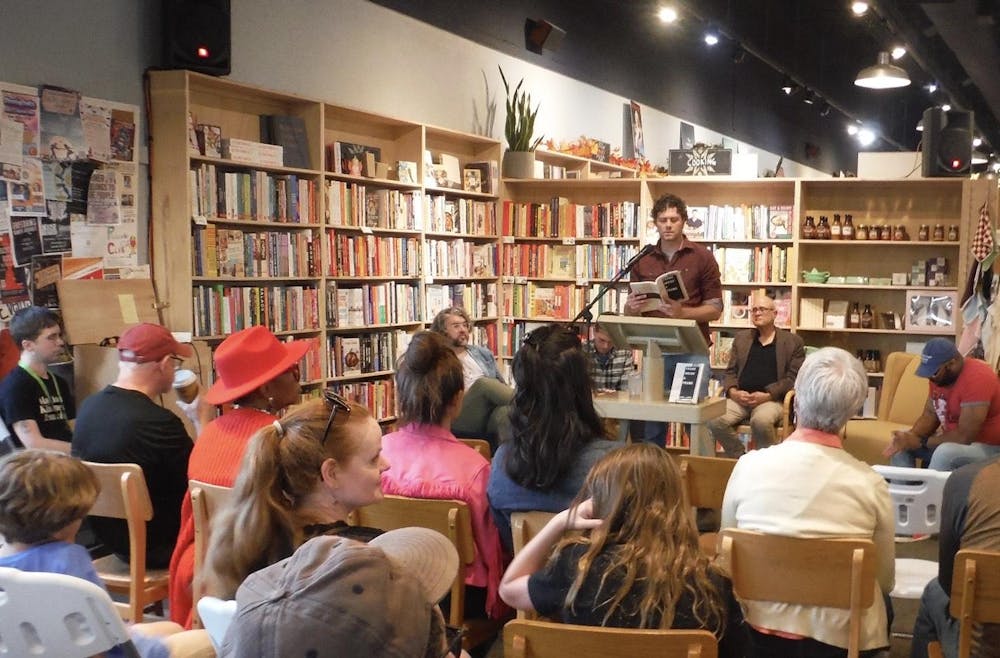
Award-winning poet Daniel Lassell discussed the thematic elements and inspiration for his newest poetry collection “Frame Inside of a Frame” at Morgenstern Books & Cafe Wednesday evening.
“Frame Inside of a Frame” explores memory and proximity through philosophical “frames,” which Lassell said represent the boundaries of memory and seeking the past through memories.
“The frames themselves are just philosophical context to interrogate and explore ideas of proximity memory,” Lassell said.
Lassell’s previous work, “Spit,” explores his childhood experience of growing up on a llama farm in Kentucky. “Frame Inside a Frame” delves deeper into the concept of his childhood memory by exploring the same themes through different lenses.
Guest readers Michael Kuhl, Joe Betz, Doug Paul Case and Jason B. Crawford were also part of the event, presenting their poetry and thoughts on Lassell’s latest collection. While all the guest readers are poets who were there to showcase their work, Kuhl, who is Lassell’s uncle, has a special connection to his poetry.
After an introduction from a Morgenstern’s staff member, Kuhl started off the night — not with poetry, but an emotional story about the house where his mother grew up. He detailed the features of the home, including a basement wall with names of family members carved into it.
Years later, in Kentucky, Kuhl said he remembers visiting his sister, Daniel’s mother, in their secluded Spencer County home only accessibly by a gravel road.
“There’s a lot of memories of us going to my sister’s house and sitting around the lake, watching the llamas spit at the children,” Kuhl said in an interview. “The ones (poems) about the llamas are always fascinating because it was kind of like memories for me, too.”
Lassell said his newest collection is not intended to only allude to the llama farm of his past, but to connect everyone to their childhood memories, as well.
“I hope readers come away thinking a little bit more about themselves and how memory shapes perspective,” Lassell said.
Following Kuhl’s story, the rest of the guest readers presented their poetry. Lassell finished off the night with readings from his newest collection.
Betz, assistant professor of English at Ivy Tech Community College and adjunct professor of English at IU, took the stand after Kuhl, presenting some of his poems that surround the seasons.
Case, assistant director of creative writing at IU, presented poems dissecting themes of self image, persimmon trees and pessimistic ideas about the future. Still in progress, “Letter to the Aliens,” reflects his pessimism for the future, musing on the possibility of alien life, the human experience and global warming, Case said. His goal is to have “Letter to the Aliens” become a poem the length of a book.
IU director of creative writing and audience member Angela Jackson-Brown said she likes the collection Case read because it speaks to her questions about the universe and the great beyond.
“The poems did a really good job of establishing the need to connect with something besides ourselves,” Jackson-Brown said.
Crawford stepped forward after Case, congratulating Lassell on his book release and expressing their gratitude for Lassell’s work, then presented their newest collection, “YEET!” This collection releases in about two weeks, Crawford said, and preemptively won the 2023 Omnidawn 1st Book Prize based on early drafts.
“YEET!” presents a new take on Afrofuturism and utopianism, Crawford said, looking at the possibilities of years ahead of technological change, depicting life in its aftermath. Afrofuturism is a cultural movement that reimagines, reinterprets and reclaims the past and present for the Black community.
“The premise was, what would happen if all the Black people left earth and found a safe space that they could call their own?” Crawford said. “Some of the poems interweave the understanding that we’ve been gone for like 500 years.”
Crawford also plays with the idea of taking up space as a Black person. They said the black words on the white page aim to take up as much space as possible, with the prose on each page being arranged differently.
“I’m a naturally loud person; I think there’s ways to read a poem loud and also to write a poem loud, and I hope that the book comes out loud in reading form,” Crawford said. “The words are loud and taking up space. But also, when I’m reading it, you feel like I’m taking up space.”
Lassell, like Crawford, views reading his poetry aloud as an extension of what’s on the page. In the excerpts Lassell presented at the end of the night, he incorporated physical motion through snapping and swaying.
Louisville, Kentucky, local and audience member Elizabeth Schaaf said Lassell’s movements were short, yet impactful. Schaaf is a friend of Kuhl’s, traveling from Kentucky together in support of Lassell. She said his movements enhanced his poetry.
“It’s like he did a dance almost while he was reading his poetry, which none of the other poets did,” Schaaf said. “I could feel his rhythm kind of moving to his words. It made me feel the words more.”
“Frame Inside a Frame” was published Sept. 1 and is available online, in local Bloomington bookstores and other select bookstores.


