Peaches the goat was trapped.
Above her, a trough full of hay. Around her, about 70 goats attempting to grab a bite of breakfast.
Despite arriving early and securing a prime spot at a feeding trough, Peaches drifted further down the line until she was wedged between the two troughs, unable to grab food from either side. In an attempt to scoot back to the hay, she found herself wedged beneath it.
The goats around her didn’t pay any mind to her predicament. Breakfast is a hectic time, and goats who don’t learn to push through the crowd get left behind.
Peaches was trapped only briefly, however, before her golden brown head broke through the sea of coarse fur that covered her. Her horns stuck out through the chaos like a beacon.
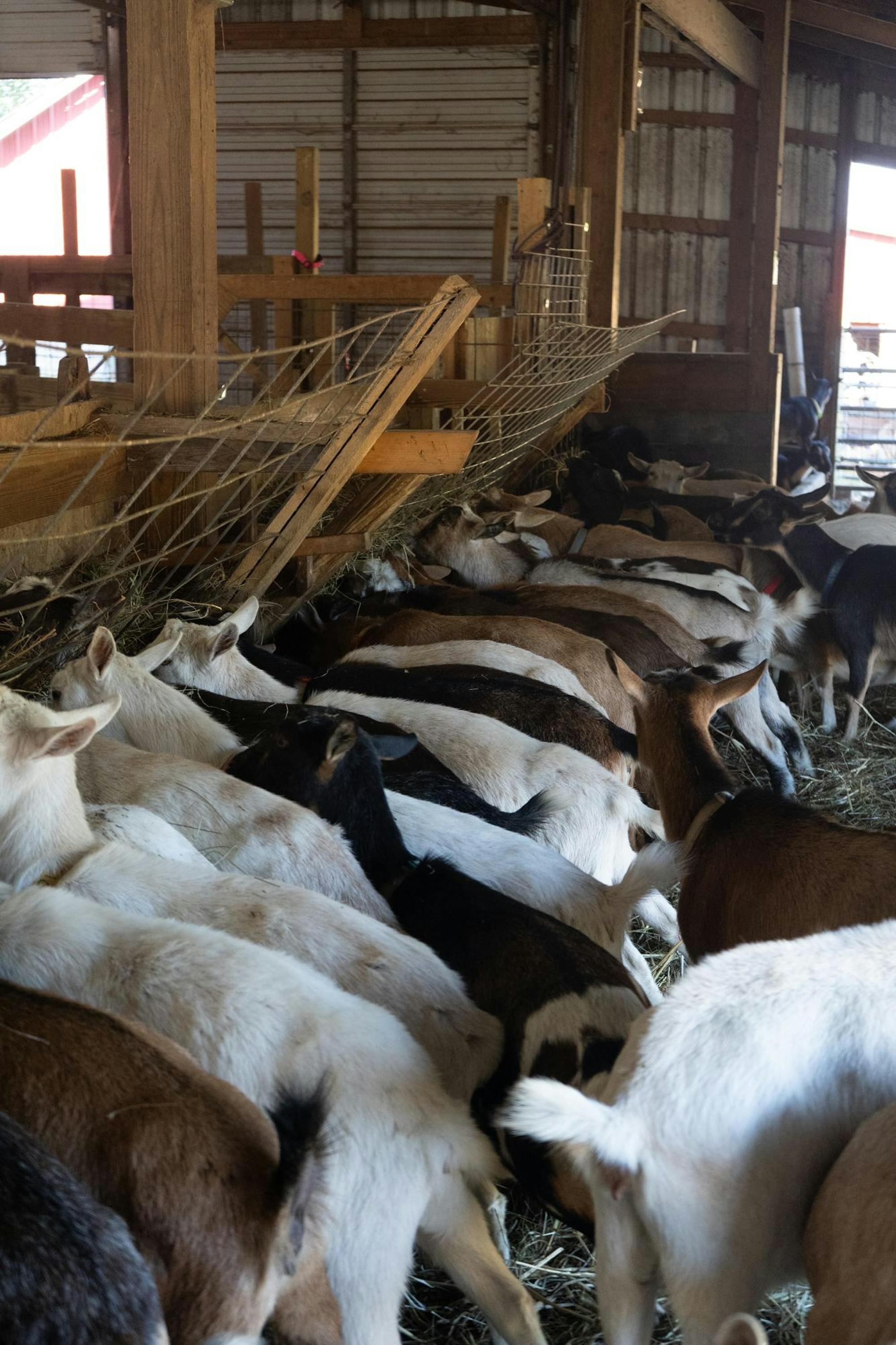
Goats in the white barn eat breakfast Oct. 9, 2025, at the Goat Conspiracy in Bloomington. The goats are split into three groups on the property, with about 70 residing in the white barn. The males live in a pen outside, and a smaller group of females live in a red barn next door.
***
She’s about 3 years old, though it’s hard to tell for sure. Goats have no birth certificates, no MyChart and no documentation of exactly how or when they came to be. She doesn’t know her father, but she’s close with her mother, Apricot, and aunt, Clementine. Her grandmother, Christina, lives further down the barn in the “golden pen” with the rest of the older goats.
Standing eye level to the people who crouch down to pet her, Peaches is small compared to the rest of the herd. Her caramel-brown fur looks dark in the shade but practically glows in sunlight. A lone tuft of white hair sprouts between her horns. Amber eyes survey the barn with a stern calmness that can only be attributed to a stress-free existence.
She is one of about 15 goats with horns out of 117 total at the Goat Conspiracy in Bloomington. Peaches the Nigerian Dwarf goat is a third-generation goat on the farm, but the first in her family to live in luxury.
Life is easy for Peaches. That’s the whole point at the Goat Conspiracy, a former creamery turned sanctuary in Bloomington. Its owners refer to the switch as its “transfarmation.”
The original farm was founded nine years ago as a project between two couples looking to practice sustainability in the dairy industry. The farm sold goat milk soaps and cheeses while hosting events including goat yoga and birthday parties.
It was created to serve the goats. However, its original owners, including current board member Nicole Schonemann, learned through the process that an ethical dairy farm was simply not possible.
“All animals are like your dog,” Schonemann said. “How weird would it be to get your dog pregnant and take its milk? How weird would it be to kill it and eat it after you’ve raised it?”
Goats must be pregnant to produce milk, so the farm housed mainly female goats with the goal of constant pregnancies. That meant the farm nearly doubled in size each year.
About 40 of the more than 120 goats on the farm were producing milk when its owners began exploring ways to exit the dairy industry. If a goat wasn’t producing, it was an expense to the farm. Schonemann said it was impossible to operate a dairy farm without slaughtering the goats who didn’t produce. Twice, the owners took goats to slaughter, but both times ended with horrified farmers returning in empty trucks after witnessing the slaughtering process.
Actively producing goats were feeling the effects of constant pregnancies and milking, and no matter how easy owners tried to make their lives, the weight of the business still fell on the goats.
Today, roughly 13-year-old Christina’s skin hangs from her ribs and hips. It's a physical sign of the work she was subjected to when the farm was a creamery from 2016-23. Christina was one of the original 15 goats used for milking when the farm began operations. She once carried Apricot, who was eventually also impregnated and milked just as her mother was. Later, Apricot got pregnant and gave birth to Peaches.
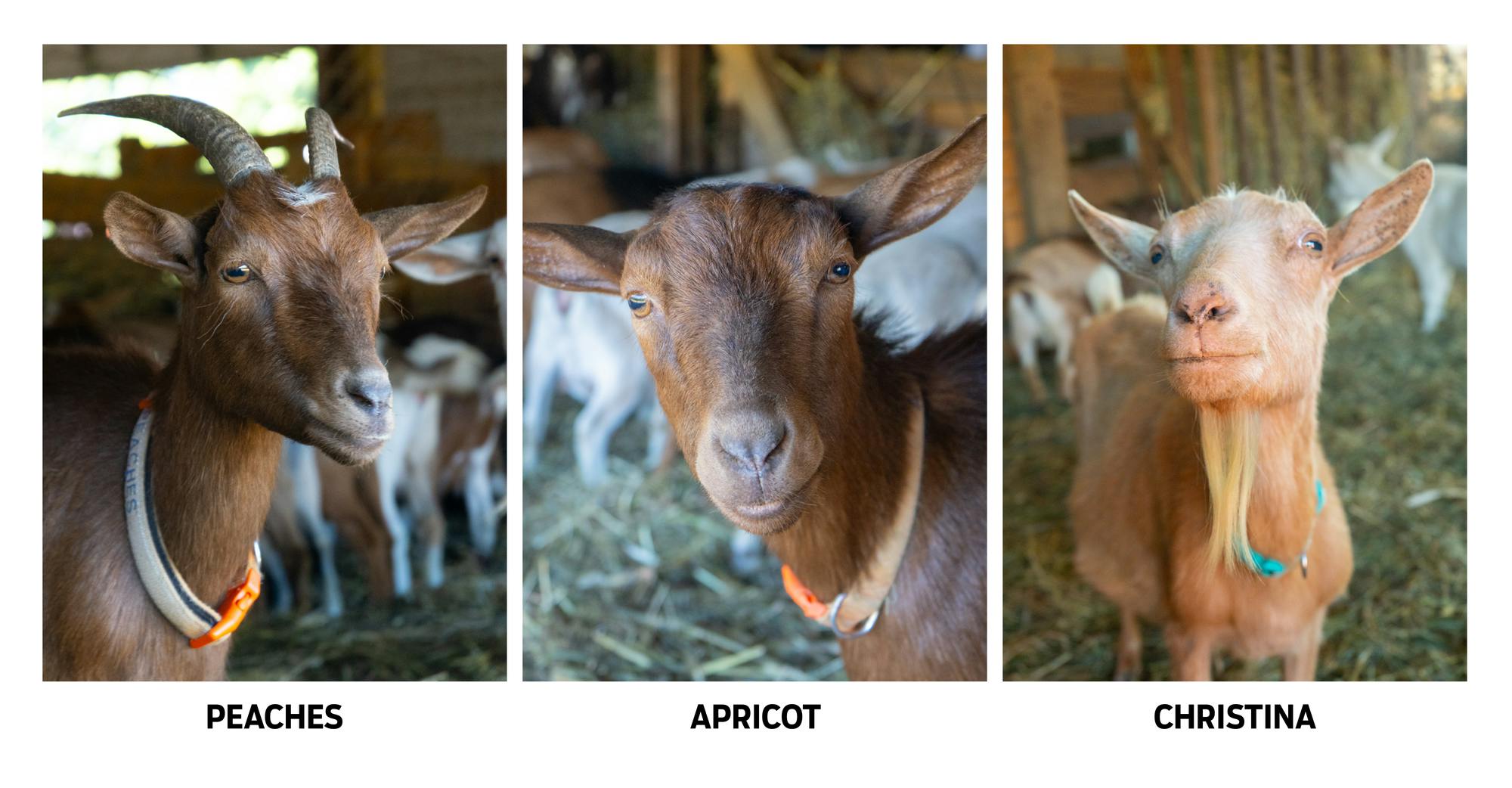
Peaches, Apricot and Christina are photographed Oct. 9, 2025, at the Goat Conspiracy in Bloomington. Christina was one of the first 15 goats to arrive on the farm, and Peaches is part of the last generation to be born there.
Most goats on the farm were used for milk, but Peaches’ generation — the last to be born on the farm — has never been milked or bred.
“Christina’s whole purpose in life was to have babies so that she could make milk,” Jac Walker, the farm’s education director, said. “Apricot’s whole purpose in life was to have babies so that she could make milk. And now Peaches; we stop that cycle with Peaches.”
The farm has switched ownership since becoming a nonprofit sanctuary in early 2024, though its founders still own the property. The Goat Conspiracy resides rent-free on the land and now focuses solely on education and social events with the goats.
Peaches’ horns are a visible symbol of the farm’s new mission. Both male and female goats grow horns, but they are typically removed in a process called disbudding. It’s often used in farming to prevent the goats from fighting each other or from hurting farmers while being milked. Disbudding typically happens within the first three weeks of a goat’s life, and is most commonly done with a hot iron.
Since the sanctuary was no longer being used for milking, disbudding wasn’t deemed necessary by the time Peaches came around.
***
Peaches stood silently by the door as visitors filed into the pen. It was late afternoon, and breakfast had been devoured long ago.
She waited as people pet the other goats around her. She stared at the guests, not annoyed but expectant. She’s not used to rejection.
Walker closed the gate behind her as the last of the guests filed in. The farm was hosting a watercolor class in a pavilion outside, but first, painters needed to find inspiration.
A few painters crouched down to pet Peaches. She pushed her head toward them as if she knew head scratches and back rubs were on the way. She’s never known the touch of a human apart from love or curiosity.
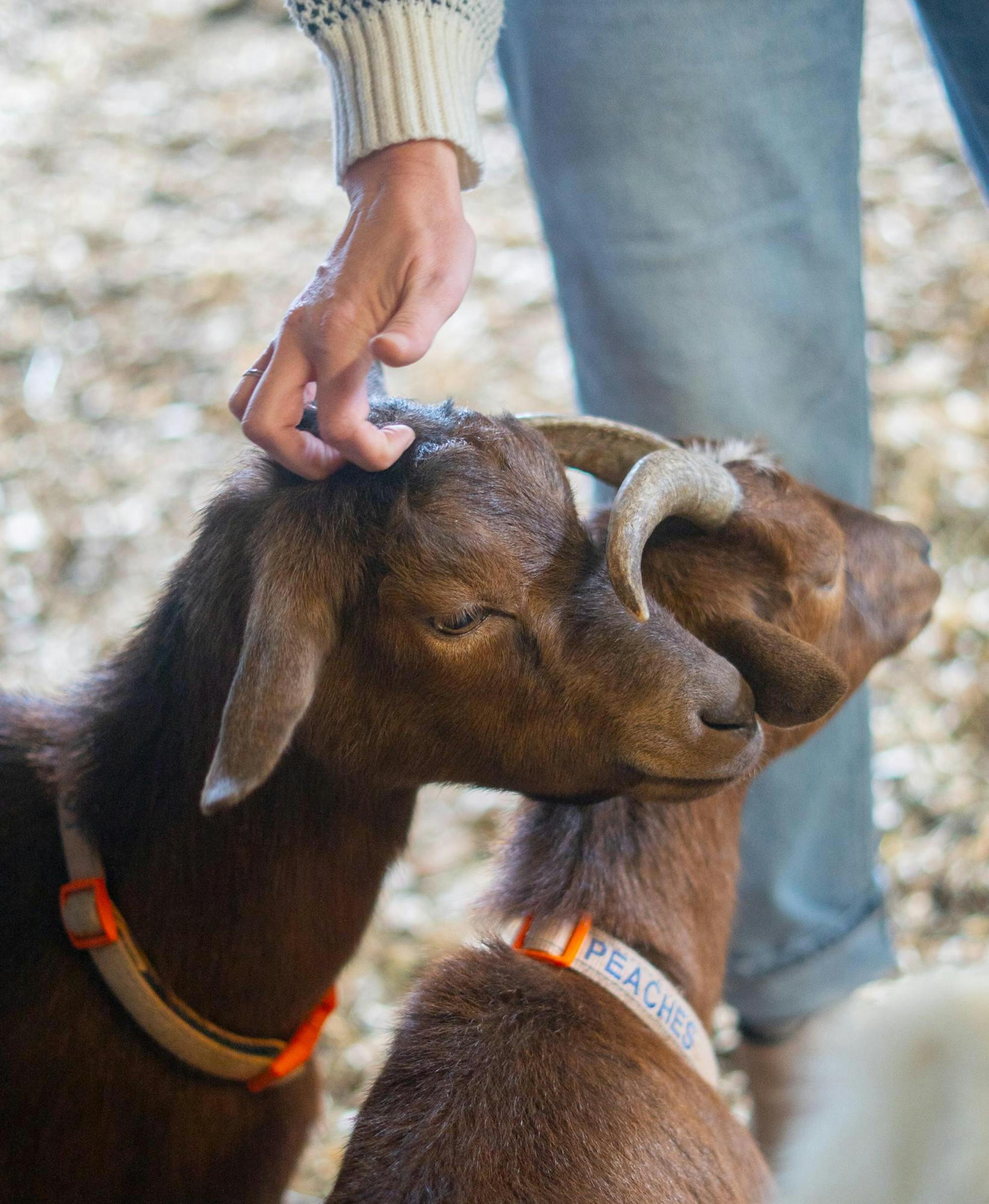
Sarah Hawthorne, a watercolor class participant, meets Peaches and Apricot on Oct. 10, 2025, at the Goat Conspiracy in Bloomington. Both goats are very social, so they are often some of the first to greet guests.
Today, goats have a choice in just about everything they do. When hosting events like goat yoga, the staff simply open the gate and see who wants to socialize that day.
“It’s part of being autonomous,” Walker said. “Part of being alive is not being forced to do anything, and that includes being pregnant, being milked.”
Abbey Janowiak, 32, lives in Bloomington and works part time at the sanctuary. She fell in love with Peaches, Apricot and the other 115 goats on her first visit. As a nurse, she needed a release from the stressors that came with working in healthcare at the time, and a few hours of farm chores and love from goats seemed like the perfect escape. She began volunteering after the COVID-19 pandemic.
Now, Janowiak works a few hours a week helping with chores and health checks. She knows almost every goat just by looking at their faces. They all have personalities, she said, and one of the best parts of the job has been figuring them out.
She's especially familiar with Peaches and often takes a break in the middle of chores to snuggle with her.
Peaches’ life is serene, but it’s one most of her barn mates didn’t grow up knowing. She doesn’t know the feeling of being pregnant, of being milked and herded around the farm. She only knows the gentle touch of a hand, the warmth of the sun on a cold morning and the wonder of a child interacting with her for the first time.
It’s a peaceful life. Exactly as it should be.