
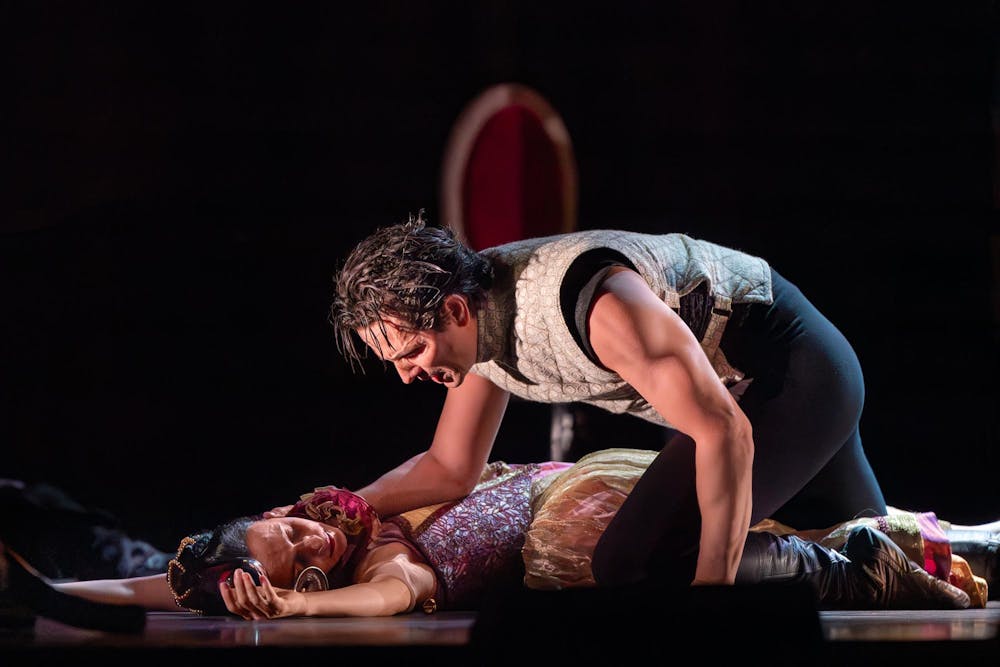
“The Tragedy of Hamlet, Prince of Denmark,” by Canadian companies Côté Danse and Ex Machina, came to IU on Oct. 14 as part of its ongoing U.S. and international tour. The show is heralded by dancer and choreographer Guillaume Côté and multidisciplinary artist Robert Lepage, who joined together to bring “Hamlet” to life without words.
Anisa Tejpar, associate producer of Côté Danse, said this non-verbal version of the play can oftentimes help audiences better understand the story without the barrier of language.
“What this show does, our version, is it gets to the crux of the concepts and the ideas and the journey of these individual characters in a way that is very clear,” Tejpar said. “But all the themes are very present and current in today’s society, today’s politics, today’s stresses and pressures that individuals and humans have to go through.”
An hour before the show began, Tejpar discussed the inspiration behind the show and its creation in a pre-show talk organized by the auditorium. Tejpar said Lepage was inspired to create a dance version of “Hamlet” after putting on many different interpretations of the play himself. He convinced Côté to create the production with him, and after two years of workshopping, the production came together.
The show is made up of nine dancers who come from different dance backgrounds. The result is a dance that incorporates contemporary, ballet and hip hop into a mesh of classical and modern movement.
The show began at 7:30 p.m. with dancers sprawled out on the floor. This was later revealed to be the end of the story. As the music began, the dancers came to life, immediately setting the dark and provocative tone of the production.
The minimalist set was made up of tables, chairs, mirrors and curtains, but these simple items managed to shapeshift throughout the show to create different settings and even reveal character’s inner thoughts. For example, the tables are at first used as actual tables, but later in the show they become a grave, a bed and an altar. Additionally, the mirrors are used as a normal mirror found in a vanity, but are later used to convey Ophelia’s mental state, taking the audience into her mind as she loses her sanity.
The curtains, while a seemingly simple piece of scenery, created breathtaking visuals that resulted in many gasps from the audience. The first notable use of the curtains is when Hamlet’s father visits him as a ghost to reveal how he died. In this production, a backlit curtain was draped over a dancer, creating a hauntingly beautiful dance. The curtain was then lifted up and pulled taught while dancers reenacted the king’s death through shadow work while Hamlet watched in horror.
Ophelia’s death was a favorite moment for the audience. After a solo dance leading up to her drowning, a blue curtain was unfurled. Ophelia walked up to the curtain and was lifted by dancers behind the curtain, creating the illusion of being enveloped and carried by water.
Arts administration master’s students Ella Cope and Jade Ha both said Ophelia’s drowning sequence was their favorite part of the show.
“I thought the combination of the mirrored stage sequence where all of her insecurities and, sort of, the demons of her life in the palace are surrounding her, and then the upheaval of the water was really effective and beautiful,” Cope said.
The combination of the lighting, curtain and movement made this moment stand out as a haunting and gorgeous portrait of Ophelia’s demise.
“Using a fabric and light and wind is a brilliant idea,” Ha said. “The portrait of, like, she’s drowned by sadness, not only water. It was very symbolic and it was very beautiful.”
Along with the effectiveness of the sets, the music played a vital role in bringing the story to life. The score, composed by John Gzowski, mixed traditional Danish instruments from the time period of “Hamlet” with modern instruments, like electric guitar. This created a dramatic and intense backdrop for the dance and helped convey the emotions of the characters.
The show incorporates one piece of written word through a screen that types out different stage directions and descriptive writing. This simple aspect of the show also managed to leave audiences mystified as words and phrases were rearranged to turn their meanings on their heads.
Maryann Iaria, a retired IU employee and current Shakespeare actor for the Monroe County Civic Theater, was blown away by the production.
“It’s fantastic, I mean, it was breathtaking,” Iaria said.
After the show, Côté discussed how he put the show together, advice he had for emerging dancers and the value of communicating a story without words.
“You see it bare bones and, in a way, it’s a two-hour version of ‘Hamlet’ that is truly kind of a little bit more, if I can humbly say, probably visceral instead of more cerebral,” Côté said in the discussion.
Ha said she didn’t want the show to end.
“I felt like I’m in a bizarre dream that I don’t really want to wake up from, you know, I want this to last,” Ha said.


