
Editor’s Note: This story includes mention of potentially triggering situations, such as violence and death.
As I sat in my seat at Bloomington’s AMC theater and waited for my movie to start, I couldn’t look away from my phone. I don’t make a habit of being the obnoxious person on their phone during movies, but I really did have a good reason for it: I hate horror movies.
They freak me out, give me bad dreams and make me more anxious in my everyday life. To relieve this, I have a plan whenever I go see a movie in theaters during or right before the month of October: I do whatever possible to ensure that no disturbing clips from whatever new movies there may be lodge themselves in my brain. And yet, there I was sitting in the theater, $11 poorer to see the King of Horror’s newest film: “The Long Walk.”
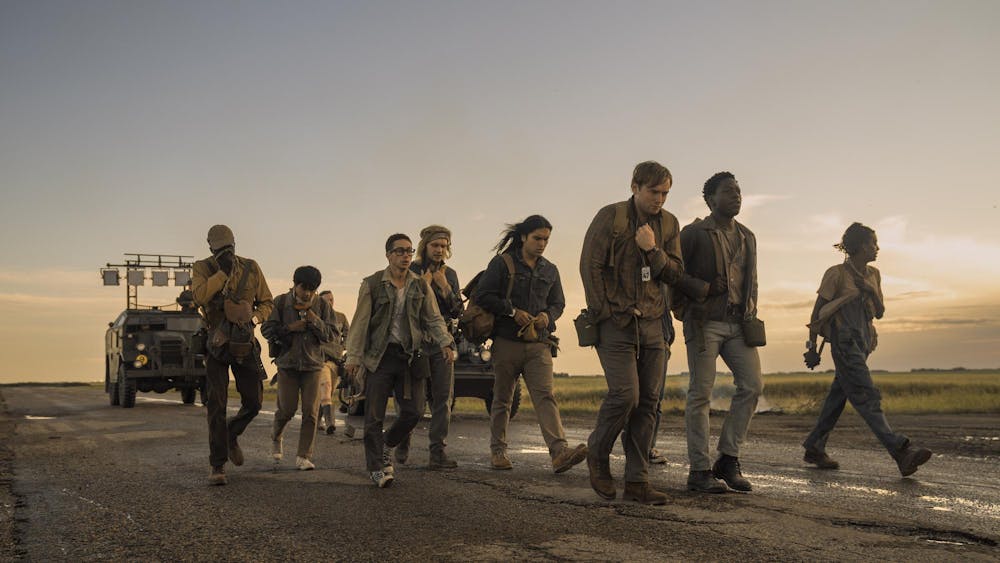
The Stephen King adaptation follows Ray Garraty (Cooper Hoffman) as he sets out on the Long Walk — an annual contest men 18 years or older are eligible to enter. The rules are simple: maintain a walking speed of 3 mph and don’t stop walking until you’re the only one left alive. There’s no finish line, and as one in 50 contestants — to reference another dystopian work about a death contest — the odds are not in your favor.
The alternate version of the United States that Garraty and the rest of the participants live in is miserable. The nation suffered a second, devastating civil war 19 years before the film is set and is now under the control of a totalitarian military regime.
Life is bleak. Morale is, not surprisingly, low. And how do you inspire a war-torn country? Obviously more death.
When Long Walk participants fail to meet pace for 30 seconds or attempt to leave the concrete road, they are unceremoniously shot and killed, as the rest of the group must keep walking.
They know the risks going into it; it’s technically an optional contest, though there’s social pressure to apply, and is widely publicized every year. But to the contestants, at least at the start of the walk, it’s worth it for the prize: a large sum of money and one wish fulfilled.
It’s a bit surprising it took until 2025 for “The Long Walk” to be adapted into film after being released in 1979, especially with the dystopian young adult movie craze of the 2010s. The book deals with what is now a classic YA conflict structure with teenagers competing in some sort of battle to the death for the public’s entertainment (“Hunger Games,” “Battle Royale” and “Maze Runner,” for some examples).
"The Long Walk” was King’s first book he wrote, but his first published novel was 1974’s “Carrie,” which has since been adapted into four different movies. “The Long Walk” wasn’t released until 1979 under King’s pseudonym Richard Bachman, but he started it in high school and finished it as a 19-year-old college freshman in 1967 as he watched classmates of his "win the lottery” for the Vietnam draft and never return.
The story has since been read as an allegory for the Vietnam War and an anti-war book, but King didn’t set out to with that goal.
“You write from your times, so certainly, that was in my mind. But I never thought about it consciously,” King said in a May 2025 interview with Vanity Fair. “I was writing a kind of a brutal thing. It was hopeless, and just what you write when you’re 19 years old, man. You’re full of beans and you’re full of cynicism, and that’s the way it was.”
What I appreciate about “The Long Walk” is that it strips the idea of violence and war down to what death truly means.
Most media depicting death at such a rate as “The Long Walk” –– after all, the audience knows at least 49 people will die in under two hours — would glorify or minimize it in some capacity.
“The Long Walk” doesn’t do this. It forces the viewers to reckon with the gruesome reality of death and the loss that survivors must face after it.
Friends told me that the movie was gory, and I thought, “How bad can it really be?” After all, I’ve seen “Game of Thrones.”
But I have never seen anything as gory as “The Long Walk.” The first death in the film shocked me the most because I had never seen a movie show how a bullet affects the human body so graphically.
This was King’s intention.
“If you look at these superhero movies, you’ll see… some supervillain who’s destroying whole city blocks, but you never see any blood,” he said in an August 2025 interview with The Times. “And man, that’s wrong. It’s almost, like, pornographic… I said, if you’re not going to show it, don’t bother. And so, they made a pretty brutal movie.”
The film almost felt like a bottle episode in cinematic form. The shots were nothing special; sure, there were visually pretty moments, but cinematographers can only make shots of a dwindling group walking interesting so many times.
The characters — especially Garraty and Peter McVries (David Jonsson), who are easily the two leads — are given so many chances to shine, as they go from the hope of winning to facing their inevitable deaths.
The movie takes a more character-focused approach than its literary version, and I think it soars because of it. I skimmed the book summary when the movie was first announced, but even while knowing the basic plot, I couldn’t believe how much the film moved me.
I doubted how emotional I would feel toward the characters, knowing about their fates, yet I still found myself hoping that, just somehow, they would all make it. One of the saddest scenes in the film was a character discarding their chewing gum, which I never knew could be an emotional moment.
“The Long Walk” isn’t perfect, but I do think it’s one of the best dystopian movies to come out in recent years.


