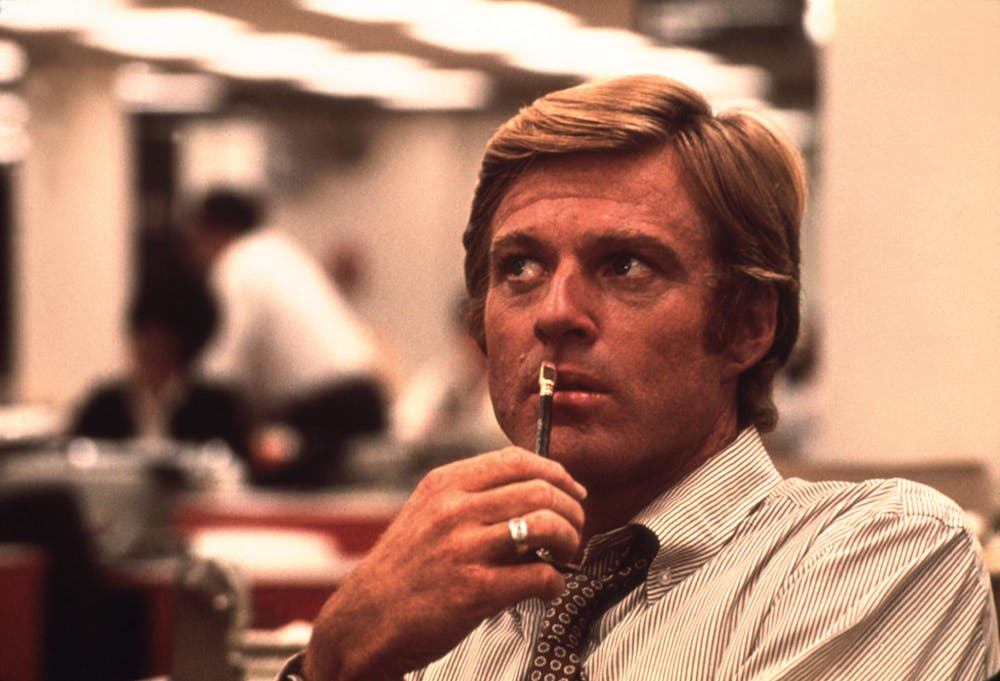
American actor and filmmaker Robert Redford died Sept. 16 at the age of 89. While best known for his work on the big screen, earning four Academy Award nominations throughout his career, Redford’s legacy beyond Hollywood deserves greater recognition.
Elevating journalism
In one his most iconic acting roles in the 1976 film, “All the President’s Men,” Redford stars as investigative journalist Bob Woodward, working alongside fellow reporter Carl Bernstein, played by Dustin Hoffman, to uncover the Watergate scandal.
Redford played a crucial role in portraying a positive representation of journalism and embodying an icon in the industry. While his acting stands out, Redford’s lasting impact on journalism through the Oscar-nominated film is often overlooked.
In addition to acting, Redford was heavily involved in the production of the film, helping turn the story into an on-screen experience while highlighting Woodward and Bernstein’s work in a noble light. The duo’s investigative reporting sparked a rise in journalism trends throughout the United States. Journalism student enrollments soared by 93% between 1970 and 1975, per the New York Times, which can largely be accredited to the journalistic work of Woodward and Bernstein.
The release of “All the President's Men” in 1976 coincided with a 72% public trust in media that year across the United States according to a survey conducted by Gallup — the highest since the company began asking this question in 1972. This surge in trust underscores the substantial impact that Woodward and Bernstein’s investigation — and Redford’s production of the story and acting in the film — had on elevating the power of journalism.
Championing environmentalism
Since the beginning of the modern environmentalist movement, which began in the late 1960s and early ‘70s, Redford used his public persona to push for environmental causes.
Over the last five decades of his life, Redford worked closely with the Natural Resources Defense Council (NRDC) as a trustee.
He also consistently advocated for environmental justice. In the late ‘70s, Redford advocated for the passage of the Alaska National Interest Lands Conservation Act, which expanded the Arctic National Wildlife Refuge — a more than 19 million-acre protected home to an abundance of wildlife.
Most recently, Redford publicly supported clean energy legislation, which turned into the Inflation Reduction Act of 2022 — the largest climate and clean energy bill in United States history.
“The environmental movement has lost a giant,” NRDC president and CEO Manish Bapna said in a press release. “Nobody has done more to shine a light on the most important environmental issues from the dawn of the environmental movement in the ‘70s through the biodiversity and climate crises of today. We must continue to honor his vision in the difficult environmental landscape we face today.”
Empowering independent filmmakers
Despite receiving numerous Academy Award nominations and epitomizing the classic Hollywood movie star, perhaps Redford’s most defining traits were his significant contributions to independent filmmakers and the indie film industry.
In 1969, Redford purchased land to open the Sundance Mountain Resort in Utah, which he later fostered into a space for the Sundance Institute — a nonprofit organization dedicated to celebrating and cultivating independent filmmakers. Despite his success in acting and directing, Redford recognized that smaller creative minds lacked the opportunities and attention they deserved.
The institute hosts the annual Sundance Film Festival, which has helped launch some of the biggest director names in Hollywood, including Quentin Tarantino and Wes Anderson.
Brittany Friesner, managing director for the Indiana University Cinema, worked with Sundance in theater operations from 2008-2015 and remembers the feelings surrounding Redford within the organization.
“It was electric to have him in the building and there to remind everyone of the heart and soul and original intent of the festival,” Friesner said. “To highlight independent filmmakers, to celebrate their work, to gather together in a communal space, to connect and reflect on the stories we all have inside of us.”
Beyond his critically acclaimed performances on-screen, Redford’s legacy should be celebrated as an enduring commitment to truth, environmentalism and enhancing small voices in film.
Conor Banks (he/him) is a sophomore studying media.