
Editor's note: All opinions, columns and letters reflect the views of the individual writer and not necessarily those of the IDS or its staffers.
I was a faculty member at Indiana University for 22 years. I am an award-winning teacher who deeply cares about my students and community. Yet, I decided to leave IU, Indiana and the United States to assume a new position at an excellent rising university in another country.
I left IU because IU President Pamela Whitten’s administration and the IU Board of Trustees, backed by Indiana’s state government and collaborating with ideological organizations, are waging war on IU’s faculty, mistreating IU’s staff and attacking IU’s students if they dare to express views the administrators and politicians do not agree with.
The IU community — students, staff, faculty, alumni and citizens — must mobilize to save IU from irreversible harm.
In April 2021, an IU Board of Trustees comprising mostly political appointees ignored the recommendations of the search committee it appointed by choosing Whitten as the 19th president of IU. While Whitten was not a qualified candidate to lead a top research university, she had a history of doing exactly what conservative politicians wanted.
Whitten must have known she soon would be detested for the changes she was hired to implement because she immediately demanded, then received IU Police Department protection and locked IU administrative offices to protect herself and her appointees from expected future threats.
To transform IU at will, Whitten methodically appointed acquaintances and other loyalists to all key administrative positions at IU by December 2023.
After the Oct. 7 attack and the beginning of the war in Gaza, pressure from conservative politicians motivated Whitten to enact her ultra-conservative and anti-intellectual mandate. She even acknowledged in a letter to then-Representative (and now U.S. Senator) Jim Banks that IU worked closely alongside the pro-Israel organization Israel on Campus Coalition, which has deep links to that foreign nation, to target our own IU students, staff and faculty.
Soon afterward, Whitten and her appointees suspended me, the faculty advisor of the Palestine Solidarity Committee; cancelled a retrospective by Palestinian American IU alumna and renowned artist Samia Halaby; changed IU’s own policies overnight to ban the student encampment for Gaza; twice attacked the Gaza solidarity encampment and placed snipers who pointed their rifles at IU students on the IMU’s roof; falsely described our own student and faculty protesters as violent outsiders to excuse inflicting real violence on them; modified the IU policy governing free speech on campus to make it highly punitive and restrictive; and stripped the Dunn Meadow area of its storied status as the zone for unhindered free speech at IU. In addition, Whitten’s administration maneuvered to end independent media on campus by forcefully restructuring the IDS and public radio.
After attacking constitutionally-protected free speech, the Whitten administration collaborated with the state legislature, governor and Board of Trustees to attack academic freedom, faculty tenure and shared governance.
In March 2024, the state legislature passed, and the governor signed, Senate Enrolled Act 202, a law that established a snitching system to report members of the IU community, particularly faculty and assistant instructors, to administrators for investigations that could lead to their dismissal from IU. The zealous IU administrators went beyond SEA 202’s mandate: they implemented the system in a way that allows even anonymous complaints and gives them the backing of the law.
We all understood that the administration would use SEA 202 to selectively target faculty who challenged it or who did not declare fealty to conservative causes. Indeed, the administration aggressively harassed my colleague, Professor Ben Robinson, targeted in an anonymous complaint, on the basis of SEA 202. Professor Robinson’s sin? He supposedly mentioned in class that he was arrested at Dunn Meadow when protesting the ongoing genocide in Gaza and criticized the brutal foreign policy of another state, Israel.
Then, in April 2025, the Indiana legislature, in a move that appears designed to benefit Whitten, inserted sweeping changes to the governance of IU, faculty tenure and IU majors and departments into House Bill 1001, the state budget. The changes prevented IU alumni from voting for members of the Board of Trustees and reduced the student trustee’s term from two years to one to reduce their influence. It ended tenure for faculty, a necessity to protect independent inquiry and thinking, with frequent mandatory reviews that can lead to dismissal. It allowed the suspension of smaller majors, particularly those the conservative legislators consider problematic because they promote independent thinking or humanize minorities, and made it easier for the Whitten administration to close departments that offer them. Finally, it deprived faculty organizations, such as the Bloomington Faculty Council and University Faculty Council of all influence over IU policy-making, effectively turning the university into an administrative dictatorship.
We are left with a husk of a university that lacks freedom of speech, academic freedom, the protections of tenure and shared governance.
Knowledge and truth can no longer flourish at IU.
To add insult to injury, the IU administrators implementing these draconian changes fall far short of the ethical standards they, and all members of the IU community, are expected to uphold. Pamela Whitten apparently plagiarized others’ work in her own doctoral dissertation, to a degree that could get an IU student to be disciplined and possibly expelled if they did the same. How can a faculty member tell her students that plagiarism is wrong anymore if the university president is a plagiarizer?
Just as grievously, Provost Rahul Shrivastav and the Vice Provost of Faculty Affairs Carrie Docherty have repeatedly violated the very IU policies they were supposed to uphold as part of their job descriptions. For example, the provost fired IU Professor Xiaofeng Wang and his partner staff member Nianli Ma without due process when policies clearly required such a process. The two administrators also violated multiple IU policies when they were trying to suspend me for two semesters based on an absurd claim that I reserved a room by using the wrong form. Other colleagues who chose not to go public have also reported in private conversations that they have been subjected to harassment and the violation of their policy-mandated protections by the administration.
It is no surprise then that Whitten, Shrivastav and Docherty are the most detested administrators in the history of Indiana University, as shown by an overwhelming vote of non-confidence by the IU Bloomington faculty and by the multiple IU campuses and schools' votes calling on them to resign.
What does all this mean for the future of IU and Indiana?
Many of IU’s best teachers and researchers are leaving or retiring early to avoid dealing with IU’s new toxic culture. They are IU’s loss and other universities’ gain. This will undoubtedly bring down the quality of teaching at IU and the ranking of the university, which will in turn hurt the standing of its graduates and its ability to attract promising students.
As damage spreads at IU, the best Hoosier students will choose to go to college outside the state, leading to brain drain and causing harm to the Indiana economy and business community.
The harmful changes instituted by Whitten also impede the recruitment of new faculty to fill important gaps in departmental offerings. A sensible candidate would accept an offer promising real tenure at another university over one with pretend tenure at IU.
IU was a gem in Indiana. The state legislature and the IU Board of Trustees appear to have hired Whitten to fulfill an ultraconservative and Christian nationalist agenda against all that they perceive to be different to their narrow understanding of how society should be organized. Sadly, they are destroying all that made IU great in the process.
What can the IU community do to save IU from rogue administrators, irresponsible trustees and ideological state politicians?
There are no venues left for the faculty and graduate students to be heard — the BFC and UFC have lost virtually all policy-making powers, the administrators repeatedly ignore the recommendations of the Faculty Board of Review and the trustees and legislators have even made speech punishable.
The only option left for the faculty and graduate students is to unionize.
The administration will try to sabotage unionization. It is no coincidence that Pamela Whitten appointed Anthony Prather as IU General Counsel — Prather is a management-side attorney who specializes in defending management and in limiting workers’ interests in corporate environments. At IU, he and his subalterns have been writing many of the sanction letters addressed to faculty by Docherty and Shrivastav. His insidious role at IU is yet one more reason why graduate students and faculty need to unionize before it is too late.
Should I have stayed to continue to fight for a better IU? Perhaps.
Many colleagues and I have fought hard to protect faculty, students and staff from Whitten and her appointees. Numerous votes of no confidence showed virtually no faculty members have confidence in Pamela Whitten, Rahul Shrivastav and Carrie Docherty. We planned protests and vigils. We built meaningful ties with staff and graduate student organizations. We produced a newsletter to update colleagues about the transgressions of the rogue administrators and the irresponsible members of the Board of Trustees. Other colleagues challenged the administration in court over free speech restrictions, among many other actions.
Our mobilization was so meaningful and potent that the Indiana legislature, possibly wanting to protect Whitten or to assist her at her request, passed laws to end the protection of tenure for faculty and to terminate degrees (and consequently departments) that encourage engagement, independent thinking and activism.
I knew that I would be targeted immediately because I was one of the faculty members who frankly told the vindictive administrators to their faces that they are unethical, incompetent and harmful. I also happened to receive an excellent offer from a rising institution that is open to the world and educates the leaders of the Global South. The contrast couldn’t be greater with a fast-sinking IU that is kept back by fear, pessimism, authoritarianism and a backward ultra-conservative ethos.
I therefore voted with my feet.
Many others are doing the same.
I miss my colleagues and our students in the IU trenches who are defending IU and our amazing IU students, but it made a lot of sense for me to join a new institution where I could work with a supportive administration to do good in this world.
Some, particularly those who dislike others who look or think differently, may be glad to see me leave IU, Indiana and the United States. I hope they realize, however, that the road to a quick American decline begins with the fear of differences and the fear of ideas. A country of insecure citizens that is led by manipulative politicians will soon strip away its own freedoms and cannibalize its own institutions. American decline is real, and it is being accelerated by selfish American politicians and those foolish enough to vote for them.
While Americans are harming other Americans because they fear difference, the rest of the world is catching up and surpassing the United States. You can see the future more clearly nowadays in Morocco, Turkey, Malaysia, China, Singapore and South Korea than you do in Indiana or even in California. And while Americans always comforted themselves with the thought that they at least have freedoms and democracy, we are well on our way to losing those as well.
I very much hope that the IU community and the Hoosier state more broadly will rally to defend IU against a rogue university administration, irresponsible trustees and ideological politicians who are constantly fabricating cultural threats to motivate voters. Losing IU cannot be good for Indiana.
The IU community and the people of Indiana must save IU before it is too late.
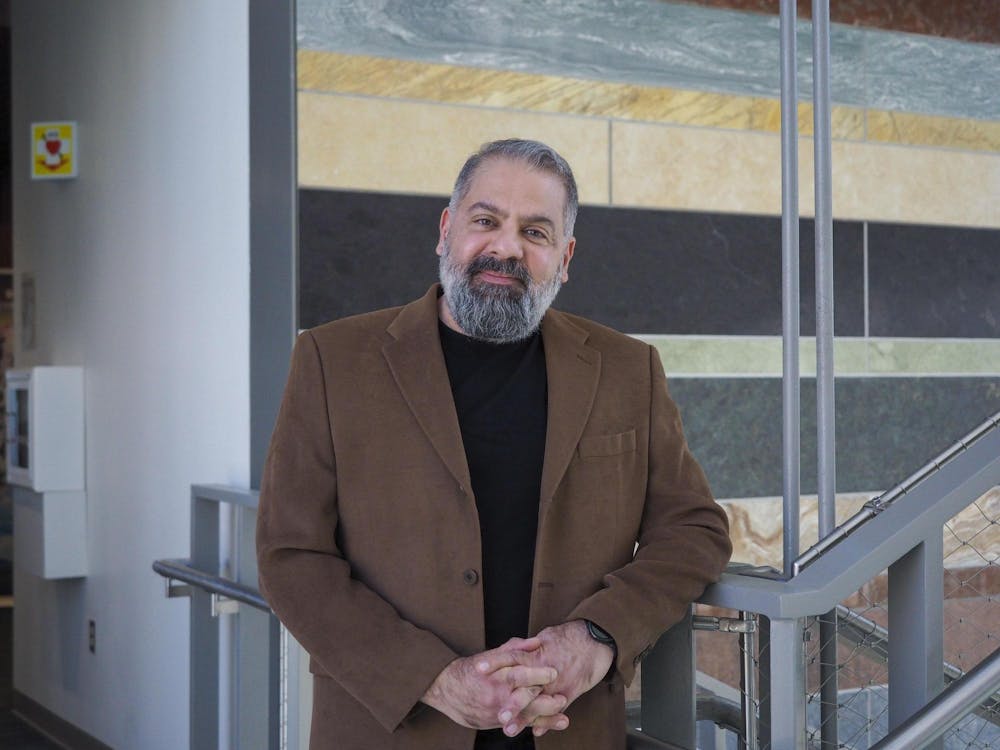
Abdulkader Sinno (he/him) taught political science at IU for 22 years. He is now Professor of Political Science at University Mohammed VI Polytechnic in Rabat, Morocco.



