
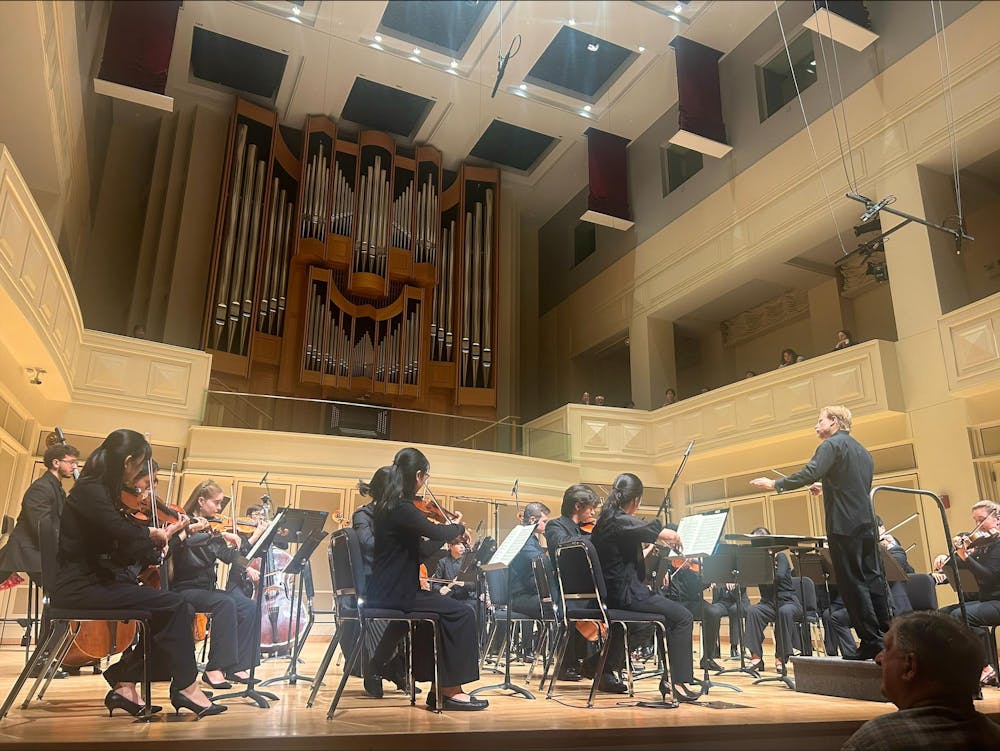
Jacobs School of Music’s Auer Hall was filled with vibrant melodies Friday night as the Chamber Orchestra gave its first concert performance of the fall semester. The concert was free for anyone to attend, and the 400-seat auditorium was more than halfway full.
The ensemble was directed by Jeffery Meyer, an orchestral professor and co-chair of the Department of Orchestral Conducting. His selected set list included three pieces, each from different time periods: Maurice Ravel’s “Le tombeau de Couperin” (1919), Errollyn Wallen’s “Mighty River” (2007) and Mendelssohn’s 1833 “Italian” symphony.
“Together, these works form a kind of journey: reflection, resilience and joy,” Meyer said in an email to the IDS.
Principal second violinist Emilia Sharpe said “Le tombeau de Couperin” was new to her, and she had not heard it before receiving the music about three weeks ago. She admires its composition.
“It’s a really powerful piece and it really highlights Ravel’s skill at orchestration,” Sharpe said. “And it’s really playful, and there are really beautiful moments in that.”
The Ravel piece consisted of four movements, each one offering different tempos and moods. It is a common pattern within music for a piece with multiple movements to contain an upbeat opening movement, a slower midsection and an up-tempo celebratory final movement; this was absolutely the case for “Le tombeau de Couperin.”
There was a bated silence between each movement as the audience waited to hear more. After the final movement, Meyer briefly stepped off stage before returning to begin the evocative “Mighty River.”
The piece, composed in 2007, was written to mark the bicentenary of the slave trade in Great Britain being abolished. Errollyn Wallen, a Black woman who grew up in London, was inspired by the strength of her ancestors. The piece captures that spirit of hope and determination through dark times.
The piece began with “Amazing Grace,” with the melody interspersed throughout different points within the piece. With its historical context, the performance was highly emotive and powerful.
Meyer highlighted the importance of featuring the music of contemporary composers within his programs.
“Contemporary music has always been a really big part of my heart and passion,” he said. “And I find it part of my mission to bring these musicians to the stage, because these people are of our time. They are living. They have things to say about our time right now.”
After a short intermission, the ensemble returned to deliver its rendition of Mendelssohn’s “Italian” symphony. Principal violist Chi-Yun Liu said it was her favorite piece within the concert.
“I think you can enjoy a different vibe from every single movement,” she said.
The piece began with an opening movement that was lively and triumphant. The music cascaded into gorgeous crescendos, encompassing a sense of grandiosity with every dynamic change. Meyer described the symphony as “bright, infectious and full of rhythmic energy,” and the piece was a vivacious conclusion to the concert.
After the final piece, Meyer gestured individually for each section to stand and be honored with applause. The crowd gave a thunderous standing ovation that lasted nearly five minutes.


