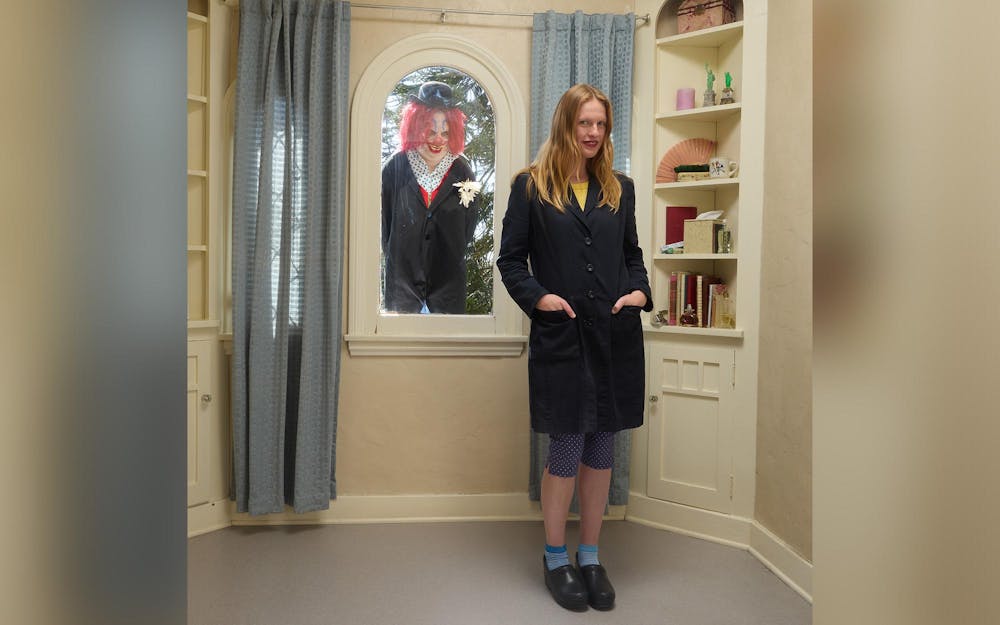
Audrey Hobert might be just like you — messy, socially anxious, insecure but also confident to a fault. Like most good pop music, Hobert’s features a carefully crafted pop persona, of course, but it’s her real personality and her heart that truly illuminate her work.
Her ability to be so unashamed and honest, not only about who she is but what she really thinks, is incredibly refreshing.
Through her catchy melodies, clever lyrics and quirky personality, Hobert has captured the internet’s attention. On her debut album “Who’s the Clown?” she explores the pitfalls of modern girlhood, insecurities and hookup culture, approaching these subjects with both humor and vulnerability.
Hobert’s debut single “Sue Me” and its eccentric music video was, for many, their first introduction to her. The success of the single generated significant online interest, propelling Hobert’s name into the pop space and powering the campaign for “Who’s the Clown? her debut record. On Aug. 15, Hobert released the album to an overall positive reception.
Although her background is in screenwriting, Hobert’s songwriting with her best friend Gracie Abrams catapulted her into writing songs for other artists. She quickly found that her witty, narrative style of songwriting suited her own experiences best and she began developing songs for what would become her own debut album.
“Sue Me,” accompanied by a quirky music video of Hobert dancing like nobody is watching, instantly resonated with online audiences after its May 9 release. The song has since been used in over 9,000 TikTok videos and entered the 39th spot on Billboard’s Pop Airplay chart during the week of July 25.
Rather than cheapening the quality of the song as one might think, the algorithmic appeal of “Sue Me” actually works in the song’s overall favor. It is ridiculously catchy and was clearly made to appeal to mass audiences. Still, its lyrical quality doesn’t suffer. Putting voice to the complex feeling of wanting to feel wanted for the sake of knowing someone desires you makes it a pop song with genuine heart and passion.
With its tongue-twisting verses and sticky chorus, “Sue Me” was an indication of the kind of whip-smart writing the record would include. The album is chock-full of catchiness and self-deprecating humor, and the lyrics give words to the formative life experiences of being a young girl in today’s modern world; through her lyrics she says the things many people may be too embarrassed to say, spilling her guts so we don’t have to.
From the start of the album, we are introduced immediately to Hobert’s provocative sense of humor with the song “I like to touch people,” whose off-putting title is an instant attention grabber. Although the title suggests the opposite, the song is about the ardent human desire we all have to be liked, to make people laugh and make a good impression. Here, we get a taste of Hobert’s insightful songwriting being couched in humor.
Midway through the album, “Thirst Trap” is a standout track which pontificates on the universal desire to feel beautiful and desired based on Hobert’s own experience. In the song, she is so consumed by her want to feel seen as attractive that she’s lost all the hobbies and interests that shaped her personality.
Now, all her energy is devoted to achieving social validation. In our age of hyper-visibility and social media exposure, keeping up appearances is something our society is quite singularly focused on; “Thirst Trap” pokes fun at this phenomenon while also relating it to Hobert’s own insecurities. “But now I’m lame, it’s such a shame/I used to be so super cool,” she laments on the track.
Hobert’s unique ability to blend vulnerability with humor is on full display on tracks such as “Bowling Alley,” a song about a make-believe scenario in which Hobert shows up to a party at a bowling alley and becomes the star of the show. The song tells an exaggerated, feel-good story of overcoming social anxieties and embracing one’s inner star.
“Chateau” is another standout in which Hobert laments the singularity of feeling alone in a crowded room. The ebb and flow of the song’s instrumentals feel like sitting on a train, watching the world through a moving window after a social event that drained all your energy.
Hobert’s tone throughout the record is incredibly self-aware, and she is able to laugh at her mistakes and shortcomings, such as on “Shooting Star.” In the song, she chides herself for building people up in her head based on imagined potential, but also admits that in a messed up way, she enjoys it: “I like it the best when I’m losing, baby.”
The clearest through-line of this record is Hobert’s strong sense of personality and humor, and as cliché as it sounds, a message of being yourself no matter what. Coming from Hobert, who is admittedly imperfect, but trying her best, the sentiment lands gracefully.
Hobert sings about getting drunk at the club on a Thursday night, dancing in a nightgown in the light of a candle, showing up to a date with sopping wet hair, speaking out of turn and putting her foot in her mouth. She is painfully relatable, shamefully messy and her songwriting is diaristic in a way that truly resonates. In her music she comes across as approachable and real, like someone you might know in your own life. It seems as though everyone wants to try their hand at confessional songwriting these days, but Hobert is doing it in a way that feels fresh and authentic.
Amidst all the cleverly worded jokes and jabs on this record, Hobert’s emotional sincerity shines through. She’s the wise older sister, she’s strange and quirky, she embarrasses herself and dances like no one’s watching. She is unabashedly herself, and it all comes through in her debut album.