
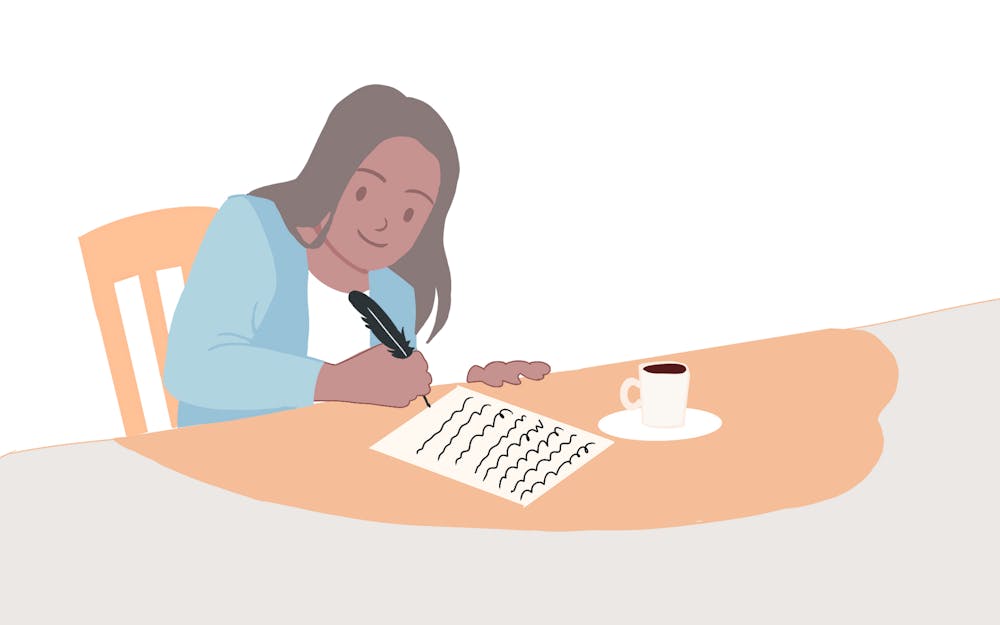
Inside a worn notebook from the mid 2000s — or perhaps it’s a binder — I have a copy of a poem that I wrote in elementary school. I remember being very proud that I figured out what rhymes with “turkey;” it’s obviously “Albuquerque,” and I probably misspelled it.
It’s not a good poem. I have no intention of that piece ever seeing the light of day — so no, I’m not going to transcribe it here — but it does give me a window into my fourth-grade world. Comparing those lines with ones I’ve written more recently, I can see how my voice has developed over the years, or, at times, hasn’t.
Especially in high school, I often wrote poems when I wanted to capture a moment and wrestle it onto a page. The goal was to remember what happened and how I felt. Inspiration was fleeting, so I jotted down what sounded good to me at the time.
I rarely edit those pieces. They’re rough around the edges, but they serve their purpose. I’ll polish them up if I’m submitting them for publication — I might go back and change up the line structure, the rhyme scheme or the vocabulary.
A friend recently read over one that I wrote on a spring evening in high school, after my mom and I drove home from watching Lauren Gunderson’s play “Silent Sky.” I had wanted to bottle up the feeling of cruising along country roads with someone I loved, soft night air blowing past us.
My friend had good, constructive feedback for me, but my perfectionistic side chafed a little bit at her suggestions. Perfectionism hates the idea of a rough draft; can’t it be flawless the first time around?
This is where a G.K. Chesterton quote becomes very applicable. Chesterton, an English author, is attributed with a great many quotes. They're often witty, silly, profound or all three at once. I’m a big fan of the observation that “Poets have been mysteriously silent on the subject of cheese,” but relevant to this column is the seemingly inside out truism, “If a thing is worth doing, it is worth doing badly.”
Upon hearing this for the first time, I thought it was a garbled version of the motivational maxim attributed to, among other people, Hunter S. Thompson: “Anything worth doing, is worth doing well.” I don’t know if I’ve ever actually seen it on a motivational poster, but it seems like the kind of thing that would hang on a CEO’s wall.
Chesterton’s quote seemed like Mark Twain-style satire until I learned that he was referring to hobbies when he penned those words. As a result, I thought about the line from a new angle, and it made a lot of sense.
I look back at some of the things that I’ve written over the years and cringe, especially at a poem that I wrote about U.S. holidays that repeats the line “with good ‘ol holiday cheer” entirely too many times.
But poetry, like walking, isn’t something you have totally figured out the first time you try it. You’re likely to be quite wobbly at first. Skills take time to develop. This is a lesson that I have to learn over and over again, but I’m growing in appreciation for wobbly attempts at new ventures.
There’s joy in writing terrible poetry. In looking back at it and laughing a little. It’s the joy of having tried something for the fun of it and doing something because you loved it. You don’t have to be good at everything.
This summer, I recommend attempting a new hobby. Don’t worry if it doesn’t go well at first (or even after twenty tries). If a thing is worth doing, it’s worth doing badly.



