
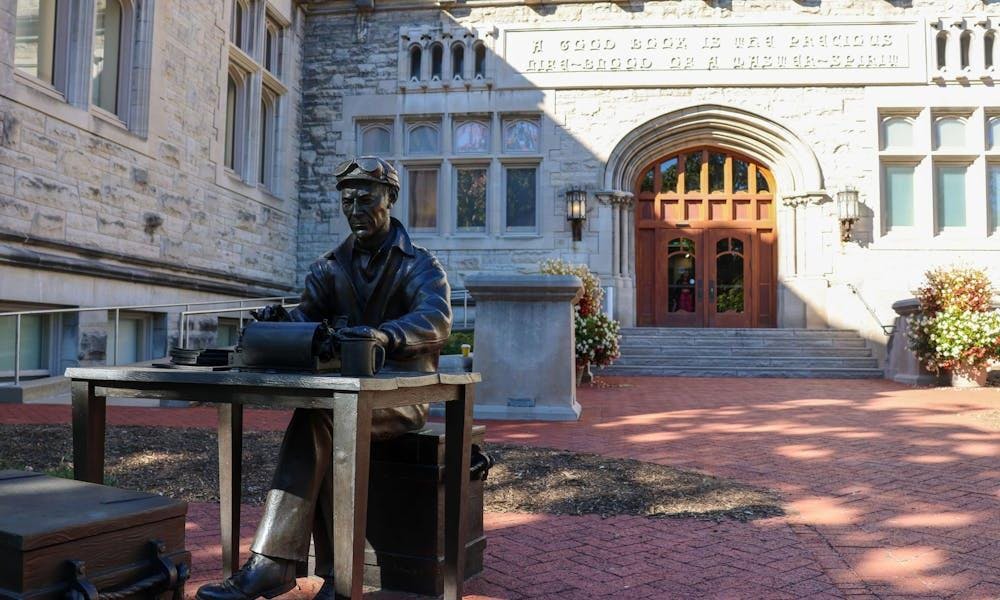
When IU announced plans to merge the IU School of Journalism into what would eventually become The Media School, then-president Michael McRobbie compared the journalism school to horses in an age of automobiles.
“There’s no point in saving a school that trains people to manage fleets of horses if the motor car has taken over horse-drawn transportation,” he told the Herald-Times in 2012.
McRobbie is no longer president, but his philosophy continues to echo in the school’s messaging and curriculum.
For years I thought about writing this column. It stunned me that a school with such excellent faculty and student media opportunities could be teaching and promoting concepts that I saw as antithetical to the profession. I wasn’t alone in noticing this trend — faculty, staff and other students have each voiced similar concerns.
I am grateful for The Media School in a lot of ways — the fact it gave me the ability to learn from and teach my peers at the IDS, the generous scholarships from donors that allowed me to graduate debt-free and the faculty and staff that taught me how to get to the heart of a story.
But the leadership of the school has its eyes on a different vision entirely, one that I fear could harm IU’s decades-long legacy as a top school for journalism.
***
When the merger occurred, it was promised that journalism would get its own department. That promise was never kept; instead, the school became a unit of The Media School and no longer enjoys the budgetary or curricular control it had previously.
Perhaps that’s why I’ve found many of my classes here so disappointing. The program’s core curriculum focuses on giving students video and audio skills as well as writing, but the result — at least from what I’ve experienced — is never creating anything substantive or building any long-lasting skills.
For example, I’ve only been required to write one story on my own in the four-course sequence that made up the core of my journalism degree requirements (I’ve written over 200 for the IDS in comparison). All other major assignments were either done in a group or allowed students to choose a medium — either a photo, graphic, video, podcast or written story.
While it’s good to be well-rounded across storytelling platforms, repetition and practice is critical for every type of media career. If it wasn’t for student media, internships or the advanced reporting electives I took, I would be hopelessly unprepared.
In response to a request for comment, Media School Dean David Tolchinsky wrote in an email that the school hired two journalism faculty this year; one is not yet listed in IU’s system and another who specializes in sports broadcasting. He also wrote that the school had recently added a data journalism course (which I actually took this semester — it’s now one of my favorite classes I’ve taken at IU).
“Journalism is sewn into the fiber of who we are as a school,” he wrote. “Keeping pace with journalism education and creating a worthwhile learning environment for students is central to what we do as a school, and I think our track record in this area indicates that journalism is emphasized just as strongly as any other aspect of the school.”
I think the disconnect may come from what the word “journalism” really means. To me, this profession is about knowing how to find information, ask the right questions and discover untold stories. We can tell those stories in a variety of ways, but it must be told clearly and concisely. Choosing which stories to tell depends on whether it serves the public interest and helps keep the powerful in check. Sometimes that can mean a feature story about a dog learning to heal from abuse. Other times, it can be a piece investigating how government decisions impact vulnerable communities.
What The Media School’s core curriculum struggles to do is teach us how to go through this process, with too heavy a focus on the technical skills involved in creating content. This may help graduates feel prepared to produce media, but it is not sufficient when it comes to producing quality journalism.
***
There’s no question journalism must become more digital than it has in the past. I’m not advocating that IU teach us as if we will all be seeing our work in print, and I don’t disagree that journalists should be more aware of how to use video and audio to tell stories.
The school is in the process of revising its journalism curriculum. I hope these changes allow students to experience a more focused education, where all students can learn the fundamentals of interviewing, generating story ideas and filing public records in their core courses. I hope they’ll incorporate more opportunities to produce depth audio and video courses to bolster quality multimedia journalism education.
And ultimately, I hope their process involves discussion with the countless students who no longer feel like their classes will adequately teach them how to be good journalists.



