
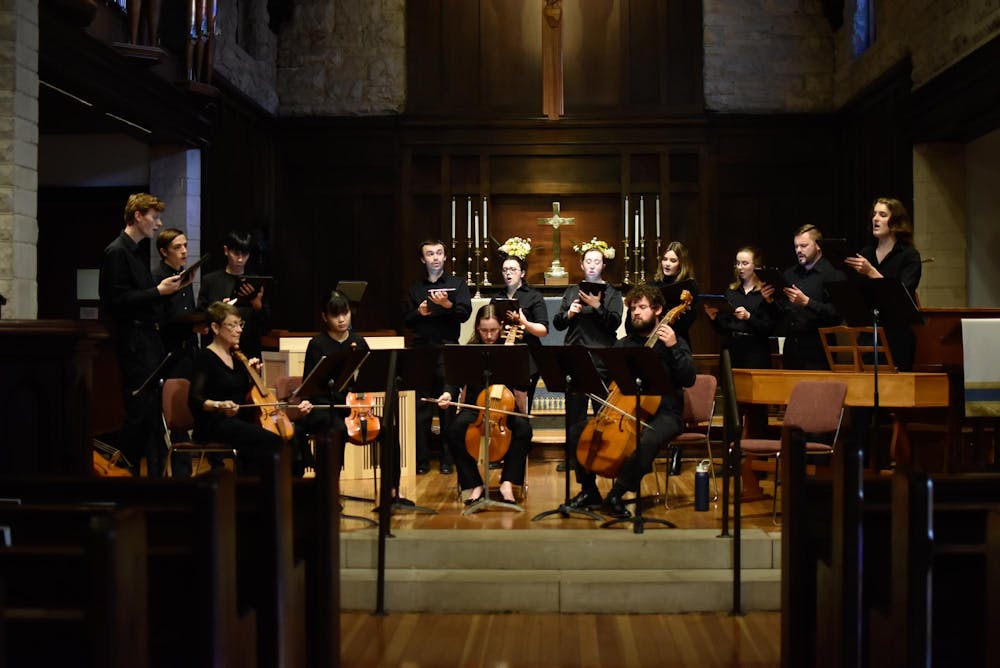
Inside the Trinity Episcopal Church on Wednesday night, an array of instruments was arranged onstage, illuminated by diffused light from the colorful stained-glass windows. Audience members sat not in the typical theatre seats expected when attending a Jacobs School of Music concert, but in richly stained wooden pews.
“This church is awesome,” one audience member remarked as they walked into the space.
Concentus — the Jacobs ensemble attached to the Historical Performance Department within the school — performs historical pieces on the same instruments they were written for, not what they have evolved into since.
While the group partially chose to perform its final concert of the season in the church due to scheduling conflicts and date changes, there was more to the decision than just that.
“A lot of the music in this concert is sacred music that would have originally been performed in a church setting,” graduate student Olivia Helman said. “Also, the space is just great. It's super echoey, and I think it really serves the ensemble that's doing it.”
Helman is a part of the choral section of Concentus. The group also offers ensembles for wind, brass and string performers.
The group performed works by Orlando Gibbons, an English composer who lived from 1583-1625, on Wednesday. Helman said Gibbons’ work, as he was a Renaissance and Baroque composer, is very typical for the group to perform.
Joanna Blendulf and Dana Marsh serve as the directors for Concentus. Blendulf is a professor of music and specializes in the baroque cello and viola da gamba. Marsh is also a professor of music but specializes in early music/voice. He also serves as the Chair of Historical Performance and director of the Historical Performance Institute within Jacobs.
“Oftentimes in modern concerts, they'll be the modern versions of the same instruments, but what we're trying to do is, we can't ever 100% replicate them. We're trying to kind of get into the spirit and ideals that these composers and performers felt at the time,” Marsh said.
Marsh said he thinks listening to a piece with the original instruments can offer new experiences to listeners.
“It's kind of a paradox because this is older music,” Marsh said. “But when you sort of dig deep and look for new revelations in it, there's a freshness and a newness that comes right to the surface, and it's infectious.”
Marsh served as director only for the performance Wednesday, while Blendulf acted as a director but also performed within the ensemble. Blendulf said that being both a director and a performer in the same concert is a “natural pairing.” She said that she is able to influence the musicians and “bounce off ideas in real time as the music is happening.”
Marsh said Bloomington has a large early music audience who often attend Concentus concerts and appreciate the niche music performed. The audience often makes the performances special, Blendulf said, but instructing the students in the music makes her see the music in a new light.
“It's exciting because, just to get to see how they respond and how they light up and are uplifted by the experience and then they themselves know that repertory and have a sense of the style,” Blendulf said.

