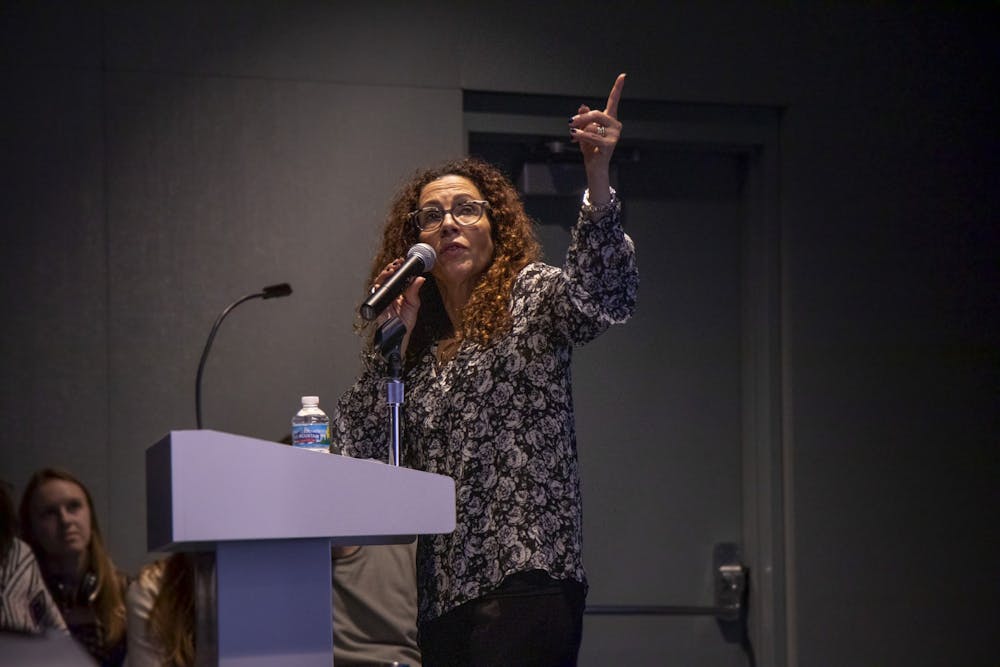
Photographer Rania Matar captures the universality of growing up through portraiture, she said during an artist talk Thursday at the Sidney and Lois Eskenazi Museum of Art.
Her visit drew an audience of 176, filling a room in the museum's education center to capacity.
Matar is a portrait photographer who takes portraits of women, especially young women, in their bedrooms and natural locations, such as flowery fields and shorelines. She was born in Lebanon and moved to the U.S. when she was 20.
“It’s that age, pre-puberty, when girls start changing, their bodies change quickly, and their whole demeanor and attitude change,” Mater said. “It’s a very fleeting, short moment.”
Matar photographed girls who highlight what she calls “beautiful awkwardness,” with serious expressions and unconventional poses. One photo entitled “Darine 7 and Dania 8, Beirut Lebanon, 2014” features two girls, one in yellow and the other in pink and wearing a hijab.
Elliot Reichert, curator of contemporary art at the museum, said the young women in the photo are depicted as strong because of their facial expressions. They seem to be in control of their own identity, he said.
“I think this piece is broadly representative of the kind of emotional specificity she’s able to capture,” Reichert said.
This image is in the “Re/New: Recent Acquisitions by Contemporary Artists” exhibit in the Featured Exhibition Gallery, available through March 1.
Matar said she does not consider her work as activism, but it shatters misunderstandings about Middle Eastern culture and politics. She said that in Lebanon, wearing the hijab is not mandatory and can signify modesty, fashion, devotion or statement, depending on the wearer.
Matar returned to Lebanon after Sept. 11, 2001, and again after the war in 2006 to photograph its aftermath. One photo featured a young girl wearing a Barbie shirt lifting her arms in the air while buildings crumbled in the background, as her mother looks on with a smile.
Matar said many of these black-and-white images communicate hope rather than despair.
“There is something about moving forward,” Matar said. “There are wars, they rebuild and people move on.”
Liliana Guzman, a second year MFA student, said she admired Matar’s ability to honor the subjects of her photographs and make the photoshoot experience a collaborative process.
“She’s able to capture all of the subjects in her portraits in a very natural way and in a very human, sincere way,” Guzman said. “That’s what draws me.”
Matar does not pose her photo subjects. She said she encourages them to choose their own pose.
She said this helps communicate intimacy, vulnerability and attitude in the final image, especially in her series “A Girl in Her Room." For this project, Matar photographed girls in their bedrooms, or their cocoons, she said.
“I love it when I can get the woman I’m photographing to get to that point where they’re fully invested in the process,” Matar said.
Nanette Brewer, Lucienne M. Glaubinger curator of works on paper, said including this piece in the Re/New exhibit offers a diverse perspective to a collection that already features work by transgender, African American, Latinx and international artists.
After her talk, Matar answered a question about how she picks her sitters. She said she looks for attitude, prominent features and vulnerability.
“I’m drawn to people who I find vulnerable,” Matar said. “People who look a little bit off, or more vulnerable, I’m more interested in.”