The 1815 eruption of Mount Tambora in Indonesia had major effects on Indiana’s crops and wildlife during the year Indiana would attain statehood, but the first Hoosiers perservered through the challenges. Because of their efforts, Indiana was eventually able to join the Union.
This is the story behind one of the exhibits that is part of the Strength of Hoosiers project, “Struggles, Starvation and Statehood.” The Strength of Hoosiers is a three-part exhibit at the Monroe County History Center that will be released throughout the year to celebrate Indiana’s bicentennial.
“Struggles, Starvation and Statehood” is the only exhibit currently on display. This piece is separated into two parts, which were constructed by exhibit managers Emily Musgrave and Kaylee Witt.
“Our focus is the strength of Hoosiers, and, honestly, nothing brings out the strength of Hoosiers like the ‘Struggles, Starvation and Statehood’ exhibit,” Musgrave said.
“Struggles, Starvation and Statehood” is separated into two pieces on either side of a hallway. One side references 1816, the year without a summer, after the volcanic eruption’s devastating results.
The year began normally, Musgrave said, but instead of warming up, things continued to frost.
“Cholera broke out and covered the globe,” Musgrave said. “There was a poet in China who was starving, and he wrote about women who killed their babies out of mercy instead of letting them starve to death.”
In front of the exhibit, Musgrave put hand-made fake dead corn, which represents the color of the crops at the time. Witt created a lean-to, an open and primitive structure in which many Indiana settlers were forced to live until they could construct a cabin, Musgrave said. However, the change of weather halted production, and many people were forced to survive the year-long weather in their small shelters.
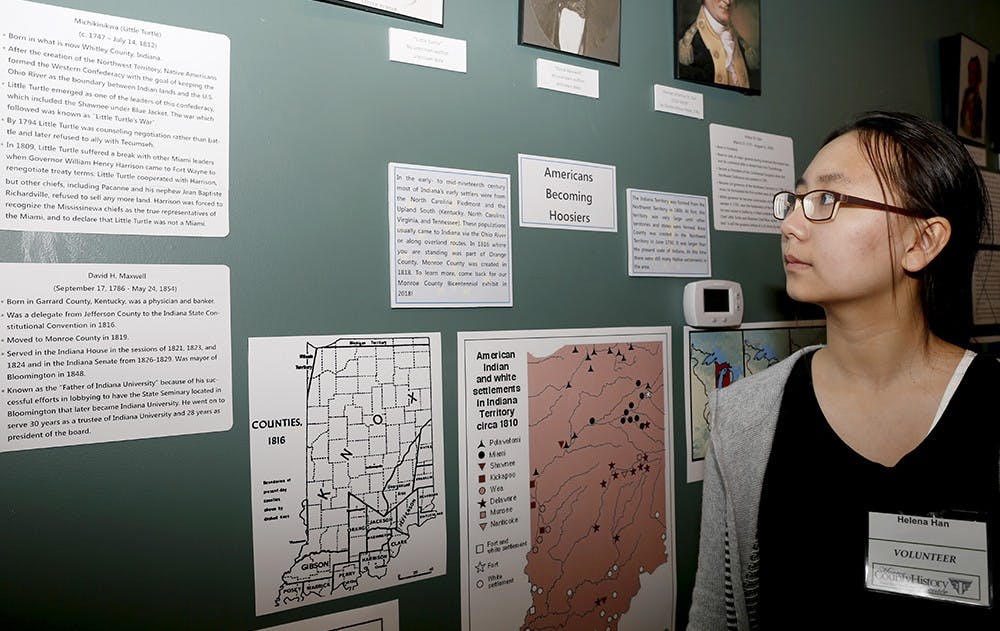
The other side of the hallway refers to Indiana’s history from its assignation of land to the Native Americans to its early battles until statehood. Maps, graphs and photos tell the story of Indiana’s rise to join the Union.
“Even though the British said we could have that land, we still had to negotiate with the natives because it really was theirs,” Witt said.
There are two exhibits in addition to “Struggles, Starvation and Statehood” that are unavailable to the public. The other two exhibits are “The Make-do Generation” and “The Ultimate Sacrifice.”
“The Make-do Generation” shows Indiana during the Depression. Within the exhibit are antique board games, movie posters and an antique radio playing songs from the time period.
There are also quotes that reference the time period and area spread throughout the room.
“The Depression was awful. It was really, really awful, and the fact that they got through it is just amazing,” Witt said. “I’m hoping we can get some of that across with what we’re doing here.”
The exhibit debuts tomorrow.
“The Ultimate Sacrifice,” which doesn't debut until Aug. 9, highlights the contributions Indiana has made to the United States’ military efforts since the Revolutionary War.
The exhibit is not constructed yet because it won't be on display for a while. Witt and Musgrave discussed if they could access Revolutionary uniforms from the reenactment group that Witt is a part of.
The exhibit will depict times from the Revolutionary War to modern conflicts, Witt said. Local veterans will be donating uniforms to make up for the museum’s lack of modern soldier regalia.
Witt and Musgrave have been partners at the Monroe County Historical Society since May 2015, Musgrave said.
“She helps me with looking up artifacts and placing things and making things look pretty,” Witt said.
Musgrave also said she values her partnership with Witt.
“Working with Kaylee is fabulous,” Musgrave said. “She is creative, and she fabricates just about anything I can think of. It’s really a great partnership, I feel.”
The two exhibit managers said a lot of research went into the projects but it was interesting and worthwhile.
“I’ve been really impressed, through time, watching my own family and how strong they are and how they get through hard times,” Musgrave said. “They’ve impressed me so much, and I’ve been really happy that I’m now in a place where I can share this strength of Hoosiers.”
Her nieces and nephews don’t understand what Hoosiers went through, Musgrave said. She said they don’t yet understand why Hoosiers are tough and why they support each other.
“I’d really like it if my nieces and nephews and other such people could learn about this so if that ever happens again, they’re not completely stunned,” Musgrave said. “They know it happened once before, and they can get through it again.”