
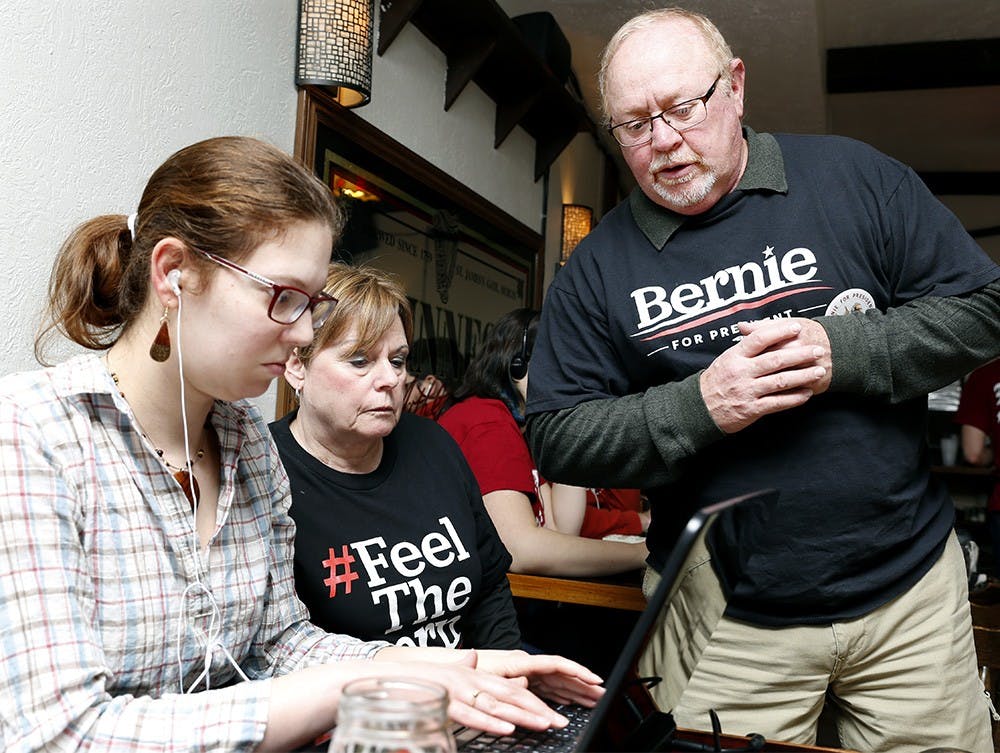
Upstairs at Nick’s English Hut on Sunday, volunteers sat in a small room with their cellphones and laptops. They were calling strangers and classifying them as such:
“Strong Bernie”
“Leaning Bernie”
“Undecided”
“Leaning Hillary”
“Strong Hillary”
Call after call, they kept dialing voters in Super Tuesday states, hoping they could bring “undecided” up to “leaning” and “leaning” up to “strong Bernie.”
Before IU freshman Stanley Njuguna left Nick’s English Hut, he had called about 60 voters to talk to them about voting for Bernie Sanders. The other members of Students for Bernie Sanders at Indiana University put in their share of phone calls too, including the group’s president, IU junior Caleb Bauer.
“There’s always been a period where the people take their power back,” said Bauer, who equates the grassroots Bernie campaign efforts to the civil rights movements of the 1960s and 1970s. “This is a rebirth of that attitude, of being active citizens in a democracy and making sure our voices are heard,”
IU’s Students for Bernie Sanders group, which is not an official IU organization, is the second-largest campus Bernie Sanders campaign group in the country, Bauer said. The group is second in size to the Students for Bernie at the University of California-Berkley.
The group has a small executive board that meets biweekly and a core group of members who meet weekly. The group also meets with the IU College Democrats to register voters. Together, the Sanders group and College Democrats have registered almost 200 students to vote, Njuguna said.
Voter registration, phone-banking and traveling to primary and caucus states are a big part of what the Sanders group does, Bauer said.
In contrast, the Students for Hillary Clinton group focuses more on registering Indiana voters and campaigning for local and state Indiana Democrats, the group’s president Kegan Ferguson said.
Ferguson said that’s the main difference between former Secretary of State Hillary Clinton’s campaign and Bernie’s.
“Hillary’s campaign recognizes that a true ‘political revolution’ is a continual process of Democratic progress at the local and statewide level,” Ferguson said. “Not just rushing to the nearest primary state to attend a large rally.”
The Clinton student group has around 15-20 core members. Like the Sanders group, Clinton supporters focus mostly on coordinating voter registration and phone-banking, Ferguson said.
Voter registration efforts for the Clinton group can last anywhere from 2-6 hours depending on the day and event, he said, adding that last weekend, Sanders and Clinton volunteers spent three days together registering students to vote.
IU College Democrats helps both sides register voters and will endorse and campaign for the candidate who wins the nomination at the end of the primaries, Njuguna said.
According to IU College Republicans, Senator Marco Rubio and Senator Ted Cruz have active campus groups.
IU Students for Marco Rubio’s group has about 30 active members who volunteer their time, the group’s chairman Mason Schreiber said Monday.
Group members do not meet regularly and communicate primarily through email and GroupMe, he said. A few group members volunteered to call voters in Super Tuesday states, Schreiber said. But like the Clinton group, most of their current efforts are focused on Indiana voters and getting Rubio on the Indiana ballot.
By the end of Super Tuesday, voters in 12 states will bring the nation one step closer to recognizing its Republican and Democratic candidates for President of the United States. Super Tuesday matters because no other primary day has as many delegates grouped at once; 661 Republican and 865 delegates will be allocated.
Sunday’s event at Nick’s saw plenty of hang-ups. But there were also a few voters who confirmed themselves as Sanders supporters. Most calls landed somewhere in between.



