Kerry is expected to outline the Obama administration’s foreign policy for the next 15 months and to detail priorities regarding Iran, Cuba, Europe’s refugee crisis and climate change.
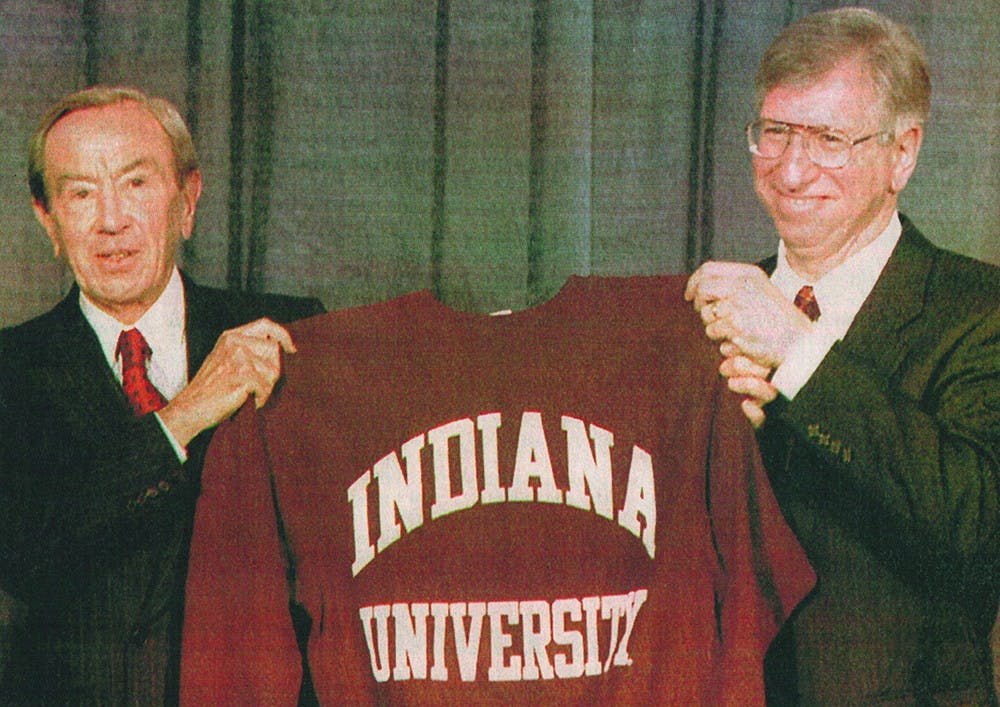
Twenty years ago, Warren Christopher — the last Secretary of State to visit IU — focused his remarks on policy in the Post-Soviet era.
Though Christopher saw opportunity in addressing Russia, Kerry now faces a different challenge.
“I think what we have now with Russia is a much narrower zone of cooperation than what people hoped for 20 years ago,” said Lee Feinstein, dean of the School of Global and International Studies.
Russia’s invasion of Ukraine and actions in Syria put a severe strain on relations between the two countries, Feinstein said.
“U.S.-Russian relations are probably at their worst point since the end of the Cold War,” Feinstein said.
In 1995, Christopher said the United States could work with Russia when interests overlap but will speak and act appropriately when interests collide.
“Policy toward Russia (is) still one of caution,” said Lee Hamilton, who chaired the House Foreign Affairs Committee from 1993-95 and is now the director of the Center on Congress at IU.
Russia’s invasion of Crimea and eastern Ukraine and its decision to bomb Syrian rebel forces have shown a timid U.S., said Hamilton.
“Russia’s played a weak hand pretty smartly,” Hamilton said. He also said Russia gambled correctly on U.S. inaction.
Hamilton said the U.S. is now “wary of military interventions” after wars in Afghanistan and Iraq. He said the U.S. halted its rebel training program in Syria after Russian military action.
Russian President Vladimir Putin has led the country more aggressively, but its influence has diminished, Hamilton said.
“Russia is not a power like it once was but is still a factor,” he said.
In the wake of the Soviet Union’s collapse, Christopher paid particular attention to the importance of the now-independent states in the region. He said the U.S. had an interest in the sovereignty of those states, particularly Ukraine.
“Ukraine is critical,” Christopher said in 1995. “With its size and its position, juxtaposed between Russia and Central Europe, it is a lynchpin of European security.”
Feinstein said Ukraine shares borders with European Union countries and NATO countries as well as Russia, and that’s what makes it a critical player in Eastern Europe.
Feinstein said while Russia should have an interest in Ukraine, it should not invade a sovereign country.
“That’s the key issue,” he said.
Not only has the dynamic between the U.S. and Russia shifted in 20 years, but Congress has made it difficult to act on foreign policy.
Hamilton said recent events show an “inability of U.S. institutions to perform,” which has obstructed U.S. leadership abroad.
“(The) world is beginning to wonder whether we can get our act together,” Hamilton said.