
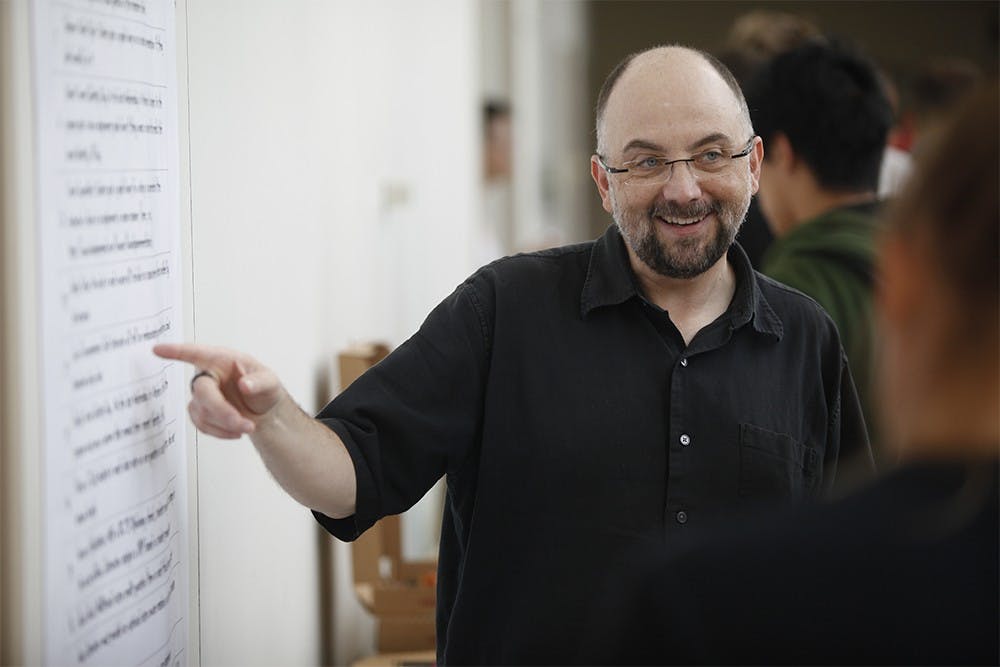
As participants enjoyed pizza and beverages, Ted Castronova, director of the new game design program, along with current game design students, discussed the details of the new bachelor of science in game design program that was launched this summer.
Students learned about program requirements and the possible career paths a bachelor of science in game design program can offer to them.
“Most of these industries are coastal — you have to be in New York or L.A. to do this,” Castronova said. “We’re very lucky that the University has decided to put a program down here in the Midwest. It’s really a special opportunity.”
Max Lancaster, a senior marketing student who is in the process of completing the game design capstone project, helped run the open house.
“The professors are all excellent,” Lancaster said. “Many are industry veterans, and all of them want to see their students succeed. They help resolve the most maddening problems — and trust me, the problems are often maddening — both in and out of class, and they teach in a way that is consistent with industry standards, unlike many game-design education programs.”
The bachelor of science in game design program encourages students of all skill levels to develop their skills in creative storytelling and illustration with the help of powerful new media platforms and animation tools to turn their visions into virtual realities.
“Game design really requires a lot of different skills, so that’s why we move people through it pretty slowly,” Castronova said. “You don’t have to know anything to start the program, but we can get you to the point where you’re actually publishing games.”
The bachelor of science in game design program is similar in structure to other undergraduate degrees offered by the Media School, but, unlike the other undergraduate degrees offered, it does not require a concentration.
In place of a concentration, bachelor of science in game design program students can decide to complete up to three Media School specializations, including Game Production, Creative Industry Management, Game Art, New Media Marketing and Photojournalism, according to the Media School’s website.
Students must complete 45 credit hours of courses that develop the skills and knowledge base necessary for their field.
Juniors and seniors should not be discouraged from pursuing a bachelor of science in game design, Castronova said.
“It is possible for advanced students to get the degree, but it takes some shifting,” Castronova said. “It might take them an extra year or two.”
Students interested in graphic design, game programming and animation, or music composition and sound production for multimedia will be able to count approved, completed courses in fine arts studio, informatics and the Jacobs School of Music toward completion of the bachelor of science in game design program’s five required electives, according to the Media School’s website.
“We want to encourage people from very diverse backgrounds to come,” Castronova said. “Success in the program does not come from being brilliant or from being a gamer. It comes from hard work. Anybody who comes here and wants to work hard, you can do it.”



