
“I probably didn’t look at what the weather was going to be for two or three years,” she said.
Before, she made hospitals her home. She made friends in the lunchroom and slept on fold-out chairs. She didn’t notice there was a shower in the hospital room for two months. It finally hit her that her husband was dying. She didn’t think about anything but their last moments together.
After, she made a list of things that mattered. Family, friends. She recited the list to keep herself sane. She struggled to deal with loss.
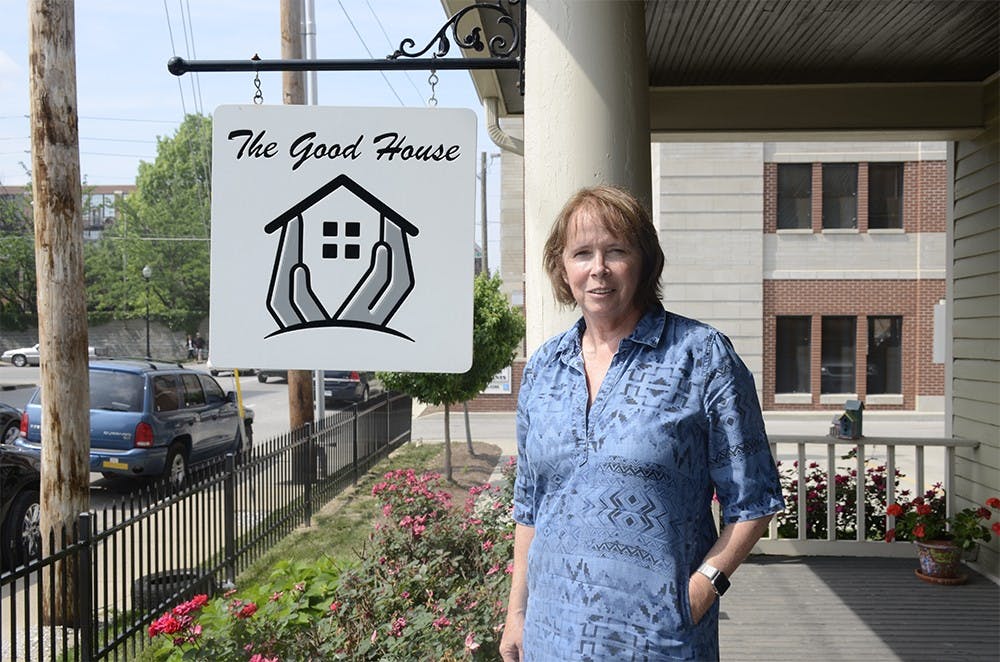
She built the Good House.
The green-paneled historic home sits on a lot in northern Indianapolis, hand-painted bird houses line its deck railing. The inside is clean and bright, but preserving its historic integrity has been hard, Armbruster said. The house leaks like a sieve in the wintertime.
Armbruster doesn’t live there. No one does, really. She created the home five years ago to provide free temporary housing for cancer patients and their loved ones who couldn’t afford a place to stay while seeking treatment at the nearby IU Cancer Center. Families are in and out, usually staying for fewer than two weeks. The house sees all types, from young people battling leukemia to older patients fighting thymoma. Some are optimistic; some are depressed. People are brought together through the house’s community feel, she said. She’s made lifelong friends.
She had wanted to do something like it for some time, since her husband died, and when her brother bought a commercial building on College Avenue, she couldn’t ignore the run-down house next door. It was her way of giving back, because she didn’t like sharing her story. It’s not what people fighting for their lives need to hear.
“I’m not a good representation of hope,” she said. “My husband passed away. These people need to hang on to all the hope they’ve got.”
The first guests at the Good House arrived on her husband’s birthday, but she stayed quiet.
She grabs a red box of tissues off a side table in the living room and dabs at her eyes under her round tortoiseshell glasses.
“I try not to cry, too,” she said.
***
Paper cranes — blue, green, yellow polka-dotted — fill the interior of the Good House, floating on strings in the hallway and living room and sitting on dressers in guests’ rooms next to wicker welcome baskets.
Like so many things in the house, they were donated, Armbruster said. Adams Elementary School in Indianapolis folded thousands of them in the Japanese peace tradition of origami. One thousand folded paper cranes grant one wish of life.
Armbruster sits in a modern living room on a loveseat which used to be her own. She gave her old furniture to the Good House after her husband died, she said. Assets didn’t really matter to her anymore. Hank, her Shih tzu-poodle mix, dances around her feet before jumping on the couch.
Reid Latimer, a friend, sits across the room. He’s done his fair share of sleeping in hospital chairs, too — he met Armbruster while his wife, Lisa, was battling cancer.
Some people just need a place to crash for a few hours while their loved ones are in the hospital, he said. Some of these people are coming from 15 hours away and can’t afford to pay for a hotel on top of high medical bills.
Latimer said the house gives the feeling of a hospital community without the sanitary, depressed feeling. Cold waiting rooms don’t exactly feel like home, but it’s nice being around people who understand.
Latimer’s wife was diagnosed with leukemia when she was 8 weeks pregnant with twins. She left behind a boy, Grant, who’s 14 now.
Her treatment terminated her pregnancy. She endured a year of chemo, a bone marrow transplant and an umbilical cord blood transplant before dying of complications nine months later.
The first person to sit down at the baby grand piano in the Good House living room played “I’ll Be Seeing You” — “If I remember that right,” Armbruster said — on the anniversary of Latimer’s wife’s death.
Armbruster said she and Reid always say they wish they hadn’t met, but they’re happy they did, and they’re friends now. They’re together in this group of people who understand death and what it’s like to lose someone.
“You’re a member of a club you don’t want to be a member of,” Latimer said. “These people get it.”
The pair, along with their friend Kathy — also a member of the club — get together every Valentine’s Day to dull the ache of the holidays. They usually go to a pub by the hospital, or somewhere else couples avoid, Armbruster said. Anywhere they can get pizza and beer, really.
“We call it our ‘Crappy Valentine’s Day,’ instead of ‘Happy Valentine’s Day,’” ?she said.
Latimer said most people don’t understand.
“And thank God they don’t.”
***
The Good House feels like a bed-and-breakfast, which is what Armbruster said she wanted when she started the nonprofit. It isn’t a huge property, but the house fits several bedrooms, each with their own bathrooms. Every room is furnished with items donated items. Guests are greeted with welcome baskets — small treats, light reading, cups of Easy Mac, a handwritten letter.
The Good House is well-loved by the people who stay there, she said. One patient, who was going through radiation therapy, wanted to stay long-term, although it wasn’t an option. Too many people needed to come and go to have a permanent resident. A taxi driver once offered to take all patients to and from the hospital for free. Indianapolis mayor Greg Ballard and Indianapolis Colts Coach Chuck Pagano’s doctor showed up at the ribbon-cutting ceremony.
“We get to see the good side of humanity every day,” Armbruster said.
The Good House runs off donations and fundraisers. There’s no way they can meet the demand of people who want or need free housing consistently. Other houses are popping up, though, like the nearby Son House.
Armbruster says she might invest in a larger building in the future and convert it into dozens of apartments.
“But that loses the feel of this house,” Latimer said.
Armbruster nods.
“So maybe I’ll find another house,” she said.
The garden in the back, a small patch of grass planted by volunteers, is dedicated to Latimer’s wife. He’s from Bloomington but comes up when he can to see Armbruster and help out.
Sometimes, Armbruster visits Bloomington to see Latimer and his mother, who is a donor to the house despite not having much. She has also lost a spouse. It’s strange, Latimer said, to have that in common with your mom.
Latimer’s son, Grant, is a teenager now. Sometimes, when Latimer least expects it, Grant makes an expression or says something that reminds Latimer of his wife. That’s when it hurts most.
“This is when I get choked up,” Latimer said, his eyes glassy, “Because he’s how I hold on to her.”
Armbruster reaches for the red box of tissues and walks across the room to hand them to him.
“I think I’d go crazy if I didn’t have my son,” he says.
Latimer and Armbruster aren’t fond of dwelling. If you let it define you, Armbruster said, two lives have been lost.
She gets up to put the tissues back in their place. Boxes are all over the house.
“You’d think that after seven years, I would’ve stopped tearing up,” she said, turning to Latimer.
He smiled weakly.
“I don’t think I ever want to get to the point where I stop tearing up.”



