
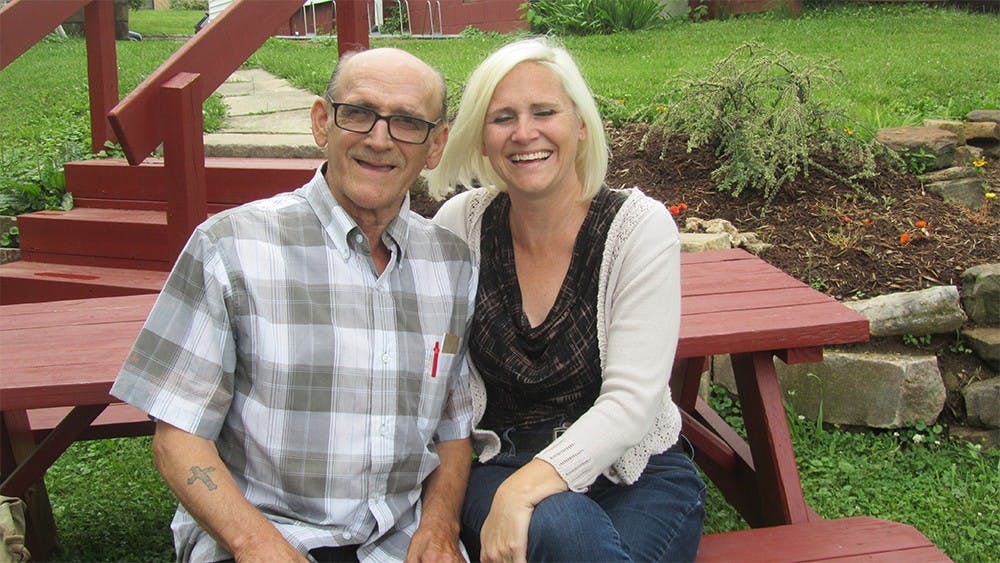
After years of not talking about her family’s struggle, she sat at her computer, reflected on her life and wrote a 14-page blog post titled, “Life with Dad: a (formerly) homeless alcoholic.”
“Dad wasn’t always a pain in the ass.” she wrote. “As a little girl, just as any daughter, he was my hero — just like any other dad.”
Her father, Elmer Guinn, was born into a large family in Southern Indiana. Elaine has been told that he was exceptionally bright — a hard working truck driver and a natural mechanic. Elmer said he first noticed his problem with alcohol at a very young age, when he was too intoxicated to help his grandmother roll dough in the kitchen and she kicked him out.
“Even before my children were born, I learned how to be a sneaky snake,” Elmer, whose father was also an alcoholic, said. “I could always find a way to get to the bottle. I worked for all the promotions, getting better and better, only to feed the addiction.”
Elaine sometimes calls her life a series of unfortunate events. Her mother was diagnosed with breast cancer at the age of 32, her dad fell asleep at the wheel and lost his truck and his livelihood and their house caught on fire two days before ?Christmas.
By the time she was 13 years old, they had moved 15 times.
After working three jobs to compensate for Elmer’s alcoholism, Elaine’s mother eventually had had enough. The couple got a divorce and Elaine, then 19, moved in with her father only to discover that the problem was much worse than she thought.
“My mom had hidden the severity of it from me,” she said. “I think she was embarrassed for him. Slowly everything fell apart. I moved out and within a matter of months my dad was living in a van.”
***
Since then, Elmer has lived in garages, under bridges, on friends’ couches, in his office and on the street.
Never knowing where he was, Elaine collected a list of phone numbers. She would call the hospitals first, then the jails, then the morgue.
“It’s a lot like death,” she said. “It’s a grief that’s hard to explain because the person is still living. I used to say it’s like loving a zombie. They’re just a shell of the person you used to know.”
As Elaine grew up, she learned how to blend into the middle class world so different from the one she grew up in. She wore suits to her job in the Bank One tower, now the Chase Bank tower, in downtown Indianapolis.
“One day the security guard called up to my office and said that someone in the lobby was claiming to be my father,” Elaine remembered. “I go down, and there’s my dad looking like a homeless guy. He had a beard with who knows what in it, he smelled and I just walked up and hugged him. I hadn’t known if he was alive.”
Elmer spent plenty of time in prison for crimes like public intoxication. Two years ago, Elaine ran a background check to figure out how much money her father’s criminal activity has cost society.
She estimates that his time in jail cost the public around $150,000.
“That’s a small figure I think,” she said. “It’s probably double that when you add in all the times he’s been in the hospital.”
Elmer had severe bronchitis because he couldn’t take antibiotics and drink alcohol. He got sepsis of the blood when a cut became infected. He suffered severe head trauma when people on the street robbed and beat him.
“People said it to me so many times,” Elmer said. “I was smarter than that. I was better than that. I just couldn’t stop. I thought I was ?invincible.”
When Elaine moved to Bloomington, she found the New Hope Family Shelter, which provides temporary housing to homeless families. It was just starting up at the time, and she volunteered to rake leaves and do yard work. Today, she is the Executive ?Director.
“I’ll be honest, I was trying to save my dad,” Elaine said. “I couldn’t help him, so I wanted to give help and love to people who were willing to accept it.”
She firmly believes housing the homeless is the only way to help stop the cycle of addiction and crime. Only once you put a roof over someone’s head, she said, can the recovery process begin.
***
After 22 years of homelessness, Elmer did accept his daughter’s help. Last year he moved to Bloomington, joined Alcoholics Anonymous and turned his finances over to Elaine.
When Elaine became sick last winter, he was the one calling to see if she was OK. On the snowiest day of the year, he showed up outside the shelter to shovel the ?driveway.
For the first time in decades, he was taking care of her.
“It’s wonderful,” Elmer said. “She’s my blessing, my little sunshine.”
Elaine, now 43, remembers the Facebook posts she used to write on Father’s Day. She would put up a picture of her dad and send a prayer out into the webosphere that he was safe, wherever he ?might be.
This year they spent the day together for only the second time in Elaine’s adult life. They went to breakfast and listened to live music outdoors. Elaine’s blog post has a happy ending.
After dozens of paragraphs about sickness, fear and anger, the final page shows a photo of Elmer enjoying ice cream in Bloomington and a toast:
“To new beginnings and never giving up hope.”



