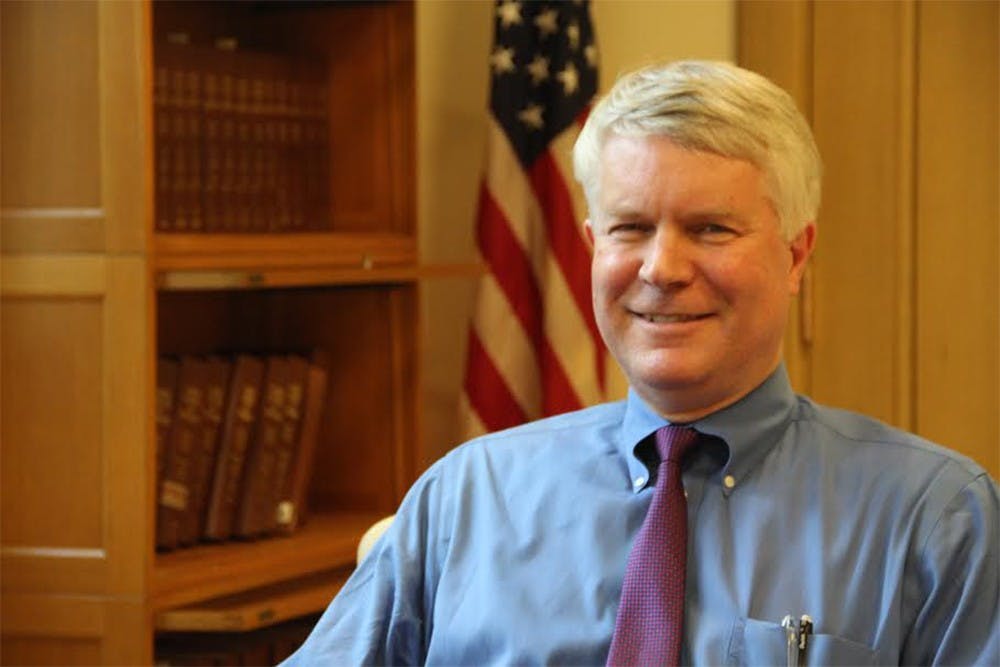
The decorations were gifts from his wife, Inge Van der Cruysse. Hamilton’s favorite is the one of his personal hero, former Supreme Court Justice John Paul Stevens.
“He’s a brilliant man, fair-minded, intelligent and very, very thoughtful,” he explained.
The light-filled office, located on the second floor of the Maurer School of Law building, also holds some more impressive decorations, such as photos of Hamilton talking to former President Bill Clinton and with President Barack Obama.
Clinton nominated Hamilton to be a judge on the United States District Court for the Southern District of Indiana in 1994, a time Hamilton remembers fondly.
“I got to spend those 14 years in a dream job,” he said. “For somebody like me who loves the give and take in the law, it’s a combination of responsibility and power and opportunity with the resources to do the job well that gave me a lot of satisfaction. We have the luxury in the legal profession of waking up every morning and going to work and knowing your job is to do the right thing today.”
Hamilton’s second federal appointment was much more high profile due to the fact that he was Obama’s very first judicial nominee in 2009.
“The process of nomination and confirmation can be a pretty wild ride in a sense because the nominee has so little influence on the process,” he said. “Because I was nominated first, I became the focus of a lot of political attention, and my nomination became very controversial.”
The Republican members of the Senate Judiciary Committee boycotted Hamilton’s first confirmation hearing, arguing they hadn’t had enough time to prepare. When the hearing eventually occurred, Hamilton was attacked for decisions he had made in his former position.
One of his most contested decisions was his ruling that having to appear at an abortion clinic twice in person before undergoing the procedure was a violation of a woman’s constitutional rights. The other was a decision he made in 2005 when he ruled that the Indiana legislature’s practice of opening sessions with largely Christian prayers was unconstitutional.
“I can tell you as a citizen, I’m certainly troubled by the increasing partisan polarization in society and politics I’ve seen over the last generation or so,” said Hamilton. “As a judge, my colleagues and I work as hard as we can to minimize those sorts of influences on our decisions.”
Even with Hamilton’s efforts to judge based on the law and not his political party, Sen. Richard Lugar, R-Ind., was the only Republican to vote yes. Hamilton was nominated with a vote of 59-39.
Though most federal court judges work in federal courthouses, Hamilton made an unconventional move when he decided to move his court’s chambers to Bloomington. The court was relocated in 2010. Only a few other judges in the country have made similar decisions.
“The work that I do is fairly isolating,” he said, explaining the move. “We can’t talk outside the office about the cases that have to be decided. So the opportunity to spend a lot of time with students and faculty here is a big plus for me. We love the Bloomington community.”