
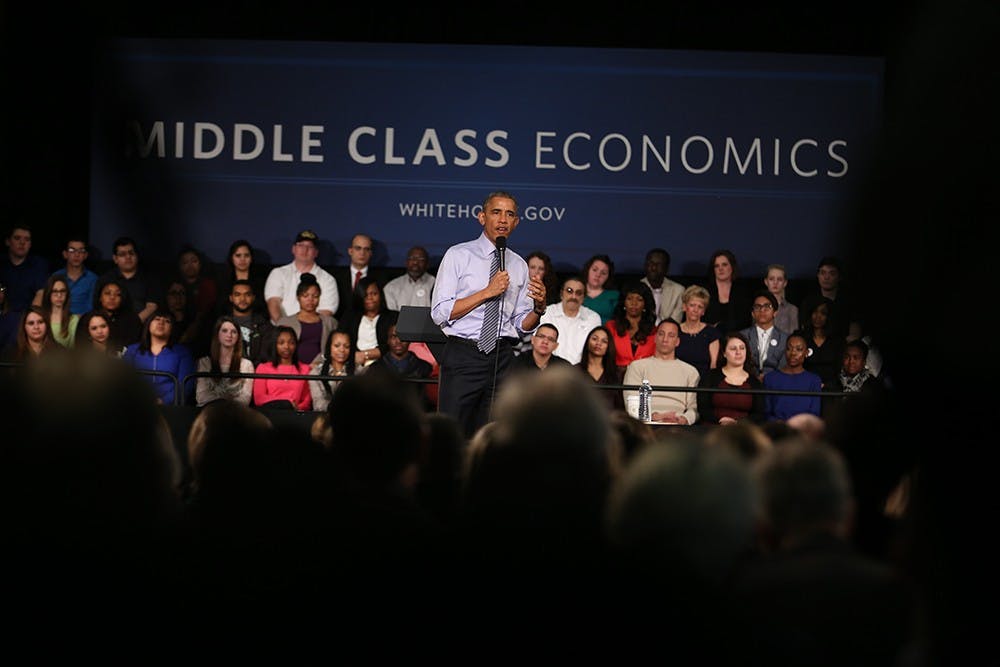
How will free community college affect traditional four-year colleges?
“There’s always going to be a market for Indiana University or Notre Dame,” Obama answered. “It’s not like suddenly people are going to stop wanting to go there.”
Obama visited Ivy Tech Community College to discuss his plan for two years of free community college, which, among other breaks for the middle class, are in his proposed federal budget.
“This plan is critical to rebuilding the middle class in Indiana,” Ivy Tech senior Vice President for Communications and Marketing Jeff Fanter said. “This gives students a means to be able to go to affordable college and get credentials that will be able to give them a good-paying job.”
Two years of free community college will give “cash-strapped” individuals the opportunity for pre-workforce training that will guarantee jobs, Obama said.
“I may have already at that point gotten the training I need to go out into the workforce and get a good-paying job,” Obama said. “Or if I decide that I want to continue with my education, I can now transfer to a four-year institution with those credits, which means that the amount of tuition I’m paying at the four-year university is going to be reduced. Either way, you are saving money.”
***
The strategy of community college-first, four-year program-second is a common one. With institutions such as Ivy Tech, consumers can get the best value.
But the increase of community college enrollments is financially troublesome for traditional higher education.
During the 2007-08 fall semester, 1,009 students enrolled IU’s history department’s intro-level American history courses. In fall 2012, enrollments were down to 360 students.
Responsibility-Centered Management is the current budgetary model in use at IU. Individual schools, led by deans, compete for University resources based on their financial activity.
“In a situation where, under RCM, a large chunk of the budget is determined by how many tuition dollars you bring in, the College is losing significant enrollments to this,” history professor Peter Guardino said to the Indiana Daily Student in 2013, explaining how declining general education enrollments shape departmental budgets.
RCM was implemented in 1990 for a University that gave individual schools autonomy.
“We’ve lost about half of the enrollment of two of our most popular classes over a period of just a few years,” Guardino said. “We need students.”
But students need jobs.
Post-degree job placement and average starting salaries are higher for Ivy Tech students than for students graduating from traditional four-year institutions, Fanter said.
Ivy Tech’s prominence as an educational institution began about five years ago, Fanter said.
Today, Ivy Tech is the nation’s largest statewide community college system and educates about 200,000 students, he said.
“The world is changing,” Fanter said, adding that people are looking for hands-on career training that prepares them for the workforce. “However, there will always be a place for a liberal arts degree.”
***
Obama acknowledged the financial challenges free community college would bring publicly funded institutions like IU.
Who is really to blame for IU’s financial pressures with regard to enrollments? Essentially, the State of Indiana legislators, Obama said.
“Part of the reason that the cost of higher education has gone up so rapidly is that state support for those institutions has gone down or not kept up with inflation,” Obama said. “So what happens is then school administrators have to make up for it with higher tuition.”
According to Ivy Tech’s website, students pay about $3,860 a year. Indiana-based IU students pay about $10,388 a year, while non-Indiana based IU students pay about $33,240 a year.
In an ideal world, the government would pay for all levels of education at every institution, for all citizens, Indiana Superintendent for Public Education Glenda Ritz said before the speech Friday.
“All students are going to need postsecondary work for their careers,” Ritz said. “President Obama is starting to make that happen. I hope Congress will follow through.”
An increased minimum wage would help students afford higher education, though it wouldn’t be enough, Ritz said.
“When I grew up, my family had no money to send me to college,” Ritz said, adding that she worked two to three minimum wage jobs during her summers to afford her undergraduate education. “Today’s minimum wage, it’s not going to do it for today’s kids.”
Obama addressed the changing standards at institutions of higher education.
“The college I started at, Occidental College, it did have a gym ... It wasn’t fancy. It wasn’t state-of-the-art,” Obama said. “The cafeteria, I don’t remember some of the stuff they served there, but I remember it wasn’t that appetizing.”
In contrast, IU students pay expensive fees to use a large, state-of-the-art exercise area. Some students purchase meal plans from Residential Programs and Services that can be used at a variety of campus dining halls serving several different food options.
It’s not just the cost of tuition that has increased in colleges, but the cost of experience, Obama said.
“Students and parents have to be better consumers,” Obama said. “Because part of what happens these days is, in recruiting students, they’ll say, ‘Don’t worry about it, you’ll be able to afford it.’”
And when the government tries to help, it can be a poor investment on the students’ parts.
“Well, it’s true that, in part, we’ve expanded Pell grants, and we cut out the bank middleman on student loans so that we could give more student loans, that a lot of young people are able to finance college that they couldn’t do before,” Obama said. “But if they don’t know ahead of time that when you get out you may have a $60,000, $70,000, $80,000 bill, then that’s a problem. So we’ve got to provide them better information.”
Until state funding of higher education increases, the future is unclear.
“These public institutions have a special obligation,” Obama said. “And it is a good investment, because the states with the best educational system, that’s where companies are going to go. It’s true not just in this country, it’s true all across the world.”



