
Mateo isn’t generally anxious.
But if he comes home with the tiniest bit of unease, Cathy Fuentes-Rohwer says she’ll know exactly what to tell her child:
“Those tests are for making rich people richer,” Fuentes-Rohwer said. “Do your best, but don’t worry about it.”
Mateo is a fourth grader at Childs Elementary School and will be taking the Indiana Statewide Testing for Educational Progress — ISTEP — test in the upcoming weeks. The exam is two parts, and the first part will be administered in March to Indiana public school students in grades three through eight.
Students in Algebra I and English 10 will also take a version of the 2015 ISTEP exam.
The ISTEP results determine federal funding and have created “pressure cookers” in Indiana classrooms, Fuentes-Rohwer said, adding that Childs’ classroom time has been eliminated for test preparation.
“I don’t think any child should be pulled out of art, music and gym to get ready for this test,” Fuentes-Rohwer said. “Those subjects might be the hook that makes them feel good about themselves. It might be the hook that makes them want to come to school. Our teachers and administrators are being put into a very, very hard position from our state legislature.”
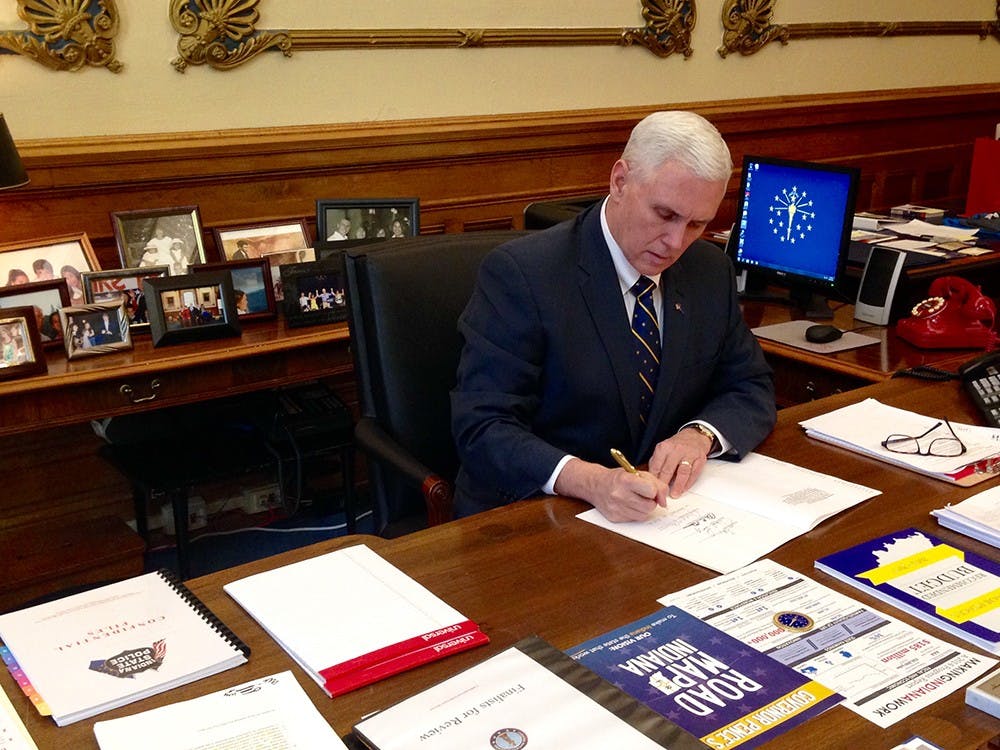
On Tuesday, Gov. Mike Pence signed into law SEA 62, the bill which allows the Indiana Department of Education to shorten this year’s 2015 ISTEP test.
Edward Roeber is the consultant who reviewed and made recommendations for shortening the ISTEP.
The maximum cost for Roeber’s contract is $22,000. The contract identifies two phases of work, each valued at $11,000, according to a press release.
The two-part exam would have been more than 12 hours for third graders. The bill passed unanimously in both houses.
“Hoosier students, teachers and ?parents can breathe easier now that this year’s ISTEP test will be significantly shortened,” Pence said in a press release. “I also am grateful for the collaboration between our administration, the Superintendent and the Department of Education to achieve this reform.”
This “collaboration” between the Pence administration and Superintendent of Public Instruction Glenda Ritz has been a messy period of transition.
The Indiana House and Senate voted to remove Ritz from her position as chair of the State Board of Education last week. She is the only elected Democrat serving in the Indiana state legislature.
Ritz attended a rally at the Indiana Statehouse last week where Fuentes-Rohwer spoke about the importance of public ?education.
The battle between public education advocates such as Fuentes-Rohwer and the Indiana Republican Party’s plans for education testing is not unique to Monroe County.
Parents in West Lafayette have chosen to opt out of the ISTEP. Their children will be allowed to be home-schooled through the testing period and re-enrolled as students after testing has ended, according to a WTHR report from Feb. 13.
The Superintendent of Public Schools in West Lafayette Community School District told WTHR he supports parents who wish to not subject their children to the stress of the state testing environment, which determines funding and students’ ability to ?advance grade levels.
“It’s inhumane what we are doing to the kids, what we are doing to the educational environment. We lost so much instructional time today, it’s ridiculous,” Superintendent Rocky Killion said in the report, referring to technical difficulties that prohibited a computerized test. “I would prefer all of my students’ parents withdraw and ?become home-schooled during ISTEP, and then we can re-enroll them.”
According to the ?Department of Education, opting out of the exam will not prohibit a student from advancing to the next grade level. However, the department says there are serious consequences for schools such as risks to accountability and federal funding, ?according to WTHR.
Though the movement to increase funding to public education while decreasing the value of a standardized test grade has been placing a “band-aid on a hemorrhaging wound,” Fuentes-Rohwer said she is hopeful for the future.
“People are starting to wake up,” Fuentes-Rohwer said, adding that since the rally, she has received phone calls from parents in other Indiana counties who wish to emulate her efforts. “This is what the grassroots ?movement is.”
While many of her friends have children with test anxiety, it is her hope that Mateo won’t be overly phased by the stress of the exams felt by teachers and administrators.
“If he comes home with any slight worry, he knows that I don’t agree with those tests,” Fuentes-Rohwer said.



