
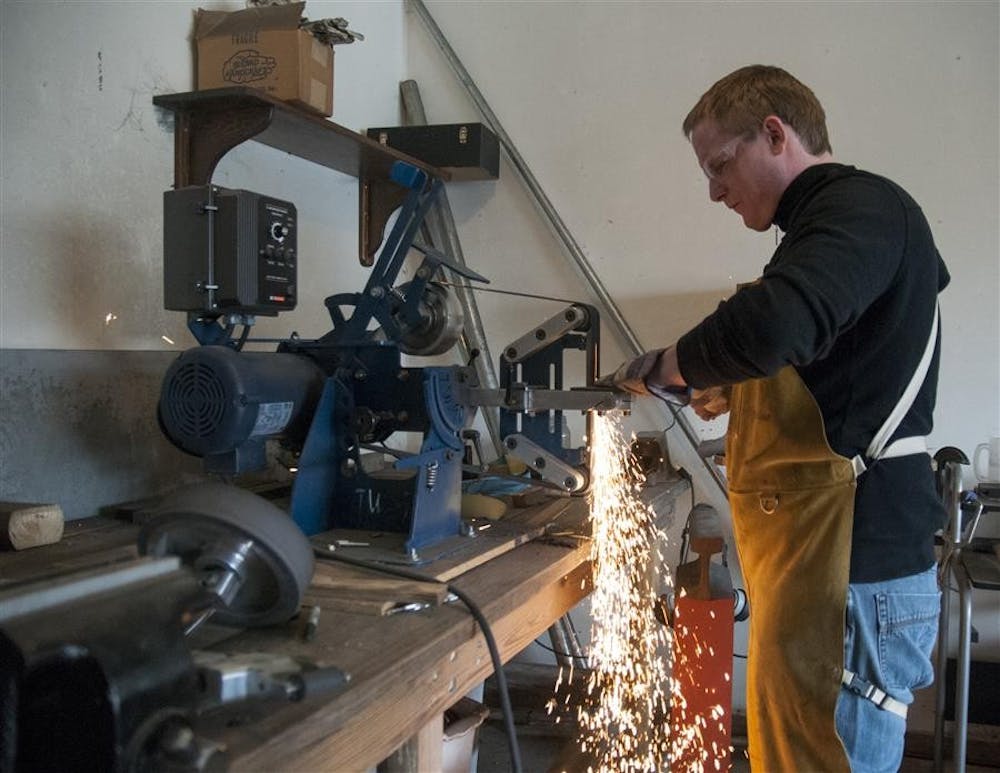
Shaped with the spark-igniting blade of a grinder, forged by fire, perfected by hammer, what starts out as a sheet of metal becomes a knife.
Bloomington resident Zach Wagner repeats this process in his garage, which doubles as a workshop for his hobby.
As a child, Wagner idolized the macho depictions of blacksmiths he saw on TV cartoons. It eventually inspired him to take on the hobby of knife-making, he said.
“(The blacksmith) was arguably a better swordsman or fighter than any of the other guys,” Wagner said. “He was just too old and haggard to do it right. He was still instrumental in making all those amazing stories happen.”
Wagner said he grew up in rural communities where knives were more functional than ornamental. They were tools.
Tools are instrumental to the trade itself, but tools for knife-making can be very expensive.
Wagner has invested in a TW-90 grinder. All attachments included, he estimated the machine has cost him about $10,000.
“A lot of this stuff is cobbled together from hand-me-down crap, but this is easily my largest investment so far,” Wagner said.
Wagner said he prefers to use 5160 alloy steel to make knives. However, while the quality of the steel may be important, so are the processes by which the blade is made. He said the heat treatment process is fundamental to the quality of the blade.
If the blade is heated sporadically, or too often, it will become brittle and break easily.
Wagner pulled out a sword that had been improperly heat-treated and showed the lack of flexibility in the blade.
“A properly heat-treated sword made out of 5160 should be able to bend pretty far,”
Wagner said as he bent the sword, almost breaking it.
“So, that means it was probably not even heat-treated at all to be that soft and flimsy.”
Stock removal, the removal of all steel irrelevant to the finished blade, as well as forging, or heating and hammering the blades into shape, are skills needed to make knives the way Wagner does.
In order to learn how to make knives, Wagner said he read books. He later honed his skill by taking a class in Washington, Ark., taught by the American Bladesmith Society.
Wagner’s dedication to making knives is demonstrated in his journey to the class.
After taking a Greyhound bus to Arkansas, he was left stranded on a cold night.
“They dropped me off at about 2:30 in the morning,” he said. “But the funny thing about that was that I needed to get to the next town over, and I had about 100 pounds of gear
on me.”
Wagner said he trekked the approximately 15-mile distance from town to town. To keep warm, he eventually had to build a fire since it took him some time to find where the classes were located.
The mission of ABS Bladesmiths is to preserve the art of making blades through teaching, challenging and endorsing its students.
“It was like a for-real religious pilgrimage,” Wagner said.
Two factors play highly into all the tool-making Wagner has studied and crafted.
The function of the knives he makes is represented through the form. Essentially, the knives he makes are meant for effectiveness and use, not to be hung as gaudy, decorative wall
ornaments.
“The form should always come after the function,” Wagner said. “Otherwise, we would all walk around with straight razors in our pockets.”
Tyler Jenkins, an IU alumnus, is involved with the IU Martial Arts Program. He met Wagner about four years ago and later approached him to make a short sword.
“The blade length is about 19 inches,” Jenkins said. “It is a leaf-pattern blade. And the handle was something that he thought up and told me about.”
The handle Jenkins described has G10 inserted between two slabs of micarta. Jenkins said micarta is a synthetic compound that absorbs skin oils and is easier gripped when wet.
Since then, Jenkins and Wagner have discussed the possibility of Wagner making safer training knives for the IU Martial Arts Program.
“He has talked about making knives that would have the weight and feel of a real blade,” Jenkins said. “But you won’t get hurt, so you know it is going to be a lot safer.”
Having spent thousands of dollars on equipment for his forge, Wagner’s passion for knives has exceeded a simple garage hobby.
He now hopes to market his knives by one day giving them to the people who will use them the most — chefs, martial artists and tradesmen.
“I am planning to turn it into a business,” Wagner said. “I’ll have to take another loan to get some more equipment. Then I should be ready to start taking orders from people.”
Wagner said he hopes to attain an anvil with a flat space for hammering within the month. Shipping expenses for an anvil can be quite expensive, he said, simply due to the weight.
The ability to make tools is only one of the things Wagner capitalized on as being necessary for human survival.
Wagner’s philosophy on the importance of certain skills is three-pronged. He said that cooking, tool-making and martial arts have all been essential services people have learned to do over the years.
“It is a really important skill in my opinion to preserve the ability to make tools,” Wagner said. “And in the midst of learning how to do bladesmithing, you learn how to make a lot of different kinds of tools. A lot of stuff you use, you ultimately end up making yourself.”
Knife maker combines form and function
Get stories like this in your inbox
Subscribe



