The forested path behind Woodburn Hall was silent except for the sound of the wind in the trees. Suddenly, the silence was ripped in half by the noise of protesters’ horns, frying pans, whistles and the booming bass of Wu Tang Clan.
“Fight back, not cut back,” they chanted over the music.
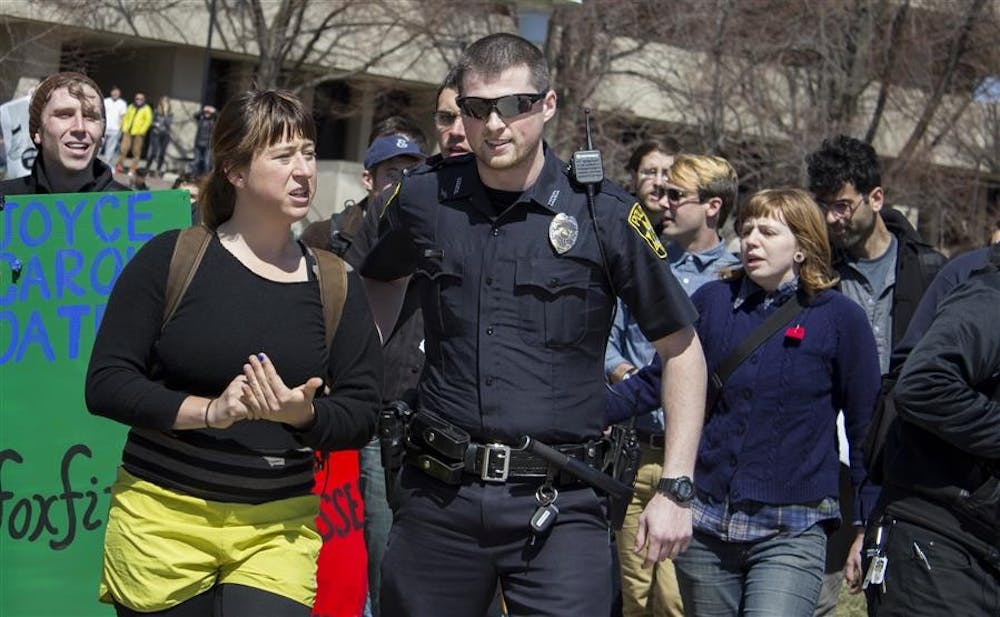
Activist group IU on Strike raised awareness of the strikes planned for April 11 and 12 in a noise demonstration that began behind Woodburn Hall on Monday at 2 p.m. Holding banners, pickets and boards, they marched up to 10th Street, down toward Wright Quad and across campus to the Provost’s office. IU Police Department eventually appeared on the scene and issued one citation for littering, IUPD Lt. William Munroe said.
Last week, flyers were passed out stating the group’s demands of the administration — to reduce tuition immediately, end privatization and outsourcing at IU, end the wage freeze and double the enrollment of African-American students. They also demanded the eradication of House Bill 1402 and Senate Bill 590, which deny illegal immigrants in-state tuition and limit work opportunities for said immigrants, respectively.
Angela Tauber, a member of IU on strike, admitted the list was hefty but said she thought the issues were worth discussing.
“I think that if we’re going to change the University and the way it runs, then we need to at least get the issues out there,” Tauber said.
To Benjamin Robinson, associate professor of Germanic studies and a supporter of the strike, the list was a way to publicize the issues while calling out the government. He said by demanding these things, the strikers are asking the government to recommit itself to public education and move away from corporations.
“The fact is, there are pressures on the University to think of itself as a revenue-generating system,” Robinson said.
He said as the University becomes increasingly run by corporations, its mission shifts due to a legal obligation to maximize revenue to shareholders.
In Robinson’s opinion, this is wrong.
“The culture of an academic experience should dominate the University,” Robinson said.
Recent cuts in state funding indicate a decline in the commitment to public education.
The state provides 16 percent of IU’s revenue today, while it provided 50 percent two decades ago, according to an IU press release from 2011.
The Indiana Daily Student reported in November 2012 that student tuition and state fees make up 51 percent of IU’s revenue.
“I’m not sure why we call ourselves a public university when less than a fourth of our money comes from the state,” Tauber said.
Robinson said it is a common misconception that state cuts in funding are solely due to the recession.
“The basic point is there was a trajectory of state funding, and that trajectory has changed, and that’s because of political reasons,” Robinson said.
Striker Dan Dethrow agreed, referring to the action as austerity.
“The recession is a false justification for the tuition increase and other effects of budget cuts,” Dethrow said.
Austerity, as the strikers define it, makes IU less accessible to the poor and further orients the University as a for-profit privatized institution.
Robinson and Tauber said they feel importance of public education needs to transcend political agendas.
“I think the government needs to put public education at a higher priority for funding,” Tauber said.
In light of Purdue’s recent tuition freeze, Robinson has hope for the results of the strike.
“I do think they could freeze tuition,” Robinson said. “They can do certain technical things, and they should be creative about that.”
Even if no big changes occur after the strike this year, Tauber knows the issues will not disappear.
“If things don’t happen this year, we wont have to spend so much time publicizing the issues next year, because they will be more known,” Tauber said.
Robinson said he thinks the administration will respond with sympathy.
“What will really happen, I don’t know,” Robinson said. “But the main thing that I would ask from the administration is that they would respond in the spirit of the strikers, not as disciplinary bureaucrats, but in the spirit of democracy,” Robinson said.
Protesters raise concerns about tuition
Get stories like this in your inbox
Subscribe