The 2013 IU Student Association Vision of the Ideal College Environment report, which claims to be “the summation of student thought,” calls for administration to address the problem of advising on this campus.
Provost Lauren Robel has embraced the report’s ideas.
What the report does not do is propose anything that will actually fix the problem.
The report asks administrators to “widen the scope of academic paths” advisers can offer advice on and increase the ability of advisers to “advise regarding co-curricular and personal interests.”
While these initiatives are certainly important and, if properly executed, will likely help students progress effectively through their college academic paths, the report offers no suggestions on the most important aspect of this problem.
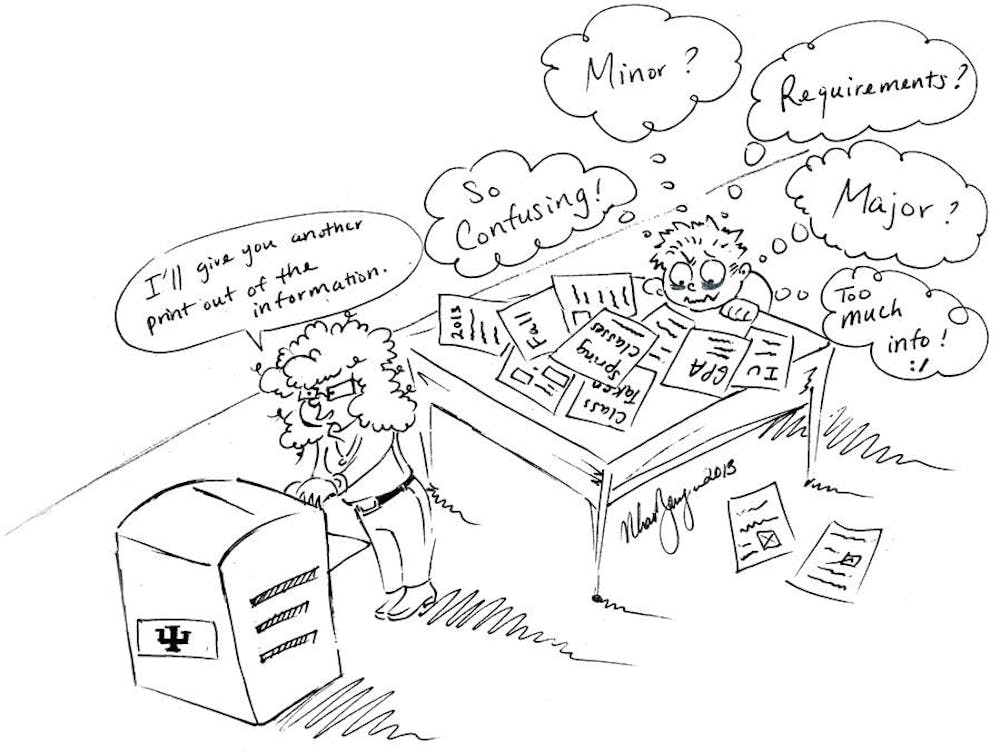
Students are not empowered by the administration to advise themselves.
“What if?” advisement reports — a way of identifying what requirements for your degree, or some other hypothetical degree, are still outstanding — are one of the means by which students can help themselves.
Few students know they exist. Of those who do, even fewer know how to effectively use them.
These reports and a well-designed spreadsheet are effective enough to render anything more than a yearly email to your adviser unnecessary.
To be sure, some aspects of being a student and earning a college degree require advice, but students must let go of the crutch of academic advising.
As adults, it’s time for us to take responsibility for our degree completion.
This can absolutely include guidance from an adviser — everyone needs help with a complex process from time to time. But this doesn’t absolve students from all responsibility in remaining on track.
Revamping the role of academic advisers treats the symptoms without addressing the disease.
The problem isn’t that advisers don’t have enough knowledge about related degree programs to give their students the best advice about completing multiple degrees.
The problem isn’t that advisers don’t or can’t advise students on selecting co-curricular activities.
The problem is that students are too dependent on their advisers to do these things in the first place.
The habit of students to play the adviser blame game clearly highlights the problem.
Expanding the role of advisers won’t solve it.
Integrating faculty into a student’s process of picking a degree path, as Vice Provost Munirpallam Venkataramanan has suggested, won’t solve it either.
If the VOICE Report really wants to create the ideal college environment — not to mention develop students into fully enfranchised adults — it must make students, not advisers, responsible for the decisions that affect degree progress.
In order to do that, it must empower students with the information necessary to make those decisions themselves.
Anything less is just bad advice.
Advice for advising
Get stories like this in your inbox
Subscribe