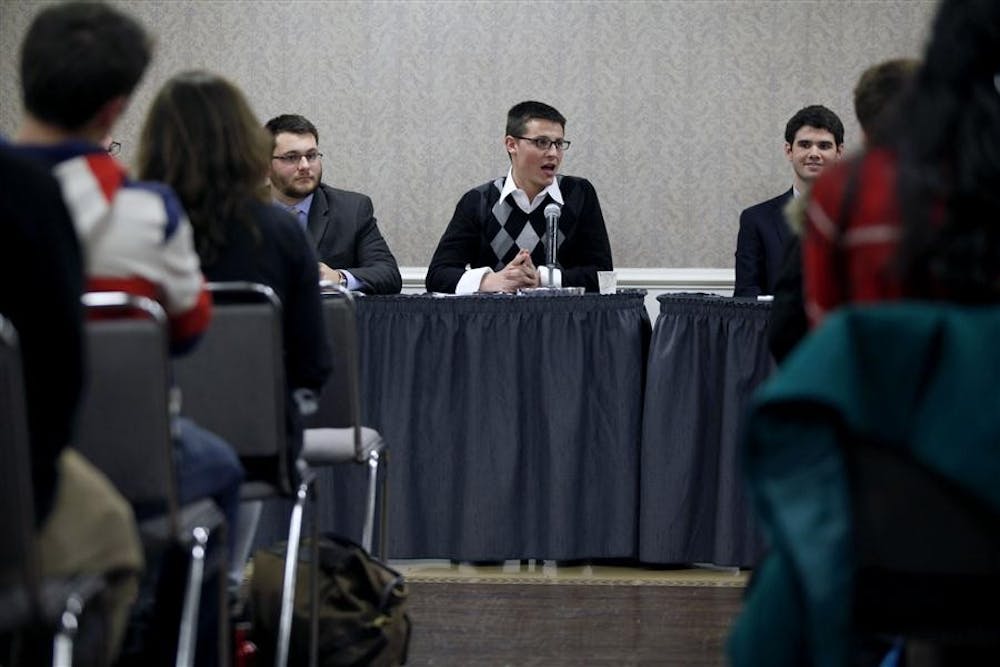
IU Student Association and Union Board leaders spoke to IU students and answered their questions in the Georgian Room at the Indiana Memorial Union Wednesday evening.
In particular, both groups faced many questions concerning how they will further represent smaller student groups on campus.
Lauren Kastner, vice president of Coal Free IU, a grassroots campaign that seeks to stop IU usage of coal, said during the question and answer portion that their group had been “snubbed” by IUSA in the past.
IUSA President Kyle Straub apologized for the actions of previous administrations, but emphasized that with so many other student groups clamoring for attention, meeting with each of these groups is difficult to prioritize.
“This issue is very select,” Straub said of Coal Free IU. “That is just me trying to be as transparent as possible. We must represent the whole. We can’t really commit unless a majority of students commit.”
In particular, Straub said the Coal Free initiative was “a lot bigger than an IU issue,” and past administrations may have been trying to avoid opening this “can of worms.”
IUSA Vice President Pat Courtney said the current administration had learned a lot since their work in IUSA last year, and were open to discussion.
Vice President of Union Board Riley Voss said Union Board had not been addressed on this issue, or issues similar to Kastner’s.
“Our focus is programming, but through programming, we influence policy,” Voss said. “We can be a vehicle to access IUSA.”
Voss then asked Kastner the best way for Coal Free IU to access IUSA and Union Board.
“It would be great to know that the student government isn’t going to dismiss us,” she said. “Some mechanism is wrong for representation here.”
Kastner said her group had gathered more than 6,000 petitions concerning the stoppage of the coal plant at IU. Straub said he hadn’t known that.
“It’s very much a two-way road,” he said. “We can meet in the middle. It hasn’t been on the agenda yet. We welcome more discussion, and it will certainly be on our agenda now.”
Demetri Morgan, a graduate student at IU, said he was concerned about IUSA’s comments about supporting the majority of student needs. He said he was also concerned about the 4 percent of IU students that are students of color, as well as Hudson-Holland students, and whether their concerns would be heard even though they were not a majority.
“We have not been approached by this, and it could be telling,” Straub said. “Either we are closed off, or people don’t know who to go to.”
Courtney immediately agreed with this sentiment, and said they were excited to raise the issue on the agenda. For these smaller student groups, he said, students should try going to IUSA Congress officials or attending IUSA focus groups to get their voices heard. He admitted it may not always be realistic to immediately approach the IUSA executives.
Union Board President AJ O’Reilly said students of these groups should not give up.
“Forming an organization is the first step in my mind,” he said. “I commend you for starting. Keep fighting.”
The two groups were also taking questions through the IUSA Twitter account. One person asked how the two groups would respond to critiques that called the groups exclusive.
O’Reilly said he had never heard that, and that the Union Board office was open to students to hang out or study in. He also emphasized that anyone could apply to be a Union Board director.
“If you are willing to put in the work, you can get elected,” he said. “People in the past who have seen things that aren’t going right with Union Board joined, became directors and changed things.”
Voss said student involvement rates were down, and that was a challenge that they had to face.
Straub said this critique was “nothing new” to IUSA. He said the five IUSA executives were elected by the whole of the student body, but that each elected ticket formed its own senior staff.
“We must be selective,” Straub said of the senior staff selection. “It’s unbelievably inefficient if we aren’t. A smaller amount of people with more accountability is the way to get work done.”
For other positions beyond senior staff, anyone can apply and go through an interview process.
This town hall is one of the first times that IUSA and Union Board has collaborated in some time.
“There’s a history of a little bit of a rivalry between the organizations,” Straub said. “But we realized they’re not the enemy. We’re trying to do the same thing, so why not cooperate?”
He said since it was still early in their new relationship, they had less chances to work together than he would have liked. O’Reilly said differing terms of office had affected the relationship in the past as well. However, they remain positive.
“Doing events like this are an example of the developing relationship,” O’Reilly said.
IUSA, UB collaborate at meeting
Get stories like this in your inbox
Subscribe