Voting is a privilege.
In this country, it's also a right.
Citizens exercise their right to vote for a new leader every four years. After weeks, even months of political advertisements, debates and rhetoric, it all comes down to an intimate moment in the voting booth, shrouded in solitude.
The main challenges in the student vote, or any vote, are getting people registered, educated and transported to the voting booth.
Elections inspire various partisan and nonpartisan organizations to register students and get out the vote. Here in Monroe County, the student vote is significant.
Granted, not all students vote, but there is power in a concentrated and potentially passionate voting group in Bloomington.
Yet, these additional voters pushed President Barack Obama over the edge in the 2008 election, turning Indiana blue for the first time since 1964. It’s also these votes that help elect our local politicians.
Students vote, often driven to the polls by national candidates and policies, but there are also local, lesser-known candidates.
The power of the student vote spawns differing philosophies about how to approach students’ ability to vote in local races.
The Local Vote
Vivien Bridges, the 2012 Republican candidate for Monroe County auditor, is making the case for an informed student vote. She ran for the same position four years ago and believes students cost her the election by voting along party lines, by voting a straight ticket.
“It was a hard tide to reverse,” Bridges said. “It was very, very difficult to reverse the Obama tide.”
She lost her individual race, but the bigger issue, she said, is the unintended effect the student voting block can have locally. She said there’s a record of corruption and error in the auditor’s office during the current administration, evidence of the danger of the student vote.
Republican Skip Daley is a first-time candidate for Monroe County Council at large. Awareness is key to voting locally, he said.
Confronting the idea of a GOP effort to prevent students from voting, both Bridges and Daley said they want students to vote — just knowledgeably.
“There’s nothing wrong with voting at that young age,” she said. “I just wish they would be cautious about the way they vote locally.”
For Bridges, caution translates to having knowledge. She has a simple message.
“Either stay away or be informed,” she said.
The informed voter argument, particularly in regards to local voting, doesn’t hold water for Rick Dietz, chair of the Monroe County Democratic Party.
“I don’t see that as being different from any other group of voters, not just here in Bloomington,” Dietz said. “People generally pay a lot more attention to national politics more than local.”
IU College Republicans President Hilary Leighty, who’s registered in Monroe County, said educating students is one of the hardest parts of the process. This challenge is worth the effort, she said, because of close races in the state, such as the Senate race that can be affected by the student vote.
When it comes to IU students, the question of voting locally is tied directly to the interpretation of residency.
Bridges also highlighted the transient nature of students and their ability to influence a place where they live temporarily.
“Where are these students who voted four years ago?” she said. “I bet half of them aren’t even on campus. But they’ve left the auditor’s office in trouble.”
Most students only experience one national voting cycle during their time at IU, yet the officials they help elect remain serving in Bloomington even after they’re gone. Dietz acknowledged this fact, but also said IU students earn their right to vote here.
“I don’t subscribe to the notion that the student population is different from any other group within our county,” Dietz said. “They live here. Many of them have jobs while they’re here, and they contribute while they’re here. And they, by right, should have a say in our democracy.”
Daley agrees that students have the right to vote. In fact, he said he wants more students to register. But he’s not sure how connected students feel with the Bloomington community.
“Because of the residency, they might feel a disconnect with the local community,” Daley said. “They might not feel the responsibility to reach out and learn what’s going on in the community that they might feel is temporary.”
Regardless of student sentiment, they are registering to vote.
From May 22 to last Friday, some 2,738 new Monroe County voters have been registered. Additionally, 5,087 existing voters have updated their information in one way or another. While these statistics from Election Supervisor Ruth Hickman include registrations from the entire county, Hickman said students at IU certainly make up the majority of new registrations.
Parties and perception
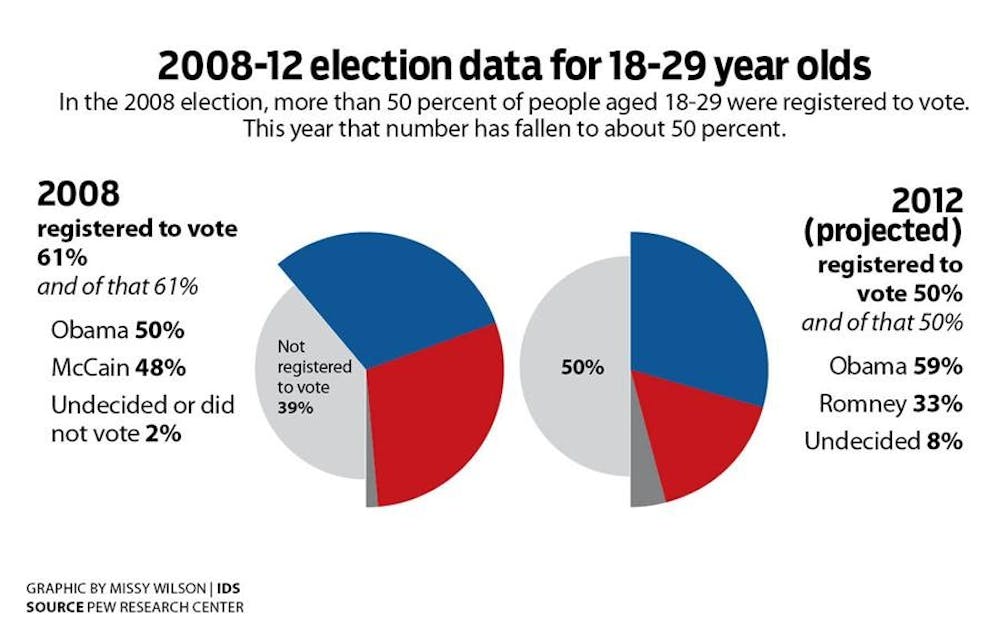
In 2008, 66 percent of voters less than 30 supported Obama. This marked the largest gap between young and old voters since exit polling began in 1972, according to the Pew Research Center.
Here in Indiana, youth voting as part of the total amount of voters increased by five percentage points from the 2004 to 2008 elections, the biggest change of any state, according to NBC News exit polling.
Students turned out to vote in the last presidential election more so than in the past, and their votes leaned Democrat. Republicans are aware of this fact, and it affects their view of campus. It also has them aware of the connection, real or perceived, between the national parties and local candidates.
“We do our best to indicate to students and the rest of the community that there is a connection between the local candidates and the national candidates,” Dietz said.
He said voters’ best bet is to cast their vote for their party of choice at the local level.
“The point that I’m trying to make is politics is a team sport, and each team has a different set of values, but those values carry through from the top to the bottom,” he said.
Daley disagreed.
Many local government positions don’t touch on large national issues, so why vote for local candidates based on those issues, he argued.
“To make a local decision based off a letter someone has after their name is a disservice to themselves and their right to vote,” Daley said. “Get out there and learn who the candidates are, what the issues are, and see if there is a candidate on that side of the issue who will best address the issues of that particular office.”
Bridges said she believes the campus won’t vote as strongly liberal as it did in 2008, but she still said being a Republican in Monroe County, particularly in Bloomington, isn’t the easiest.
“It’s very hard for me to work as a Republican on campus,” she said. “That’s all there is to it.”
She characterized the Democrats’ vigorous efforts to register students as playing to their strength.
“They know where to go to for their votes, let’s face it,” she said.
That said, she acknowledged efforts by IU College Republicans to gather campus conservatives.
Leighty said there is definitely a stereotype on campus of the liberal college student.
“I think it’s a huge stereotype, and that’s unfortunate,” she said. “There are Republican students on the campus.”
And while there are impassioned students on both ends of the political spectrum, Michael Grossberg, director of the Political and Civic Engagement Program, said he suspects most students don’t place themselves firmly in one camp or another.
“I would think that most people on campus don’t think of themselves in terms of a party because it’s not their self-definition because they’re not likely to be voting and they’re not likely to be very engaged,” Grossberg said.
Getting to the polls
Out of sight, out of mind goes the saying.
Back in 2008, the Indiana Memorial Union served as a voting location for the primaries and School of Public Health had polling station booths for the general
election.
This year, the campus satellite voting site has moved north to Assembly Hall. The move, decentralizing campus early voting, was an outcome of compromises between Republican and Democratic Monroe County Election Board members.
At least one effect is already clear — votes are down.
Linda Robbins, Monroe County Clerk and secretary of the Election Board said numbers from the primary election last spring were down for the on-campus site compared to the 2008 primaries.
Dietz said he wasn’t pleased with the move of the early voting site to Assembly Hall.
“I don’t think that it serves the purpose of being an acceptable satellite voting site on campus,” he said. “I think everybody recognizes that as a practical matter it’s on the outskirts of campus.”
He doesn’t know for sure what the effects may be of the move. He simply pointed out that Assembly Hall does not draw near the foot traffic as the IMU or the School of Public Health building.
Senior Colleen Dobry, media coordinator for INPIRG, a student-directed nonprofit, said the registration effort between the organization, IU College Democrats and the IU Student Association has totaled just less than 3,000 new registrations.
Dobry said it’s not always the easiest job to catch people’s attention to register, let alone vote.
“I don’t understand why the polling places aren’t on campus,” she said. “I don’t understand why it’s just not at the IMU in the middle of campus.”
Instead, groups like INPIRG, IU College Democrats and IU College Republicans have been out on campus soliciting registrations.
“It’s up to groups and student organizations across campus to encourage students and remind them that they should go do it,” she said.
Student vote carries sway in local races
Get stories like this in your inbox
Subscribe