
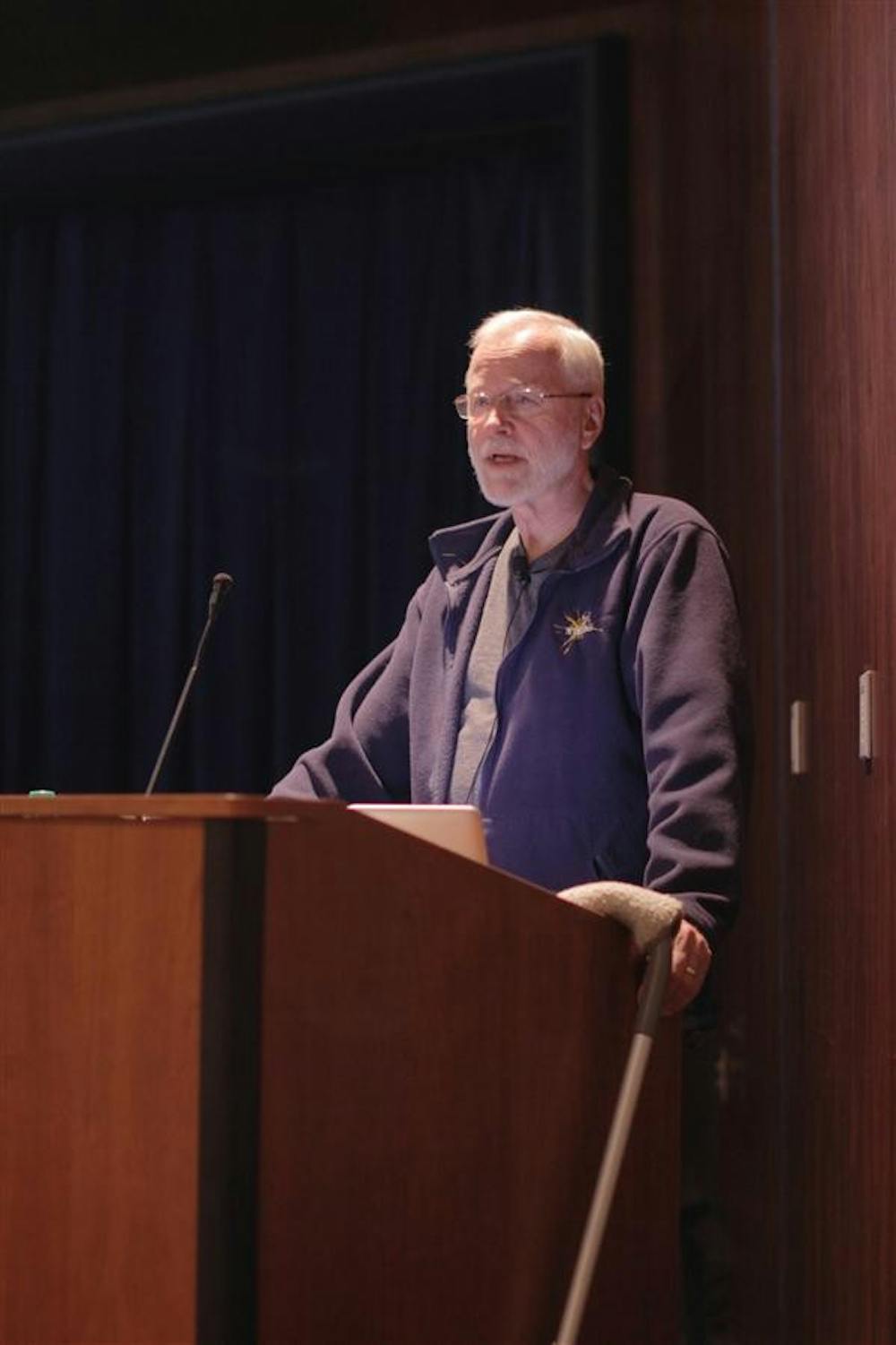
Just two years after physics professor Harold Ogren told the Indiana Daily Student the field is not expecting any discoveries in the near future, he delivered a lecture describing his contributions to one of the most significant discoveries of the last 50 years.
With PowerPoint slides with illustrations, photographs and internet memes, Ogren addressed questions related to the discovery of the Higgs boson particle.
The discovery filled a gap in the Standard Model, which describes the fundamental particles from which everything in the universe is made and forces acting between them. The Higgs boson explains why these particles have mass.
Ogren used an illustration to describe the basic concept of the Higgs boson.
First, an elementary particle gets a mass from the Higgs field. Each type of particle has a different strength with which it interacts with other particles to give them a mass.
“This could be Einstein, it could be Lady Gaga,” he said, referring to the stronger interactions. “If I were to come through, only a few people would gather around to talk to me.”
An excitation of the Higgs field generates a Higgs boson particle, just like the excitation of the electromagnetic field creating photons.
Alex Juffer, a Brown University student who was in Bloomington visiting family, attended the lecture after remembering the media frenzy surrounding the discovery. He said he appreciated Ogren’s attempt at simplicity.
“This is complicated stuff,” he said. “It’s cool that a big-time physicist can use jokes and funny pictures to engage the audience and try to explain these things in a way your average, non-physics genius can understand.”
Ogren said the discovery is not only complex, but also abstract. Put simply, Ogren said the group of researchers at CERN — the European Organization for Nuclear Research — did not discover the particle itself but rather the decay it left behind.
“The worry is that we think we have seen it, but the cleaning lady comes along and it disappears,” he said, joking about the fleeting nature of the discovery. “Unfortunately, it’s not a little dot on a screen. It’s a lot more complicated than that.”
As of Sept. 10, the discovery passed peer review and essentially became ratified science.
Ogren clarified a common misconception surrounding the Higgs boson’s nickname: the “God particle.”
“The Higgs has no religious implications,” Ogren said. “The only reason we use that expression is that the Higgs field is a pervasive field throughout our universe, and we could not be here without it.”
He showed pictures of the computer screens monitoring the Large Haldron
Collider, the scientific instrument that facilitated the discovery.
“There’s a glass wall there so visitors can come in and look at us,” Ogren said, showing a picture of himself at CERN. “I tell people I have one of the most photographed bald spots.”
Although he was alone in the photograph, Ogren said the opposite was true in the experiment.
“There are more than 3,000 physicists working on this,” he said. “But more importantly, right here at IU we had people working on it.”
Three of the collaborators from IU attended the lecture for a question and answer session: Rick Van Kooten, Sabine Lammersand Radovan Dermisek.
“It really is just the beginning of the Higgs era even though it is the ‘final’ piece of the Standard Model puzzle,” Lammers said. “We will be very eager to see what the properties of this new particle will be and whether there is a single Higgs boson or several.”
Physicist explains discovery of particle
Ogren lectures on his role in Higgs boson discovery
Get stories like this in your inbox
Subscribe



