
Trees branch the past to the present. Built on a treed landscape, IU-Bloomington is rooted in the tradition of woodlands.
Since IU acquired Dunn’s Woods, the trees and forestry have never been cleared or harvested and have been maintained with only minimal human intervention. A 19th century bylaw states that trees can only be cut when they fall naturally from old age or storm damage causes them to block a path.
Former IU President Herman B Wells fought to ensure the preservation of the trees on campus.
“To cut a tree unnecessarily has long been an act of treason against our heritage and the loyalty, love and effort of our predecessors who have preserved it for us,” he said.
In his final State of the University address, Wells noted the importance of maintaining trees on campus, as it is a part of the history of the University.
“I hope that our alumni will always insist on retention of our precious islands of green and serenity — our most important physical asset, transcending even classrooms, libraries and laboratories in their ability to inspire students to dream long dreams of future usefulness and achievement — dreams that are an important and essential part of undergraduate college experience,” he said.
Trees have always been part the physical landscape of Indiana, so there have always been many trees on the Bloomington campus, University Landscape Architect Mia Williams said.
“I absolutely think it is important to have trees on campus,” she said. “It is a part of the legacy of what this land is and was important for campus to experience the character of the land — students, faculty and staff to walk through campus and experience it.”
In 1974, Paul Weatherwax, a botany professor, wrote about the age of a bur oak tree located on the north side of the Indiana Memorial Union.
“Estimates based on the diameter of the seedlings grown from acorns from this tree would indicate the age of this venerable specimen to be about 200 years,” he said in
“The Woodland Campus of Indiana University.”
More than 40 years later, history Professor James Capshew said a tree in the parking lot outside of Ernie Pyle Hall has been cut down, but the one near the entrance of the Union is still alive and healthy.
“Those trees were here about a century before IU had a campus here,” he said.
The preservation of these trees on campus is important, said Burnell Fischer, a clinical professor.
“IUB’s Woodland Campus is famous for its trees and tree canopy cover,” he said. “It helps recruit students, and it draws back the alumni with great memories.”
Alumni look forward to returning to the treed campus, Fischer said.
“The alumni, more than anyone, consider the Woodland Campus a most beautiful place to be from and return to,” he said. “I believe the campus staff and all employees deep down know they work at a Woodland Campus, but they probably don’t say it enough because they experience it daily in their work life.”
Trees also make ecosystem contributions, Fischer said.
“All kinds of ecosystem services are provided by the campus trees, some quantifiable and others not so much,” he said. “The contributions are very significant and have been recognized by IUB leadership since its early days.”
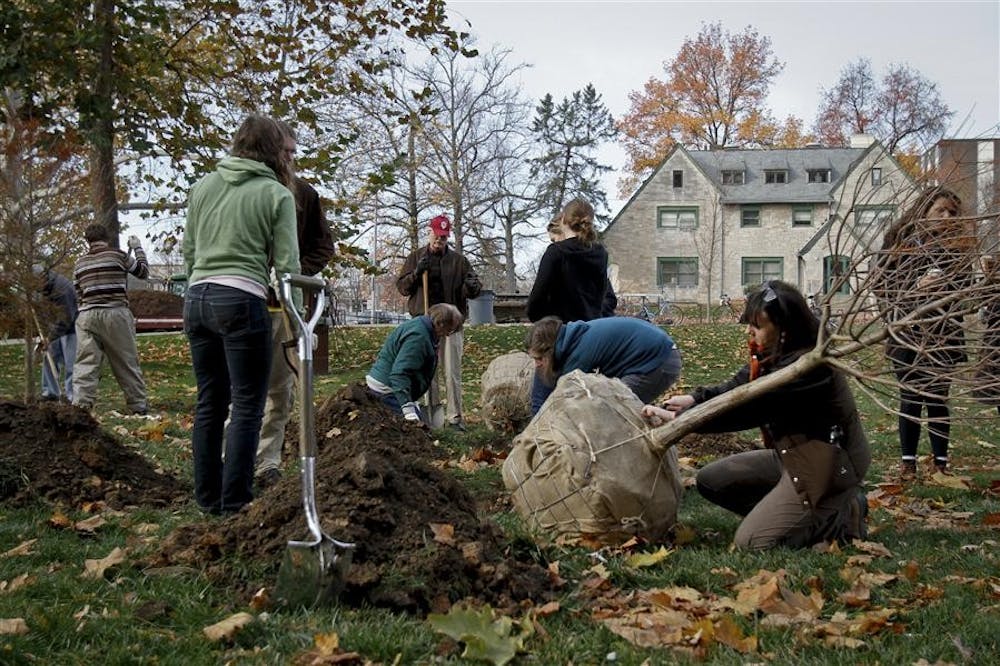
IU was recognized for its Woodland Campus in 2008 when IU was one of 29 college campuses awarded Tree Campus USA in the inaugural class.
“We have renewed that commitment to excellent tree care every year since,” Fischer said.
Williams said the old trees show the stability of the campus.
“There is something about mature trees in a land that says it is stable and not disturbed,” she said. “That is a comforting thought.”
Trees are assets to the Bloomington campus just like buildings and utilities have their own value, Williams said.
“The preservation of trees means the preservation of IU and they are an iconic element of our landscape,” she said.
Weatherwax said it is important that IU never loses sight of its past and its tradition of natural, wooded beauty.
“For we know that these trees offer much more than aesthetic enjoyment,” he said. “Their roots tie us to our history, their presence today brings shade, clean air and a true sense of place, and their future ensures our continued commitment to the education and growth of future generations.”
IU is one-of-a-kind, Weatherwax wrote.
“There are few places in the world where great laboratories, classrooms, libraries, auditoriums and other such centers of intellectual and artistic creativity are located in an environment which retains its primeval character — few places where one may so quickly and so completely cast off the tensions and anxieties of this complex modern world in quiet meditation. The tradition of a green campus and natural areas continues with the support of the IU Administration. We are fortunate to have easy access to the luxuriant forests of southern Indiana that have been specifically dedicated for teaching and research.”
Aged trees rooted in history
Scenic landscapes draws prospective students, provides sense of tradition
Get stories like this in your inbox
Subscribe



