The Dec. 5 deadline for 2012-13 resident assistant and commUNITY educator applications is approaching.
After attending an information session in October or November, applicants must now submit their applications online by Monday. Both RA and CUE applicants then sign up for U450: Foundations of Residential Leadership, a first-eight-week spring semester course.
Individual and group interviews coincide with the course in February and March. Residential Programs and Services uses the application, course performance and interviews to determine final selection and placement of RAs and CUEs in April, according to its website.
If accepted, CUEs and RAs receive a single room, an RPS meal plan at no cost and a 10-month stipend totaling $1,500.
As applicants head into the next stage of the selection process, current RAs share their experiences.
BRYN BUCHANAN
Sophomore, first-year RA in Forest Quad 5A
Pre-nursing
The RA class
“The class is really one big interview,” she said. “RAs are supposed to be these happy, joyful people that get along with everyone. You form bonds with people, but in the back of your head, you’re questioning if you’re doing things right or if other people are doing things better than you.”
Finding out
“There were other people on my floor who applied,” she said. “When you find out, you have to make sure you keep it low key until you find out who else made it, or else it could get awkward.”
Her experience so far
“Overall, me personally, I’ve had the best experience that I could ever have imagined. It’s not necessarily like that for everybody.”
The hardest part
Time management is the biggest challenge, Buchanan said. Because resident issues could pop up at any time, RAs needs to plan ahead. She also said becoming an authority figure that enforces rules was also an adjustment, but it was necessary.
Finding balance
“Take time to do your work, but also make time to hang out with your old friends and your friends who you won’t see on a daily basis,” she said.
What she’s learned
“Skill-wise, it’s increased my social ability, but it’s also helped me with time management and learning to sit down and study,” she said. “There are times when every minute of the day is scheduled out so you can get everything done. I’ve probably become more open to more views and ideas, more diversity in my thinking just because I’m surrounded by so many people that are different than me.”
Main advice
“To actually get the job, get to know the heads of the residence centers,” she said. “The more people that you know and that enjoy you and your personality and your work, the better your chances are for getting the job.”
ADAM KOUBA
Junior, second-year RA in McNutt Quad’s Kelley LLC.
Business, supply chain management and information and process management
The workload
“It’s not that bad. They say you work 40 hours per week, but some of those hours are just availability hours,” he said. “They always tell you that it’s a big time commitment, and at the beginning it can be a bit overwhelming, but there are always people to help you out, and there’s always time to just relax.”
Why he applied
“Coming into college, I wanted to be an RA. I wanted to be that mentor and help people out,” he said. “No one is going to lie and say that compensation package doesn’t hurt.”
On interviewing
Kouba said applicants need to do their homework, research what RPS is looking for in an ideal applicant and make sure applicants show how they can provide that.
On the dual role of an RA
“There are always the good times that you’re hanging out with your residents,” he said. “But there are also times that you have to be the enforcer where you have to bust people or have to deal with people lighting your bulletin boards on fire.”
What he didn’t expect
“You don’t expect to be as close to the other staff members as you get,” he said. “Now that I’m part of it, it’s basically like you’re in a frat with the other staff members.”
Main advice
“Throughout the whole process, be yourself,” he said. “Everyone else in the process is going to be really open. That’s a part of being an RA: accepting others. So, you do the same. Even if you don’t get the job, building those relationships and connections is putting yourself in a better place than if you didn’t apply at all.”
TARI MORALES
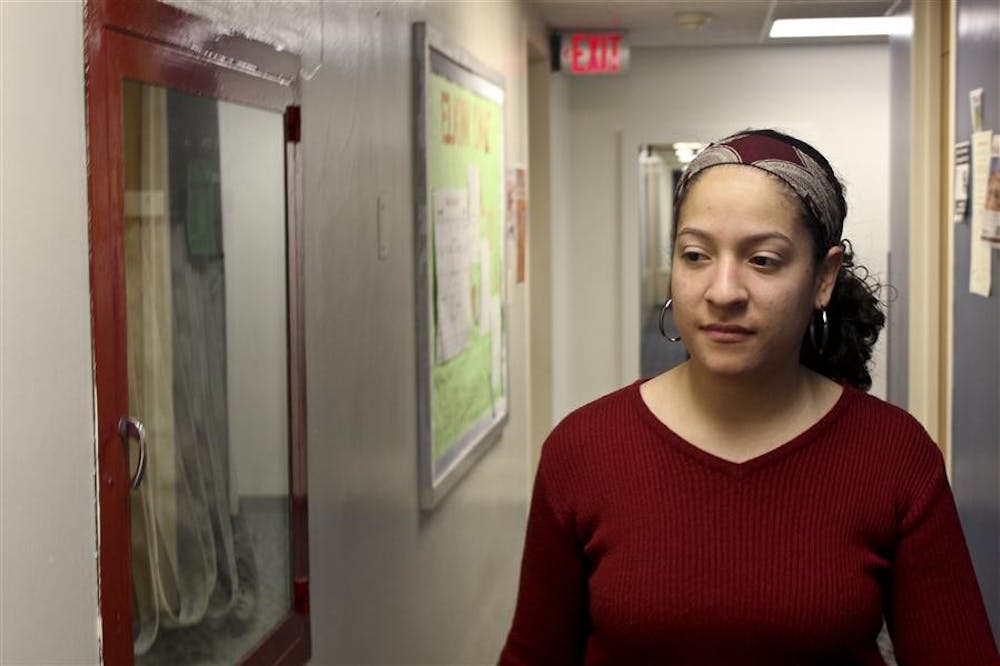
Senior RA on Teter Quad Elkin 1, CUE during her sophomore year
Pre-physical therapy
Why she applied to be a CUE
Morales said she has always appreciated diversity. “I knew I would have fun with the job, and I would learn a bunch from it.”
CUE downside
“I didn’t really know the staff as well as I wanted to last year,” she said. “Sometimes I didn’t feel like I was in the loop. You need to make yourself get in there to know what’s going on.”
CUE advice
“I’m sure that a lot of the CUES that are applying now are open-minded because you have to be to apply. Just keep your eyes, ears and hearts open,” she said. “You need to be quick on your feet, and take everything as a learning experience.”
On switching to an RA
“I wanted to be able to program around what residents wanted, and I felt like I could better know them if I became an RA on the floor,” she said.
What was unexpected
“There’s more confrontation in the RA position,” she said. “I’m OK with it now, but at first, it was challenging.”
Favorite RA activity
“I like going on walks and just hanging out in residents’ rooms,” she said. “You don’t even need to do much. Just let them know that you’re there and listening and knowing what they are going through at the moment.”
Main advice
“Patience is key,” she said. “Don’t feel overwhelmed with things going on with the job and school.”
RAs offer advice on taking charge
Get stories like this in your inbox
Subscribe