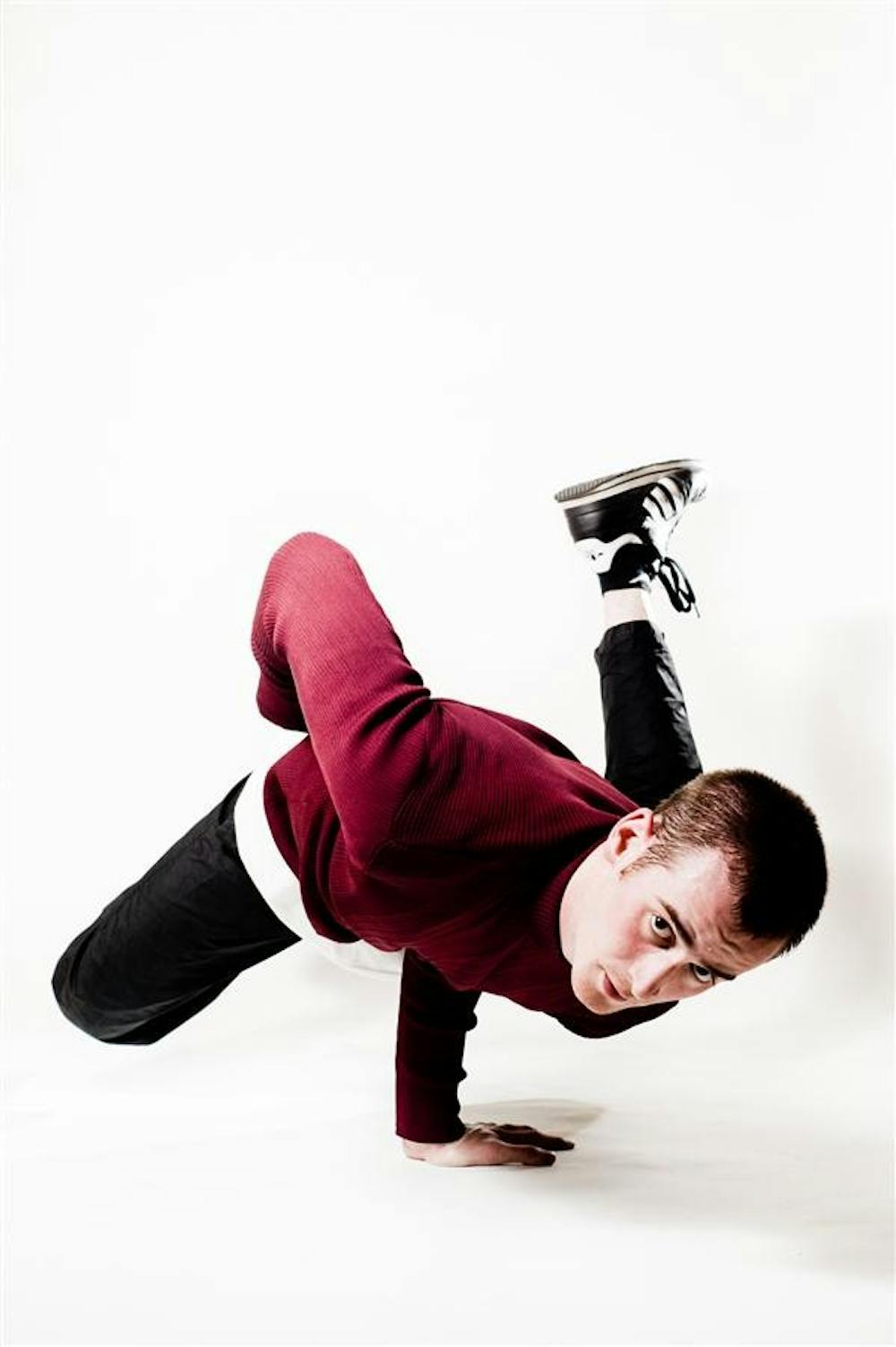
B-boy Slim made it clear.
“To those of us who do it, it’s not called
breakdancing,” said B-boy Slim, senior and president of IU Breakdance
Club, whose real name is Chris Funderburk. “That’s just what some
reporter back in the 1980s termed it. To us, it’s b-boying, b-girling or
breaking.”
So, why support the false terminology by naming the group IU Breakdance
Club? Funderburk said it’s a term most people recognize, and it’s
necessary for recruiting new members. But once introduced to the realm
of b-boying, people learn that breakdancing is a loose definition of a
dance that incorporates an entire hip-hopesque culture.
“A real b-boy will know how to dance but will also be consumed with
knowledge of the culture that they go out and break themselves for,”
Funderburk said.
The hip-hop urbanity branches into four realms: DJs,
graffiti heads, emcees and b-boys. And though each is a distinct group,
together they celebrate what Funderburk coins the true essence of
hip-hop.
“It started in the Bronx in New York because people wanted to escape
their lives of shootings and gang rivalries,” Funderburk said. “It was
something to look forward to, and for some people today, it’s still a
method of anti-drugs or gangs or whatever it may be.”
In a way, the street dance was successful in revolutionizing these
rivalries by taking gang violence from the streets to a dance floor,
introducing crews to a whole new version of tension.
“It’s competitive, but essentially, it’s all about respect,” Funderburk said. “It’s calling them out and being respectful about disrespecting. At the end of the night, we all shake
hands in love. But for a moment, yes, the intensity tests your limits of
control.”
Funderburk’s personal crew, Beatsickmisfits, has traveled
the world in search of this competitive hype. The group has been in
everything from Orlando’s elite competitions to sketchy, leaky backrooms
in Cincinnati with duct-taped linoleum floors.
Senior b-girl Samantha Estrada was first exposed to the club at
Culturefest her freshman year. The Chicago native said she never had
intentions of becoming a b-girl. In fact, in high school, she
participated in pom dance and left the breaking to her older brother.
However, after graduating and coming to IU, Estrada found the travel
opportunities of IU Breakdance Club to be her one connection to her
brother, whom she missed.
“I never planned to take it seriously,” Estrada said. “It was my answer
to being homesick. But after that first week of lessons, I became
hooked.”
Funderburk said the first practice for a b-boy or b-girl starts with learning the basic movements of toprock before ever hitting the ground. It’s where the club loses most people
because it requires dancers to take the elements of break and express
them in their own manner. But to some, this comes naturally.
“I came
from a background of hip-hop and salsa, so it was easy to find my own
toprock rhythm,” Estrada said. “But for me, it was when I hit the ground
that things changed completely.”
Style and originality are still the most important aspects. In fact,
lack the latter of the two and any b-boy will call you out as a biter.
“Copying
someone else’s moves is called biting,” Funderburk said. “Some kids
will show up the first day and show off with some move they snagged off
of ‘America’s Best Dance Crew.’ It’s my job to respond with, ‘It’s cool
that you’re able to do that, but it’s not your move.’”
Biting can attract adoration from the untrained eye allowing many
dancers to thrive outside of competition, in a different kind of scene —
the party.
“It’s not hard at all to entertain at a party,”
Funderburk said. “Two small freezes can make people scream, whereas a
real b-boy would laugh at you.”
Club members are frequently spotted breaking, whether at a house party
or local venue. Funderburk said the difference between a real b-boy and a
“breakdancer” is simply their motives to dance. But even without the
intention to “show off,” breaking simply attracts attention. In fact,
local DJ Wally Wonder said the positive attention of the dancers in a
way brings revival to the fading hip-hop scene.
“All of the hip-hop groups are about getting more momentum, a boost of
culture that reminds people of the time where hip-hop was kind of a big
thing,” he said.
Freshman Steven Hsu said the love of hip-hop and
breaking culture has replaced his initial reason to join the club, which
was impressing girls.
“In China, dance isn’t a huge part of the culture,” said Hsu, who has a
background in the popping and house dance scenes. “Here, there is such
an appreciation of dance, and that’s something I really appreciate.”
Currently, the aspiring fashion designer opts for Adidas Sambas or Converse low tops, which contribute to his overall style.
Funderburk said clothing (his pick is Dickies, due to durability) should
be optimal for slippage and power movements, adding that three shirt
changes are necessary simply because of sweat.
“Presentation is big,”
Estrada said. “But over clothes, it comes down to how you handle that
tension mentally and then what you bring to the dance floor.”
Estrada said females are outnumbered four to one in the IU club and at
least 15 to one in competitions. So for her, this mental presentation is
more important than anything.
“Some people take it easier on me
because I am a girl,” Estrada said. “But I dedicate myself to this just
as much as anyone, and when I dance, I think I prove that.”
Dedication. It’s a recurring theme that should not be underestimated in
its terms. Out of the 75 newcomers that come to the first IU Breakdance
Club’s practice of the year, more than 50 will drop within a week.
Funderburk described the level of physical devotion as a soreness that
never fades.
The few willing to dedicate themselves to the art reap rewards only a true b-boy or b-girl can comprehend.
“It’s
not for everybody, and lots of people quit,” Estrada said. “But once
you’re hooked, there’s no stopping. It’s a family with an entire culture
behind it, and it’s something I’ll never be ready to quit.”
Breaking Badasses
Get stories like this in your inbox
Subscribe