Looking at the night sky, only the faint glow of the moon can be seen. Through the lens of a telescope, every imprint and crater on its surface comes into focus.
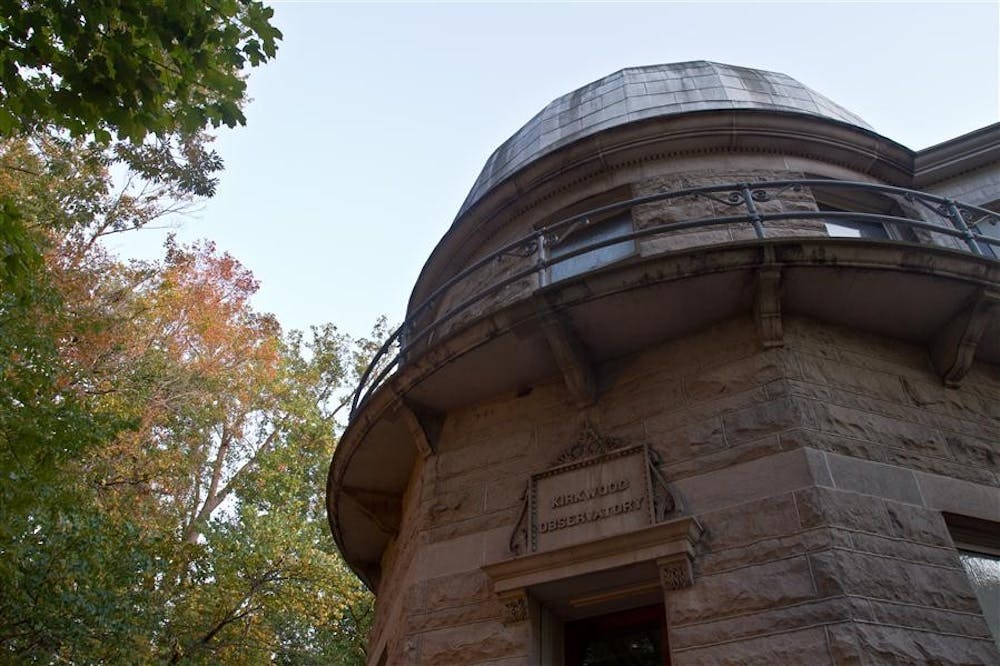
For one of the first times this semester, the Kirkwood Observatory opened its doors to the public for its weekly open house. Cloud cover had prevented its opening in previous weeks, but a clear sky Wednesday evening permitted people of all ages to enjoy what the observatory has to offer.
The line to enter the observatory practically wound its way out the door.
A family decked out in IU gear lingered near the entrance. Families herded their young children through the course of the line.
All had congregated to the observatory for the same reason: to experience the world of astronomy that so many have grown to love.
Randy Hamper, the outreach coordinator in IU’s astronomy department, said the observatory’s rustic, old-fashioned appeal is what draws people’s attention.
“When people have an idea of what astronomy is, it’s the idea of an astronomer sitting behind a telescope looking out at the night sky,” he said.
Astronomy today has changed in the sense that it is technologically based, Hamper said.
Much of the time, an astronomer sits behind a computer screen and takes digital pictures. These likenesses would once have been sketched.
“At Kirkwood, it’s still that old, romantic view,” he said.
As some people descended the mahogany steps, others were sent up into the darkness, inching the entrance line slowly along.
Upstairs, scattered fixtures provided dim lighting in the small space where yet another line wrapped around the circular area.
In the middle of everything, a vast telescope was directed toward the night sky, and the crescent moon through a slit in the ceiling.
The 12-inch retracting telescope is exactly what everyone had been waiting for.
And Hamper claimed this telescope is what he enjoys most about the observatory as a whole.
“It’s old. It’s well built,” he said. “It gives you a beautiful view of the night sky.”
The telescope dates back to 1901 but was refurbished in the early 2000s, Hamper said.
In comparison to most modern telescopes, the Kirkwood telescope is relatively small, Hamper said.
Yet to the unknowing eye, “small” would not be a word used to describe it.
A set of steps are situated beneath the telescope so observers can easily access the eyepiece.
Once the eye is in place, an extremely magnified view of the moon comes to focus. An astronomy graduate student is there to explain what is being viewed and to answer questions about the specifics of the telescope.
Craters and ridges along the moon’s surface can easily be seen through the telescope, which magnifies the size of the moon to 150 times what can be seen with the naked eye.
Because of this, not all of the moon can be viewed at once using the telescope.
After the viewer finishes looking through the telescope and steps down from the post at the eyepiece, the next person has the opportunity to experience the magic of the galaxies.
Overall, the Kirkwood Observatory stands as an outlet for knowledge and growth in the IU community, Hamper said.
“I think it’s kind of a nice piece of IU history,” he said. “It’s also really important because it enables IU to reach out to the Bloomington area and maybe central Indiana as a whole and give people the opportunity to look through the telescope — the planets, the stars, the galaxies and all the neat stuff that’s out there.”
Kirkwood observatory connects community to astronomy
Get stories like this in your inbox
Subscribe