The beautiful thing about the Internet is that it thrives on extremes — the loudest voices, most extreme arguments, craziest conspiracy theories. The web allows people to reveal themselves in ways they never would when dealing with people face-to-face.
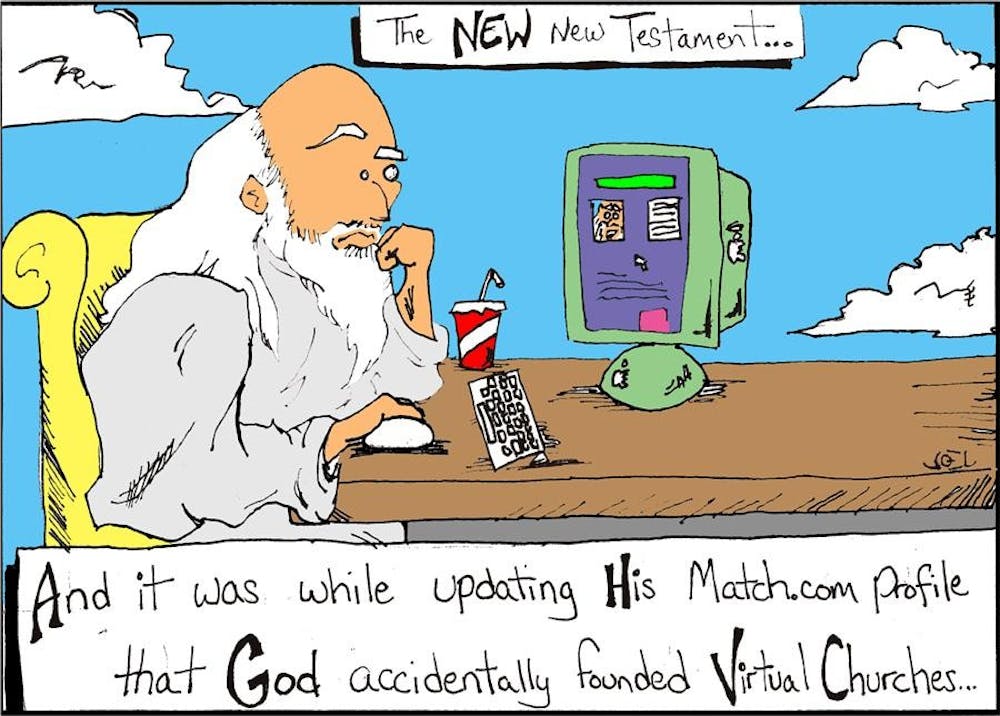
A recent demonstration of this fact: the birth of so-called “virtual churches.” Such churches exhibit the degree to which we’ve become comfortable with the Internet as a vehicle for the self-expression of our religious beliefs and as a tool to find others who share those beliefs — however idiosyncratic they might be.
Expressions of the human impulse to seek a higher power can proliferate thanks to technology, allowing those who might not have found a home in any one organized religion to give voice to what, in the past, might have been forcefully silenced.
On the other hand, such churches might be seen as less of a novelty and more an expression of the extreme individualism that has always been at the core of American religiosity.
The Protestant Reformation transformed religion. From its traditional emphasis on community and ritual, religion suddenly became a matter of individual belief — and from there, it was a short step to American evangelicalism’s “personal relationship with Jesus,” which, at its worst, turns religion into nothing more than a ticket to a happy afterlife.
Some have argued this individually focused spirituality is not specifically Christian (or, for that matter, Muslim, Jewish, Mormon, etc.), but rather Gnostic. It prefers the spiritual to the material, the heavenly hereafter to the political here and now.
In sociologist Christian Smith’s term, it’s moralistic therapy rather than meaningful interaction with the divine. What medium could be better suited than the web’s ethereal fiber optics and wireless networks to allow this vague spirituality to proliferate?
What’s lost, most obviously in virtual churches, but also with the overuse of social media of any type, is the simple fact that human beings are embodied. We depend on physical things and daily connections with people — real, live people.
By uploading our social lives and our religious beliefs, we sell ourselves short. When we reduce our religious or political beliefs to a line on our profiles, we forget that belief and practice must go together. Faith without works is dead, and political belief without voting, community involvement and protest becomes mere apathy.
So virtual church offers us a much-needed warning: social media is a wonderful supplement to our daily lives as worshipers, workers and friends.
But the second it becomes a replacement for these things, it’s good for nothing but escapism.
Virtual Churches, are they the real deal?
Get stories like this in your inbox
Subscribe