
Going to the grocery store will drain more money from your bank account than it did in 2010 and early 2011, a new survey shows.
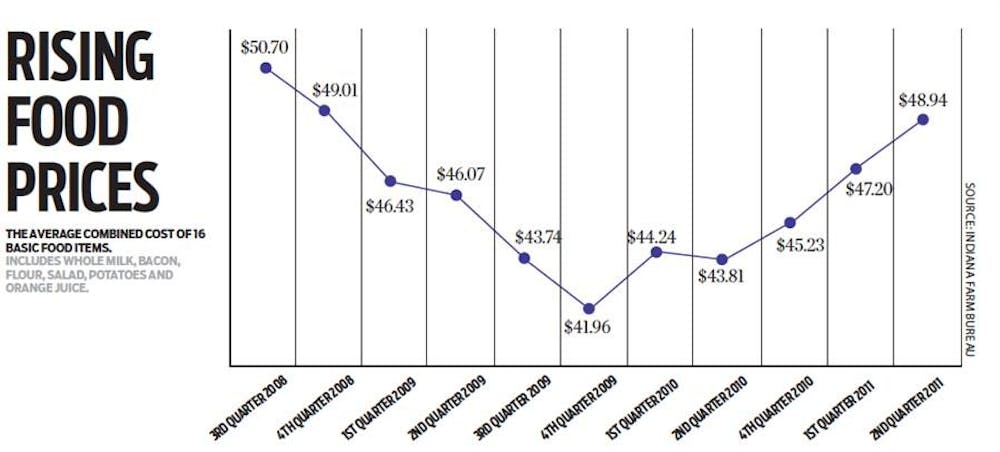
The average price of several staple food items showed an increase of 3.6 percent from 2010 and the first quarter of 2011, according to a survey from the Indiana Farm Bureau and the American Farm Bureau Federation.
“The effects of continued raw energy cost increases are reverberating throughout the food industry, and consumers are bearing the brunt of it,” AFBF economist John Anderson said in a press release.
The survey included 16 commonly purchased food items that are used as an indicator of overall food prices. Some of the surveyed foods included potatoes, bacon, whole milk, flour and orange juice.
The study said rising fuel costs are the main cause of the increase in food prices. Farmers have to pay more to run their equipment, and it costs more to transport the food to grocery stores.
“Every step in food production — from planting to fertilizing to harvesting and beyond — requires fuel, and that cost comes directly out of farmers’ pockets,” Isabella Chism, IFB second vice president, said.
The average cost for the 16 items included in the survey was $48.94, up $1.74 from the first quarter of 2011. Twelve of the items increased in price, and four decreased. Bacon, whole milk, bagged salad mix and potatoes increased the most. Sliced deli ham, flour, orange juice and ground chuck are the only food items that saw a decrease in average price.
The average price for bacon increased the most with an increase of 56 cents to $4.16. Whole milk was next with an increase of 42 cents per gallon to $3.27.
“Strong consumer demand for meats and dairy products continues to influence retail prices,” Anderson said.
The AFBF survey also said consumers are not the only ones taking a hit from the rising food prices. As food prices have increased through the years, the survey said, farmers have taken a gradually reduced percentage of the money gained from food sales.
Farmers in 2008 (the most recent year for which data is available) received about 15.8 cents for every one dollar spent on food, down from 18.4 cents in 1993, according to the U.S. Department of Agriculture. The rest of the money is taken by the food processing industry, which includes grocery stores, food processing plants and marketing.
The survey predicts food price increases will become the new normal for the next year or so, especially for meat and dairy products, so consumers should be prepared for further increases at the check-out counter.
— Zach Ammerman
Indiana food prices increase, trend to continue, survey says
Get stories like this in your inbox
Subscribe



