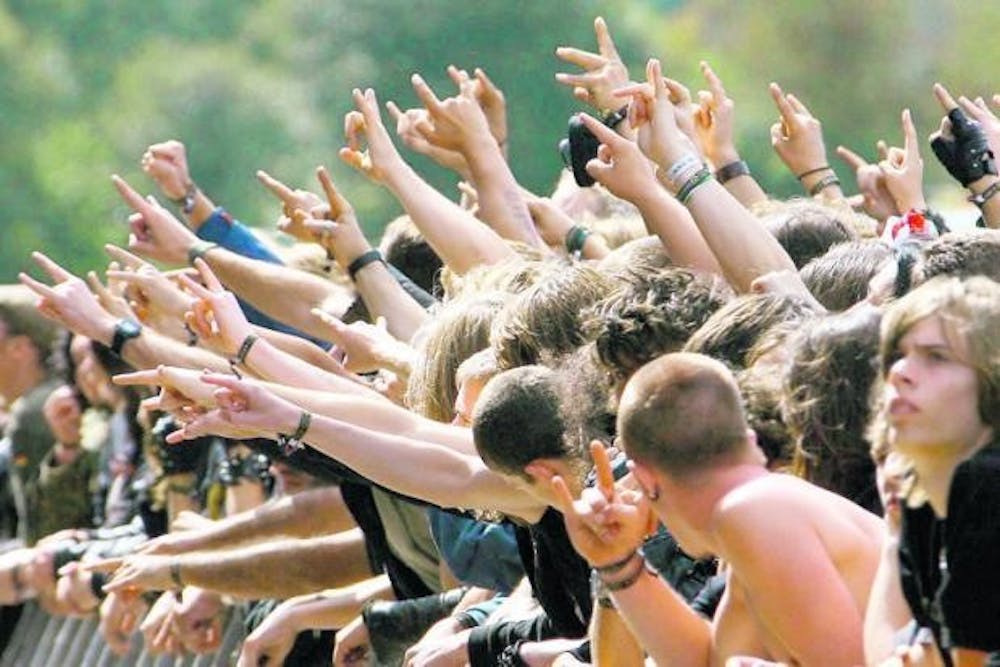
A towering man draped in leather and chains — his beard catching beer, his skin pierced and stenciled with tattoos of death — bumps into you at a show. If he’s a metalhead, associate professor of telecommunications Mark Deuze says, the man might just say, “Excuse me,” and clear the way for you to pass.
“Metal capitalizes on shock value,” says Deuze. “It’s a visual display, a show element, with symbols intended to be deviant from, or fucking with, the mainstream.”
Deuze continues, “Everybody’s incredibly ugly. It looks violent, but if you’re a part of it, it’s really not.”
Mike Lang is the president of the IU Metal Underground, a student organization created for metalheads to get together and discuss the music they love. He’s seen the potentially paradoxical behavior of so-called violent metalheads first hand.
“One time I got thrown into a mosh pit, and right away my contacts got knocked out,” Lang said. “I thought they’d be crushed, but everyone stopped, got down on their hands and knees, and we didn’t start again until someone found them.”
Deuze plays music from a band called Kill the Client in his office in the Telecom building. “You must hear this,” he says to Lang, still exuding the same enthusiasm for metal that he had when he was 15 and staffing venues in the Netherlands.
After a few moments of absorbing the adrenaline-pumping riffs, Lang says, “They’re like Terrorizer, only 2011.”
Lang and Deuze met as a result of Lang’s research for his communication and culture thesis about metal. With Lang now a grad student, the two share a friendship that has “gruff vocals” and “quick snare action” at its center. Their conversation cycles through references at breakneck speed as they evaluate the Kill the Client song, a recommendation from Deuze’s colleague Andrew Herman, a professor of metal at University of Toronto.
“Metal came out of frustration,” Deuze says. He is not afraid to use his hands to act out the story as chords accelerate from his speakers. “There was this early ’70s economic downturn in Europe, with lower class workers out of work, women passing men by left and right. So they took an existing genre and fucked it up,” he says.
Deuze discovered metal in the Netherlands at a bar called Dynamo, which gave the youth of Eindhoven a safe place to celebrate new music. Deuze compares “the vibe” to Rhino’s Youth Media Center, which throws its own metal shows. A few weeks ago, Bloomington saw the bands 3 Inches of Blood, Holy Grail and Medusa at the Bluebird Nightclub.
“There’s bands and listeners everywhere,” Lang says. “Three record stores that move metal titles, three bars that put on metal shows, the IU Metal Underground and WIUX.”
Matt Lyles is one host of the nonstop metal block at WIUX from 6 p.m. Saturdays to 6 a.m. Sundays. He gives credit to the IU Metal Underground for cultivating his interest.
“I first went the second semester of my freshman year,” Lyles says. “The other guys had been into metal a lot longer than I had. I heard all this new stuff, and my music collection expanded tenfold.”
In Lyles’ sound-sensitive booth, the phone flashes instead of ringing. He answers it. “Uh-huh ... right on,” he says. “Happy to play it for you, man.”
He hangs up and throws on the requested song. Anyone can call into the studio or post suggestions on Lyles’ “Metal to the Masses — WIUX” Facebook page.
“Sure, metal has cliques,” Lyles says. “But indie-rock hipsters like to think they’re above all that. Metal fans are very much aware that they’re in a scene and that we act in a different way, and we celebrate that.”
Metal is inclusive, but it isn’t without its barriers to entry. A music form with as much aggression and darkness at its core as metal isn’t always easy for the uninitiated to enjoy.
“As diverse a genre as metal actually is, it’s hard to get people into it unless they’re already into it,” Lang says. “Give me an hour, though, and I can almost guarantee I’ll find you a metal band you like.”
Lang uses the Metal Archives, a wiki for metal fans, to help link people to new metal experiences. It’s a helpful website for people interested in learning more about the genre, but trying to put metal in a box is a useless endeavor.
“What is metal?” is a question that will result in a thousand answers from a thousand people. For Deuze, it’s an intangible feeling that comes from the music.
“I am a bass player, and I once came across this amp that, instead of an effects pedal, had distortion built right in,” Deuze says. “You could literally press a button and it sounded broken. That, to me, is metal.”
Battles and Brotherhood
Get stories like this in your inbox
Subscribe