It’s the summer of 1956, and a theater full of people is watching John Wayne play the hero yet again, as he lumbers, silently, stoically, kidnapped niece in hand, up the steps of a lonely west Texas ranch house to deliver her home.
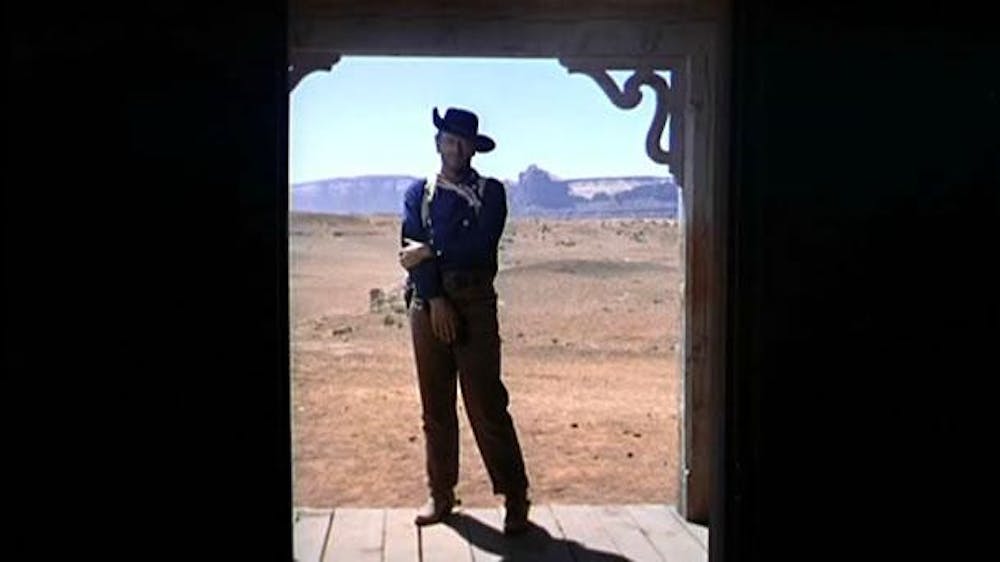
The girl’s parents rush forward to collect her, the camera pulls back, and Wayne, needing no thanks, is framed in the doorway as he walks off into the empty, dust-blown wilderness. It’s the final scene of John Ford’s “The Searchers,” and the golden era of the Western is in full swing.
Wayne’s seven Westerns during the next six years, three of them with Ford, account for a drop of water in a lake of Westerns produced within this time period.
For the latter half of the ’60s and through the ’70s, Clint Eastwood would keep the genre alive, but it would never again dominate the Hollywood landscape as it did during the prime of Wayne and Ford.
Today, on the heels of the box office success of “True Grit,” many critics are predicting a full-on Western revival. And while cowboys kicking teenage vampires off of the cultural phenomenon pedestal might sit well with some, the claim seems a bit unlikely.
Are Westerns really primed to occupy that role in theaters? Perhaps the best answer to this question lies in the reason they faded from view in the first place.
Lorrie Palmer is a Ph.D. candidate who became enamored with Wayne’s “The Cowboys” as a 12-year-old and has written some of her best work on Westerns. Her explanation is a mix of the practical and the theoretical. On one hand, some of the genre’s most popular actors, like Wayne, Jimmy Stewart and Randolph Scott, were simply getting old.
On the other, the rising tide of ’60s counterculture meant traditional Western narratives rooted in colonial and somewhat racist ideals didn’t fly as well with audiences. The traditional Western hero was replaced with the anti-hero, and while he could still be given a horse and a six shooter (“Butch Cassidy and the Sundance Kid”), this new character archetype began to branch out into films like “Easy Rider” and “Bonnie and Clyde.”
A look at this shift in cinematic values really sheds some light on how certain aspects of Westerns have been transformed with time.
Despite changes in venue, the ideal Western hero, the “lone gunslinger who must clean up the streets, even if it leaves him a bit unhinged,” as Palmer puts it, still appears regularly in the movies. In Palmer’s opinion, the recurrence of this hero, as well the replaying of a central Western theme — civilization versus wilderness — is the reason one could draw a direct line between the Western and the modern action film.
Films like “Dirty Harry,” “Die Hard” and others update the dialogue and setting, but the basic elements remain the same. When considering this, the Western no longer appears to be a tightly classified genre that went away only to recently ride back to popularity, guns blazing, but a style of storytelling which has been mutated, borrowed from and updated into countless variations.
“The fact is that the myth of the American West is our most culturally resonant self-image,” Palmer said. “Whether its themes or its aesthetics emerge in the various outlets of our narrative media, it’s just never really gone away.”
Which is why, in the opposite vein of borrowing the character and changing the location, many recent films have borrowed the classic Western setting to tell stories completely unhinged from the Westerns of Wayne and Ford. “Dances with Wolves,” “Brokeback Mountain” and “No Country for Old Men” all manage to shine in part because of their setting and yet would never be mistaken for a classic Western.
So if we really are about to be barraged with a mass of cowboy movies and Western remakes, if Taylor Lautner really is about to don chaps, hop on a horse, and chew a cigar for his next big flick, so be it. Just know that what we think of as the Western film never really left us. It has shifted with cultural values, changed with the scope of new filmmakers and been boxed up and shipped out to enhance an endless number of other cinematic storytelling styles.
Palmer for one, is looking forward to next summer’s genre bending Western sci-fi “Cowboys & Aliens.”
“The Western is just a great template for action and heroism and coolness. I’m so there.”
Bringing back the Western (if it ever really left)
From cowboys to cops
Get stories like this in your inbox
Subscribe