"Phoenix Myers looks like a hippy. Long stringy hair, beads, a safari hat drooping around his ears, casual attire and glasses that, though completely mainstream, also convey something alternative," an IDS staff member wrote in an article. "But if all he's interested in is presenting a rebel image, then he is guilty of massive overkill."
"If you write anything about me, say that my purpose is to get people to think for themselves," Myers said in the article. "Don't let the government think for you."
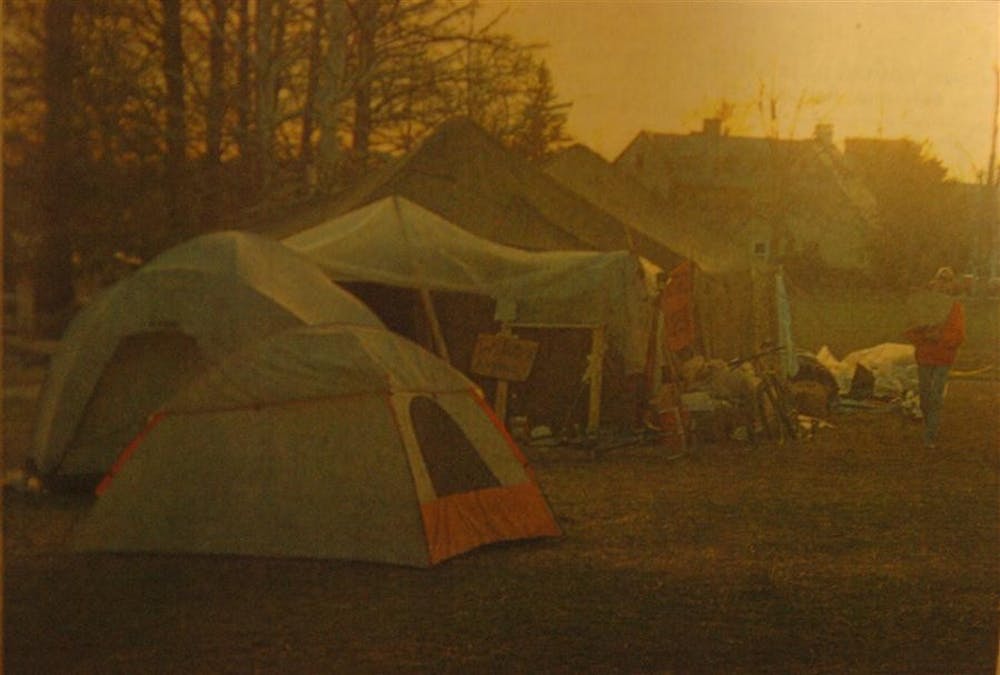
In a one-man vigil, Myers declared that he would remain in the meadow until Jan. 15, the U.N. deadline for Iraq to leave Kuwait. If war were to break out, however, Myers said he would stay longer.
On Jan. 15, 1991, "IU police officers, dressed in riot gear, were called to Dunn Meadow early this morning after a Hoosier basketball victory celebration turned into a confrontational political rally," according to an IDS article.
IU beat Purdue in a close 65-62 victory. Fans exploded on campus, rushing to the Showalter Fountain around 12:30 a.m. From the fountain they ran to Dunn Meadow to confront the anti-war protesters who had been camping out in the field for five days, taking their cue from Phoenix Myers who began the protest.
"Several IU fans were unsure when the victory celebration turned into a political rally supporting U.S. action in the Middle East," according to an IDS article.
During the confrontation, a firecracker was thrown on one of the protester's tents and some signs were destroyed.
"Nevertheless, the anti-war protesters joined hands and sang while the IU fans continued chanting 'love it or leave it," according to the IDS article.
The next day about 100 peace activists participated in an all-day boycott of classes to show their support for a peaceful solution to the Persian Gulf Crisis. Seven and a half hours before the peace activists arrived in the meadow, counter-protesters circled the field throwing firecrackers and water balloons while chanting "USA" and singing the Star-Spangled Banner.
During the rally later that day, a stark contrast, students circled together while "Let it Be" played over the loud speaker.
On Jan. 17, 1991, the implementation of Operation Desert Storm by U.S. troops brought approximately 200 demonstrators to Dunn Meadow.
The students formed a circle in the muddy meadow to listen to speeches and sing songs, a rally that lasted around 45 minutes. Some joined the group after being told about the rally; others went to the meadow without previous knowledge.
"I was coming out of class when I heard," law student Chris Bergin said in an IDS article. "I went home, watched the TV reports and then came here."
The next day Associate Dean of Students Dick McKaig presented Phoenix Myers an official letter from the University stating that sleeping is not an active form of protest.
"This protest is not a matter of eight to 10 hours a day, and then going back to the comfort of my home," Myers said in an IDS article.
However, a proposal from members of "tent city" on Jan. 23 requesting two more weeks of camping out in Dunn Meadow was accepted, allowing them to remain there until Feb. 5. McKaig wrote in a letter that the protesters could stay as long as they conducted a 24-hour vigil. Sleeping on the grounds would continue to be unacceptable.
On March 6, 1991, war protesters living in "tent city" to protest U.S. involvement in the Persian Gulf Crisis left the meadow after nearly two months of camping there. Their original deadline for leaving the meadow was Jan. 22.
One-man vigil: Tent City
Get stories like this in your inbox
Subscribe