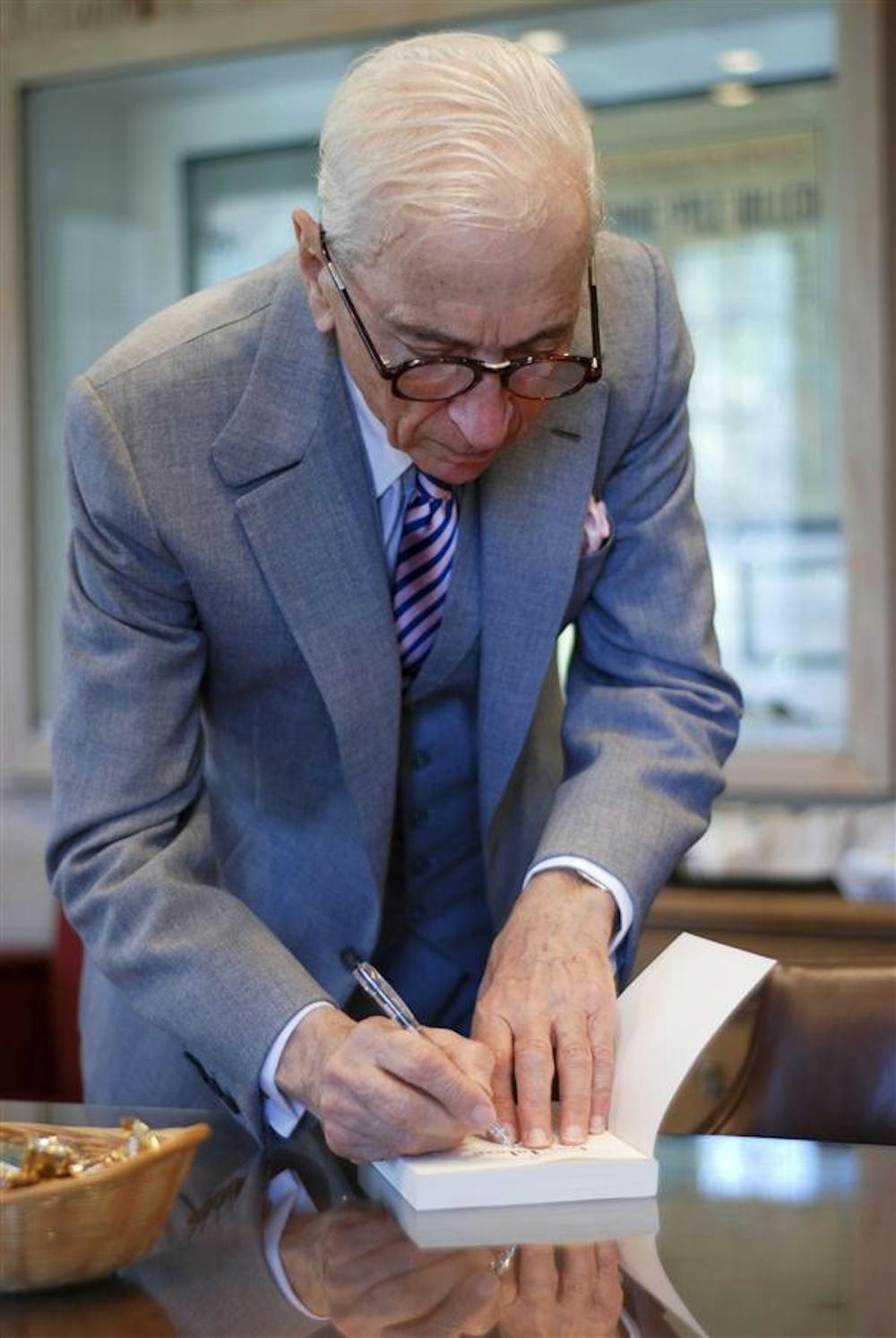
Gay Talese left his passport in the car on the way from the Indianapolis International Airport, and it is only the next day as he casually sits in front of a group of selected journalism students that he pulls out a note from his jacket that reminds him he should call the driver whose car he left it in.
“I have to make sure I do that,” Talese says smiling.
A professor leaves to have someone call for him, or else Talese might be staying in Bloomington longer than expected.
Talese is the author of numerous books, such as “Honor Thy Father”, “Thy
Neighbor’s Wife” and “The Kingdom and the Power,” along with an
assortment of magazine and newspaper articles.
He started working for the New York Times in 1953 as a copy boy and eventually became a writer.
He moved on to magazines, such as Esquire, and then started writing books. His topics have included the Mafia, Muhammad Ali, Joe DiMaggio and Frank Sinatra.
But Talese says he prefers to write about the people that others over looked instead of celebrities that are well-known.
“I like to write about people who have a history,” Talese says to the group of students.
A unique trait about Talese is his old-fashioned style. He refuses to use a tape recorder when interviewing sources and still types on a typewriter.
Talese is invested in every conversation he has, and after he is done writing a book, he keeps in touch with the subjects that he became close to during that time.
As the students stare at him with curiosity and uneaten sandwiches sit on small paper plates on the large conference table, Talese gives them some advice.
“You need to have curiosity,” Talese says. “Reporting what you see is so visual if you do it right.”
Talese is the master of storytelling. He spends seven days a week in what he calls “the bunker” of his and his wife’s four story townhouse in Manhattan, New York, which in itself is like its own apartment. It’s his hideaway where he eats his eggs for breakfast, works for a few hours and then has lunch.
He tells the aspiring journalists he isn’t lonely by himself in his bunker because there are too many distractions in his house.
“There are messengers delivering party invites to parties I don’t want to go to, the phone ringing...,” Talese says. “I have a little kitchen down there, a bed and I make sure the refrigerator always has things in it.”
But Talese isn’t spending all of his time inside and alone.
“I finish my day around 7, but I probably go out every night of the week,” Talese says. “I don’t like eating dinner at home. I like restaurants. Great ones.”
One student tells him that he would definitely like IU, in regards to going out every night. The group chuckles.
Talese doesn’t finish his sandwich, as he constantly asked how much time they have left, trying to give students enough words of wisdom and also hear student questions as well.
He drinks his Coca-Cola and says he asked where he could get a gin martini when he checked into the Indiana Memorial Union last night, but was informed that wouldn’t be possible.
Time is up and Talese is on the move. He is told they have found his passport and it will be with him when he goes to the airport tomorrow.
“They better have it or else I have to stay longer,” Talese says.
On the move
Talese wears a gold watch that looks like it was shined before he walked into the room. His grey suit is finely fitted, with a pink handkerchief that slightly peaks out of his jacket pocket. His tie is stripped and stands out. Talese’s outfit wouldn’t turn a head on the streets of Manhattan, but as he walked out of Ernie Pyle Hall Wednesday afternoon, a male student immediately comments on his attire.
“I like your outfit man,” the student says.
Talese loves it. He smiles and thanks the student for the compliment. He folds his hands behind his back, and he is off, being led to the Buskirk-Chumley Theater where he will be speaking in a few hours.
He wants to check out the venue before he speaks in front of the crowded hall filled with aspiring writers, professors who teach Talese’s work to their students and other fans of his writing.
They want to know the secret. They want to write like him.
As he walks to the theater, he notices everything, observing, taking it all in. He has made a living out of observing. He passes by Kilroys Bar & Grill and makes a point that he will have a martini not before, but after his speech.
He walks into the cold, dark theater that will soon be lit and throws his hat that spins onto the table standing between the seats and the stage. Jacob, a man that Talese starts talking to, is working on the lighting for tonight.
“I don’t want to be on stage, I want to be here on the ground,” Talese says.
He tests it out, and it is determined that if Talese speaks from the ground the people in the balcony of the theater won’t see him.
With disappoint in his voice, he says, “Alright. The stage it is. But can I have the table up here with me?”
Talese wants to be part of the people, part of the crowd that he will be speaking to.
“You need to know where you’re looking,” he says. “I don’t read from a text, I just talk.”
Jacob says having the table on stage is okay.
“Great, but what about the microphone?” Talese asks.
He stands in place on the dimly lit stage with his hands crossed in front of him, contemplating whether to use a hand held microphone or one in his ear.
“Does it fall out of your ear?” Talese asks.
He needs to make sure the words he speaks to his audience will be heard.
Talese walks off the stage slowly, one foot after the other down the narrow steps, straight to the front row where he sits down, putting his right arm across the top of the seat next to him, like he’s at the movies with his wife but she’s not there. He is his own audience in an empty hall that he says looks similar to a “1950s movie theater.”
His eyes swirl the room as he takes out a shirt board from the inside pocket of his jacket and writes down a note. The author has a thought worth writing down.
Writer Gay Talese visits IU, speaks at Buskirk
Get stories like this in your inbox
Subscribe