Afghanistan has finally gotten a bit of much-needed good news: The country is sitting on more than $1 trillion in mineral wealth, according to a report by the U.S. military and the U.S. Geological Survey. This wealth needs to be protected and monitored to ensure that Afghans can cultivate their resources in a way that will bring prosperity to the impoverished nation.
The report suggests that a vast amount of the mineral wealth lies in politically unstable regions where warlords and the Taliban have significant influence. Efforts to gain access to this wealth might prove dangerous, costly and ineffective because of the considerable planning and infrastructure needed to capitalize on this wealth.
In a press conference, Jawad Omar, a spokesperson for the country’s Ministry of Mining, said it would take five to 10 years for the country to be able to make use of these minerals. Though five to 10 years might not seem like much, Afghanistan could become unrecognizable in that time.
In the past, the Afghan government and diplomatic positions relative to the West have frequently changed on time scales of less than a decade. As such, Afghanistan must be monitored as it explores this newfound wealth.
As The New York Times reported, each individual would receive almost $35,000 if the $1 trillion were divided equally among the country’s population.
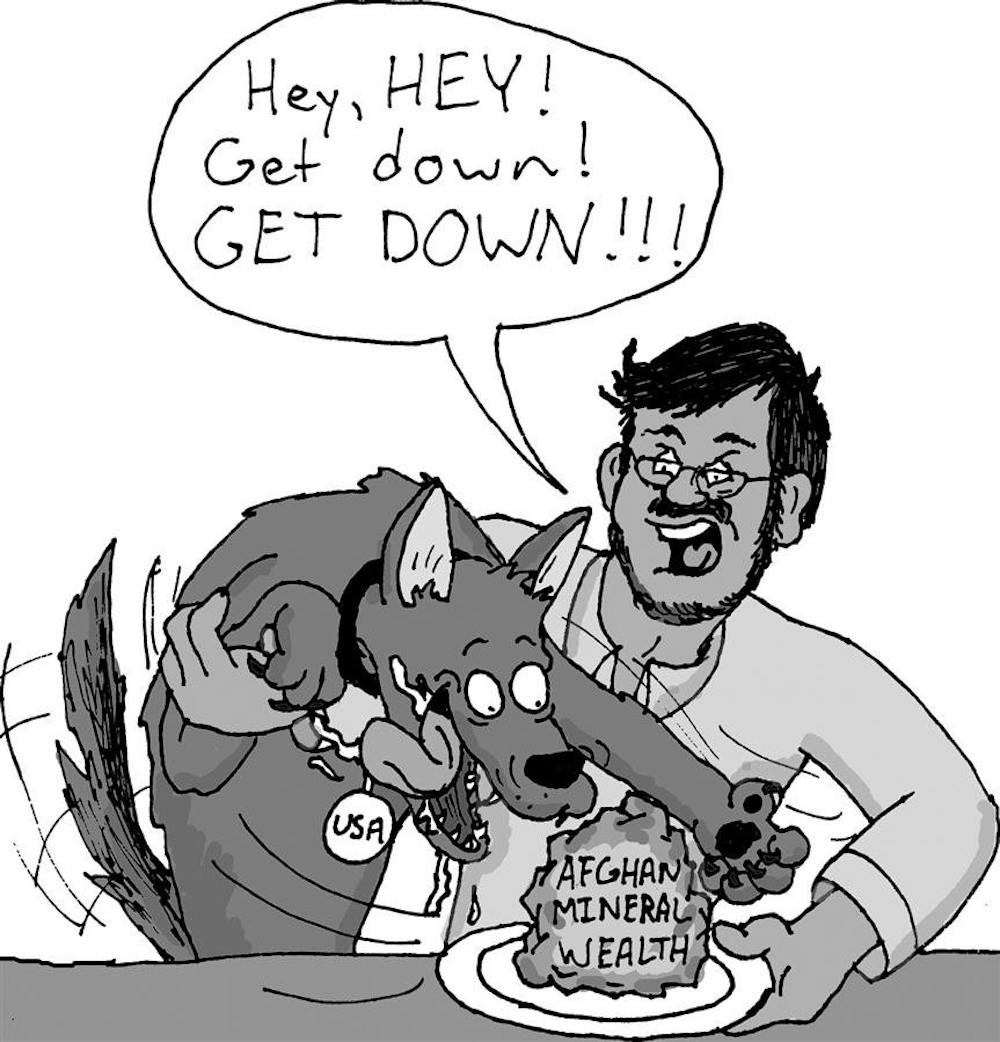
Though the notion that all the wealth will be distributed equally among Afghans is a sweet one, it’s an impractical one as well. This wealth is likely to provoke terrorism and violence like never before. The Taliban and other extremist groups will likely allege, as they did regarding U.S. involvement in Iraq, that U.S. involvement in Afghanistan is aimed at exploiting the country’s resources and its people.
Because this has been true in the past, the United States must steer clear of trying to profit off this mineral wealth.
In 2008, several Western oil companies — including Exxon Mobil, Shell, BP and Chevron — were in talks with the Iraqi Oil Ministry for no-bid contracts to service Afghanistan’s largest oil fields. Thanks to outraged critics’ vociferous objections to the West’s hold on Iraq’s native resources, the contracts never went through, and Iraq maintains control of its fields.
Afghanistan’s mineral wealth must also be mined by its own companies, not those of the West. This wealth offers real hope for improving Afghans’ quality of life. With oil, the Arab countries blossomed from barren deserts into modern, developed nations. The same metamorphosis is possible in Afghanistan, but only with strict observation.
With opium as its most lucrative export at present, Afghanistan continues to fund terrorism and spiral downward. Because current U.S. involvement in Afghanistan has allowed the opium trade to flourish after the Talban government had reduced poppy cultivation by 91 percent, we are obliged to help Afghans tap into their immense natural wealth.
Hopefully, with some guidance and protection, Afghanistan might actually be able to gain a true sense of independence and stability.
Afghan resources for Afghans
Get stories like this in your inbox
Subscribe