
Twelve students pulled their drivers’ licenses out of their pockets, placed their shoes in gray trays and hung their hands loose as they walked through metal detectors on just another Friday before class.
This time, the guard said a few shirts were cut too low. Zip up those hoodies, the students heard.
The students weren’t entering Ballantine or Woodburn Halls. For the last time in their second eight-week class, the students entered the Putnamville Correctional Facility to join their 16 classmates within the prison.
The Inside-Out Prison Exchange Program is the first of its kind at IU. Micol Seigel, assistant professor in the African American and African Diaspora Studies Department, completed instructor training last summer.
Inside-Out is a national program with courses taught in nearly 40 states, according to the program’s website.
Putnamville is about an hour’s drive northwest for students. In their weekly classes, they discuss the weight of words. “Inside students” are called just that, not “prisoner,” “offender” or “criminal.”
IU students are called “outside students.”
Inside and outside students learn side-by-side. They work together on projects, read, participate in discussions and write papers. Inside students choose whether they are graded on an honors, college or high-school level.
Their final ceremony on Friday morning featured guest speakers and student reflections.
Lindsey Krantz, a senior outside student who spoke at the ceremony, said the class sessions have made her more mindful of words and their power.
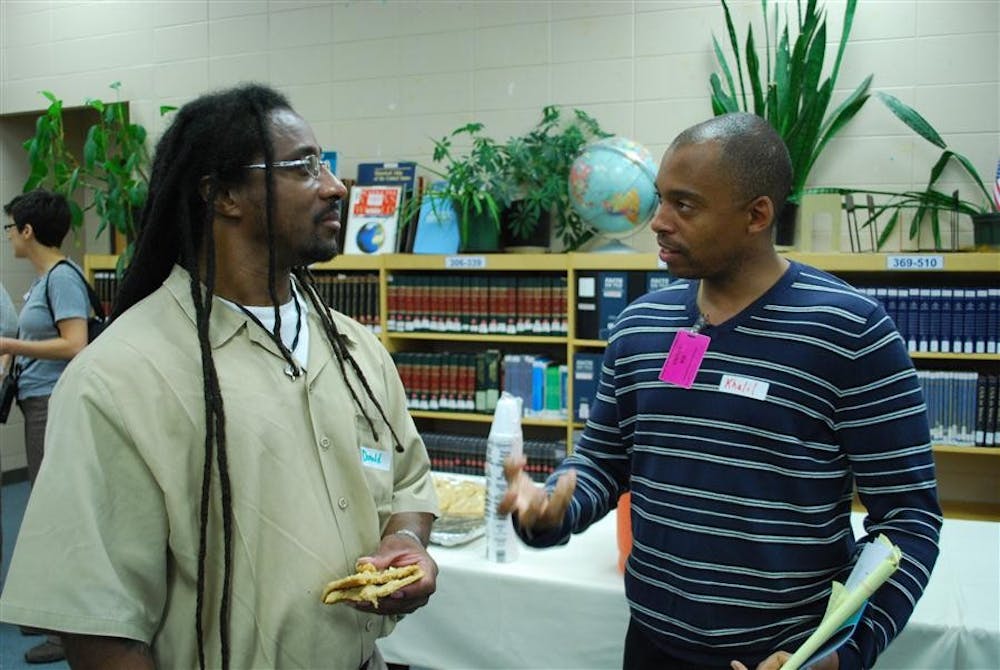
The students sat together in the prison’s common classroom space, T-shirts and sweaters next to tan institutional jumpsuits.
Donald Avance, an inside student, addressed his classmates by speaking about the “us versus them” mentality between men serving time and the guards who run the prison.
“We’ve all been so busy solidifying our position that we have lost the vision of education, respect and understanding,” he said. He spoke of the candid discussions about power and control he had throughout the past eight weeks.
Another inside student, Forrest Ferguson, read poetry about his son, two outside students sang a heartfelt rendition of a Yolanda Adams song and guests from the prison and University spoke.
Khalil Muhammad, assistant professor of history, emphasized that prisons today are based on a system of isolation and dehumanization, from high fences to unwritten rules of control. He urged the inside students to demand political and economic equality once they walked out of prison.
The prison is a low to medium-security facility, meaning the inmates have a shorter criminal history, according to the prison’s website. Bruce Lemmon, superintendent of
education at the facility, said all inside students are scheduled for release within the next decade but face a four in 10 rate of returning to prison.
Cortez Brookins, an inside student serving a seven-and-a-half-year sentence, said he thinks programs simillar to this are important for both inside and outside students. He said the students developed communication and trust in each other, something he wants to pass on to his three children.
As students and guests ate cookies and drank punch at the closing of the ceremony, Brookins explained his goals. He wants to study accounting so he can help his mother open a day care or start a catering business.
He wants his children to know and respect him as a committed father. He doesn’t want to be part of the system of control and power he sees in prison.
Seigel said she appreciated the students’ commitment to their reading and writing.
“I just had such a profound feeling of awe for the wisdom of people in the inside,” she said. “It gave them a lot more hope and made them optimistic about getting out.”
Inside-Out program addresses dominance, education in prison
Get stories like this in your inbox
Subscribe



