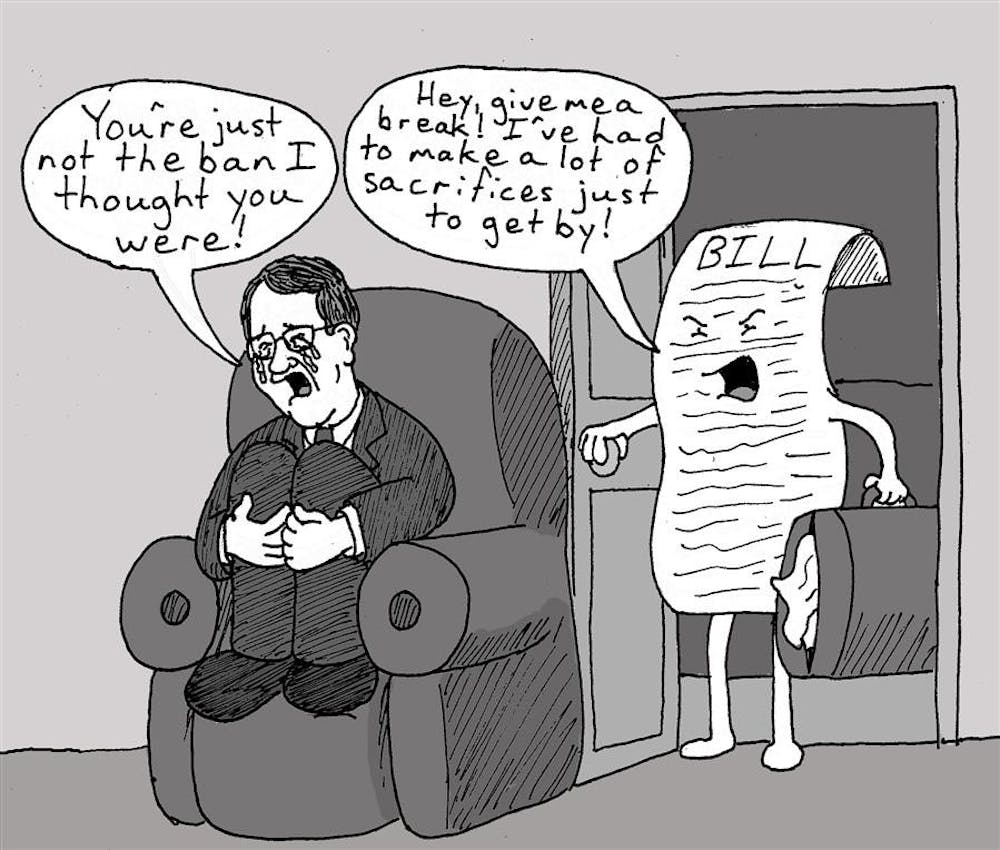
The Indiana House of Representatives voted Tuesday to approve a limited smoking ban in Indiana’s public places. The ban, which was originally intended to apply to all indoor public spaces except casinos and other legal gambling sites, was amended to allow exemptions for bars, taverns, private clubs, tobacco shops, fraternal organizations and private areas of family businesses in which all employees are related.
This watering down allowed the bill to pass the House by a wide margin of 73-26, but the bill is likely to be dead on arrival in the Senate, as Majority Leader David Long, R-Fort Wayne, has said the state is “not ready for it right now” given the sluggish economy.
The measure joins a growing club of other bills being considered in the General Assembly whose focus seems to be state restriction of citizens’ individual choices.
Other such bills include a House bill that would ban text messaging while driving and Senate bills that would mandate the school year not start until after Labor Day and advance a constitutional amendment banning same-sex marriage.
While these bills are accompanied by more sensible, relevant measures addressing issues like property tax caps and obsolete ways of governing counties and townships, they nevertheless represent a worrying trend.
Each of the aforementioned restrictive bills seeks to prohibit practices that a majority of citizens oppose or find dangerous but in which there is no compelling reason for the state to intervene.
It is clear that many people would prefer that their fellow patrons in restaurants did not smoke, that their fellow drivers paid less attention to their cell phones, that their children have a traditional Memorial-Day-to-Labor-Day summer, and that the Indiana Constitution prohibit gays and lesbians from marrying, but none of those preferences are sufficient justification for statewide bans on said practices.
After all, most Hoosiers would also probably prefer that their fellow restaurant patrons would not talk loudly and obnoxiously throughout dinner, that their fellow drivers would pay less attention to their radio dials, that their children’s schools would have to teach creationism alongside evolutionary biology, and that gays and lesbians would not engage in public displays of affection in view of their children, but we think it goes without saying that state laws codifying any of these preferences would be completely indefensible.
Why? Because in both groups of examples above, the state is – or would be – prohibiting entirely or in certain contexts practices with which a majority or vocal minority has a problem but that do not amount to an infringement of anyone’s rights.
Just as a person has every right to ask a fellow patron to tone it down a bit at dinner, or to avoid noisy locales, a person who is bothered by cigarette smoke in public should be able to avoid cigarette smoking – but should not rely on the state to snuff it out.
State proposals suggest a no-smoke nanny state
Get stories like this in your inbox
Subscribe