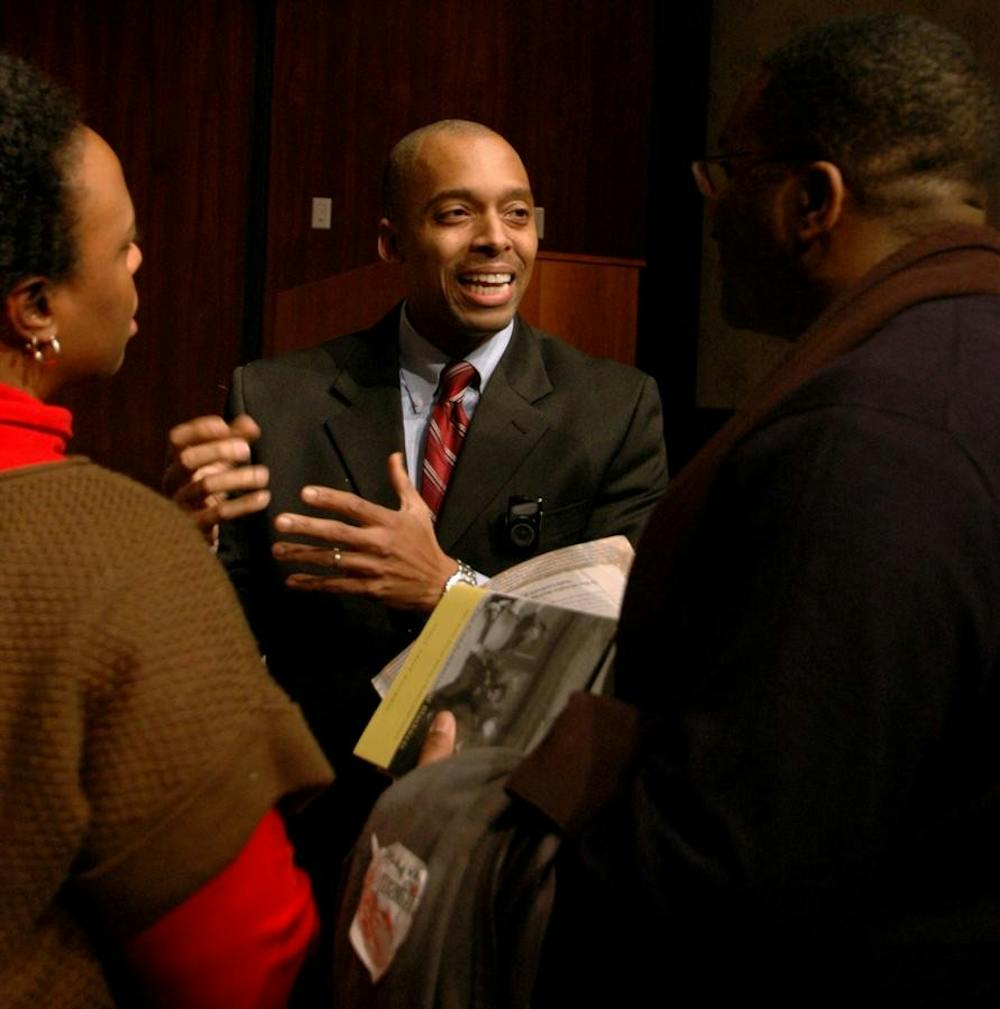
Collective ignorance, or what we don’t know, can be the ultimate cause of some types of discrimination. This was one of the underlying ideas expressed in the lecture Monday night at the Indiana Memorial Union by assistant professor of history Dr. Khalil Gibran Muhammad.
His talk was part of the lecture series “Readings on Race.”
Muhammad’s book, “The Condemnation of Blackness: Race, Crime, and the Making of Modern Urban America,” sheds light on the overrepresentation of the black race and crime statistics.
Muhammad stressed the link between race and crime and said nearly half the population behind bars in the U.S. today is black.
“Black crime statistics are ubiquitous,” he said.
Muhammad said racial crime statistics began even before Jim Crow laws were instated, and the problems of these statistics still remain not just in the south, but even in northern, liberalized areas. He said the nationwide knowledge of black crime statistics began with the 1890 U.S. Census report, and people began to make assumptions based on this information.
He highlighted one statistic: the black population, which represented 12 percent of the U.S. population, made up 30 percent of the nation’s prisoners. And as for the status of white men and women in prisons, Muhammad said, people continue to be unaware.
Muhammad said the spread of statistics reduced crime to numbers, rather than socioeconomic problems.
“Criminalization then functioned as a color-blind language to talk about black people,” he said. “Statistics have helped to simplify our conversations about race.”
Muhammad said the statistics that many people were exposed to were designed to prove black inferiority, and even today there is still debate about the representation of black people in the criminal justice system. He added that the overrepresentation of black people in the system leaves a “gaping hole” for the rest of the population that prisons are filled with.
“The numbers do not speak for themselves,” Muhammad said. “They never have.”
His lecture followed with a question-and-answer discussion with the audience. The discussion sparked audience members to bring forth complex thoughts and questions.
Sophomore Jessica Hill said she had Muhammad as a professor last semester, and while she had heard about his views in class, the lecture helped her reflect. She added that he never attempts to please people. Instead, she said, he gives facts.
“It gets you thinking,” Hill said. “He says the truth.”
Audience member Iris Rosa, associate professor of African American and African Diaspora Studies, said she thought Muhammad was “captivating” and she found it difficult to summarize just one of the many references to crime, statistics and history.
“I think Professor Muhammad is very passionate about his books,” Rosa said. “So right now what I’m doing is taking all the pieces and putting it all together.”
Prof. challenges links between race and crime
Muhammad: Statistics distort true story, oversimplify discussions of diversity
Get stories like this in your inbox
Subscribe