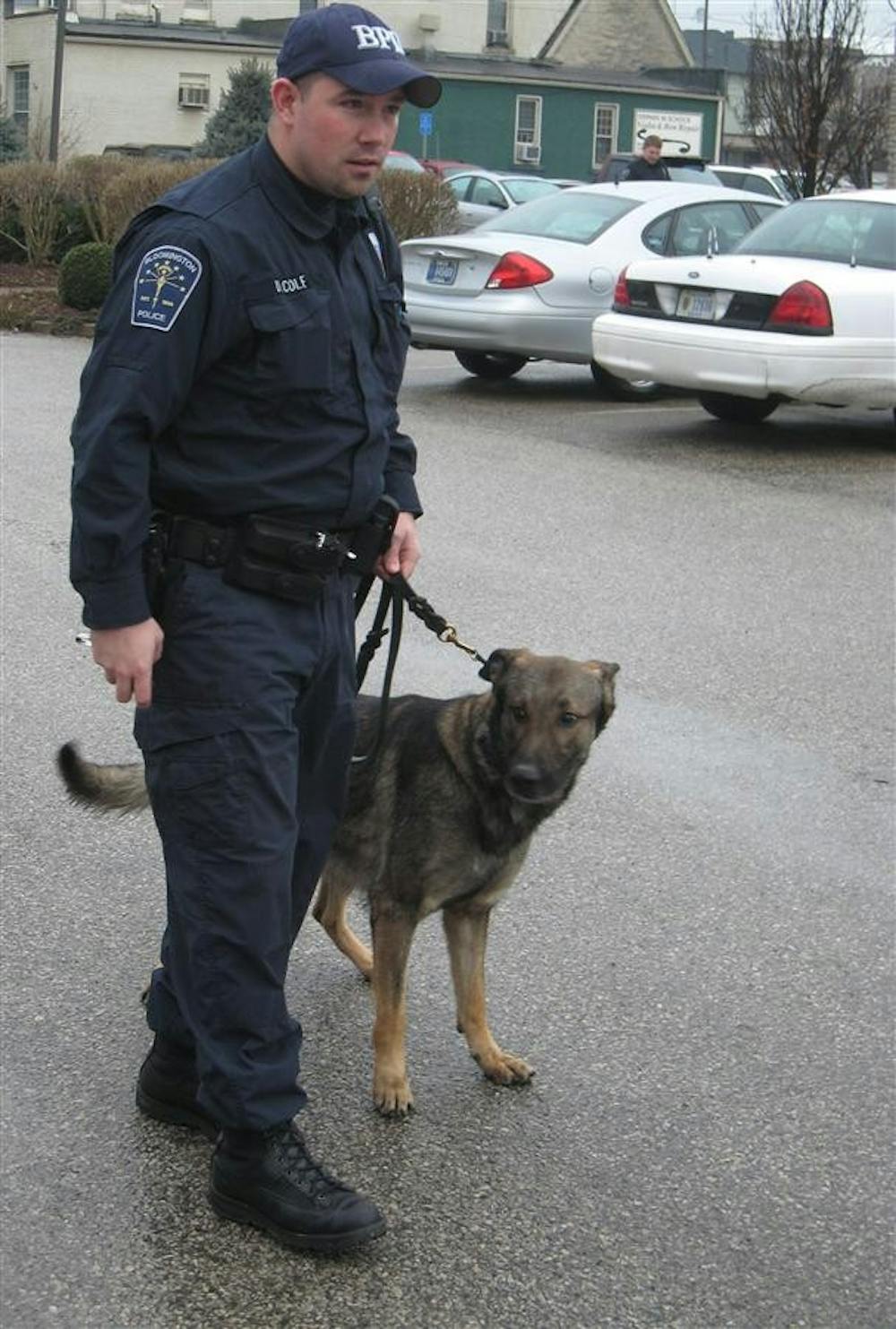
The Bloomington Police Department hired a few unconventional officers in 2009. Lesko and Pongo, both German Shepherds, became the newest additions to BPD’s K-9 unit.
As an act of public service, a local dog-training facility gave the two dogs to the Bloomington Police Department.
“We were approached by the owner of Canine Companions who said we could get the trained dogs at no cost,” Capt. Joe Qualters said.
Dual-purpose police dogs specialize in tracking, narcotics detection and criminal apprehension, said Bryan Bailey, owner of Canine Companions.
Typically, dual-purpose police dogs, including their training expense, can cost up to $20,000 each.
Lesko’s “human partner” is Officer Dana Cole. They have been working together since Dec. 9, 2009.
Cole attends to the same everyday duties as the other officers. The only difference is the large German Shepherd who rides in the back of his squad car.
BPD has had K-9 units sporadically for several years, but 2009 has seen a recent revival, Qualters said.
“One initiative of Chief (Michael) Diekhoff was to get the K-9 program running again,” he said.
Bailey is a former K-9 officer for the Monroe County Sheriff’s Department.
“(I) understand the advantages these dogs can bring to a department,” Bailey said.
Although the dogs are property of the City of Bloomington, Pongo and Lesko go home with their partners.
“After hours they are integrated with the officer and his family as any other family pet,” Qualters said.
There are many factors in determining which officers will get paired with a dog and thus become a K-9 unit, Cole said.
Cole was chosen to be a handler based on evaluations, interviews and the critiquing of his previous years of work.
Although these requirements are essential, “the dog has to be fit with the officer’s lifestyle, including the commitment of the officer’s family,” Qualters said.
Mic Foster is a trainer at Midwest Police K-9 Academy based out of Cincinnati. He is an IU grad who began training dogs while in Bloomington.
Some police departments have their own, in-house dog training facilities, Foster said. However, smaller departments, such as BPD, rely on outside trainers to provide them with trained dogs.
Although most police dogs are German Shepherds, not all German Shepherds make good police dogs, Foster said.
A good police dog will want to chase a ball for hours, Foster said, adding that it will work until it passes out.
Unlike some dogs, German Shepherds are less inclined to chase a subject off a bridge, Foster said. Rottweilers are too bulky and cannot handle heat, he added.
At Midwest Police K-9 Academy, the trainers shop from four dog kennels, Foster said. They assess the dogs for two days in the kennel, as well as in an unfamiliar setting, to make sure they are reliable.
The facility usually trains 10 dogs at a time, Foster said.
The training process lasts about five weeks, depending on what the dog is trained for.
Handlers are then introduced to their future K-9 partners and training continues, Foster said.
As far as retirement age, Lesko and Pongo are expected to stay with the department until they are between 5 and 8 years old.
Both dogs still have an expected 2 to 5 years with the department.
When that time arrives, their handlers have the option to adopt the dog from the city for $1, Cole said.
The $1 fee is a purchase agreement in which the city states it is no longer liable for the animal.
“It is environmental soundness and drive that separates your average dog from a police dog,”
BPD K-9s fight narcotics in Bloomington
Two K9s vital to BPD's fight against crime
Get stories like this in your inbox
Subscribe