Although the H1N1 pandemic shouldn’t be taken lightly, it’s just another wave in the many epidemics IU has seen. The IU Archives has preserved it all, from the Spanish Influenza during World War I to Measles and AIDS in the 1980s.
Spanish Influenza, 1918
In January 2009, some students were overjoyed when University officials cancelled classes because of the weather. But when the school was closed Oct. 10, 1918, the feeling was hardly similar.
According to the book “The History of Indiana University,” the school was closed due to the outbreak of Spanish influenza, especially among the Student Army Training Corps. At that time, the SATC consisted of about 1,200 of the 2,000
student population.
The order to close the school came from the Indiana State Board of Health and was supposed to last until Oct. 20 but instead lasted until Nov. 4, 1918. Although other students went home, those enrolled in the SATC had to stay on campus in barracks, according to the book.
The cases increased at such a significant rate that the main floor and balcony of the old Assembly Hall, razed in 1938, and the auditorium floor of the Student Building were filled with hospital beds.
In total, 350 patients were hospitalized, and there were three deaths.
Legionnaires’ Disease, 1970s
IU’s Jordan River was a hotbed for Legionella, the bacteria that causes the potentially fatal Legionnaires’ disease, from 1977 to 1979.
Legionnaires’ disease is a severe form of pneumonia.
Though the disease affected only one student, more than 30 people contracted it because they had one thing in common: They all stayed at the Indiana Memorial Union hotel.
“The disease spread through the vents in the hotel,” said University Chancellor Ken Gros Louis, who has been at IU since 1964.
The Centers for Disease Control and Prevention in Atlanta found the origin of the bacteria was from the cooling tower above the hotel and the nearby Jordan River, according to an Aug. 1978 IU press release.
To solve the problem, the CDC advised the University to use bleach to eliminate the bacteria found in the cooling tower and the river, according to the news release.
There were 36 total cases and four were fatal, according to a June 1979 Indiana Daily Student article.
Measles, 1980s
It was a measles outbreak in 1982 that affected the University en masse, said Hugh Jessop, who was the director of Health and Wellness during that time. A student most likely “brought” it on campus without his or her knowledge, Gros Louis said.
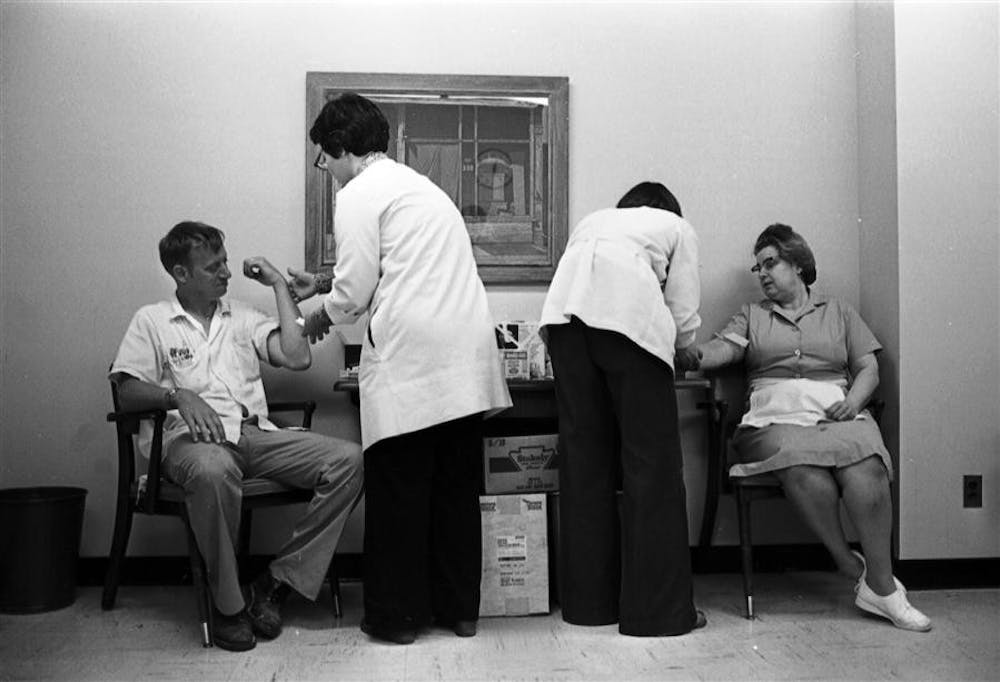
For six to eight weeks, about 26,000 students, staff and faculty were immunized, Jessop said. There were no deaths.
AIDS, 1980s
In the same year as the measles outbreak, a newly diagnosed and frightening virus hit the whole country: HIV/AIDS.
“There was a lot of anxiety,” Gros Louis said.
So how does the school fight a disease for which there was little information? In 1986, the answer came in the creation of the AIDS Task Force.
Jessop said the task force organized several programs to inform students. Some of its biggest events were the AIDS Awareness Week in fall 1987 and the Condom Sense Week in spring 1988.
The task force worked quickly to inform the students, Gros Louis said.
Some of that work included creating pamphlets, Jessop said. But, he said, it was difficult because there was no standard information about the disease, and the current information was constantly changing.
In November 1989, Planned Parenthood workers installed 41 condom machines throughout the bathrooms and laundry rooms of the residence halls, according to a Nov. 3, 1989, IDS article.
The article said the money generated would be used for education about AIDS and sexually transmitted diseases.
In a follow-up article one year later, only about 20 condoms were purchased a day and 11 of the 41 machines had been vandalized or stolen from. Thus, the company canceled its contract with the school, Jessop said.
Although the epidemic troubled the country, Gros Louis said the fear on campus passed reasonably quickly because the number of cases was not spreading at a significant rate.
“The task force closed down in early 1990s, after a standard of education was already available through other means,” Jessop said.
H1N1, 2009
Although not as widespread as the influenza in 1918, H1N1 is still a concern to University officials.
“Each time there is a flu outbreak, it’s an epidemic,” Jessop said.
Just as free shots were offered in 1919 for the Spanish Influenza and for the measles in 1983, the school will offer the same service for this virus. It will be free because the federal government, not the school, purchased the vaccine, Jessop said.
“Hopefully the immunization process will go more smoothly than it did in 1983,” he said.
H1N1 only latest in line of Bloomington outbreaks
Get stories like this in your inbox
Subscribe