
Tami Goodrich met her first colony of bees on a Saturday.
In her borrowed truck she drove more than an hour down country roads to Hunter’s Honey Farm in Martinsville, Ind. It was pickup day.
One of the first sounds she heard as she got out of the car was buzzing. Not an occasional zip from a bee passing by, but the din of thousands of bees humming in unison.
She picked up a wooden crate of bees, not sure whether it was her nerves or the energy of the hundreds of flying insects caged in her hands that sent the vibrations pulsing through her fingers. The box was going to pick up and fly away, she just knew it.
Excited and nervous, she drove the truck out to her new hive and then went to suit up.
Her vision blurred as adrenaline pumped through her veins. She was a Kelley School of Business professor, not a professional beekeeper.
“Well,” she thought as she rallied herself one last time, “no one else can do it, no one else knows how.”
She pried open the box and turned it upside down, letting a stream of honey bees flow into the hive as fluid as a stream of water.
As the bees pooled on top of the hive, Goodrich hyperventilated. They were home.
***
It’s a familiar feeling for many Bloomington beekeepers—the amateur nervously picking up her first “nuc” (short for nucleus) of bees.
Despite the increasing disappearance of honeybees—a result of a mysterious and deadly disease called Colony Collapse Disorder—beekeeping remains a popular hobby.
Some don the helmet and veil to produce their own honey, others use the bees for pollinating gardens, and some just enjoy watching the tiny creatures at work.
Approximately 160 million pounds of honey were produced in the United States in 2008. Most of the roughly 125,000 beekeepers across the country are located in rural areas and small towns like Bloomington.
It’s a hobby that cuts across profession, gender and age.
Beekeepers are parents and neighbors. They are elementary school teachers, authors, journalists and lawyers. They are even university professors, like Goodrich.
Nothing about Goodrich screams beekeeper. Sitting in her cramped office in the IU Kelley School of Business where she teaches a course in business and technology, she leans over her computer.
Her fingers fly over the keyboard as she wraps up the last e-mails of the day.
A few family photos and a plastic stone fountain are all that give the office a hint of personality. But when she talks, she exudes vivacity and earthiness.
Goodrich’s path to beekeeping, like most of her activities, was a practical one. She grew up in a poor family; her parents’ knack for gardening helped sustain the family and this skill was passed on to Goodrich and her sister Jami.
After years of fighting allergies and working in gardens, Goodrich decided to attend a two-day beekeeping workshop in the dead of winter.
Honeybees, she knew, would not only increase pollination in the garden by 500 percent, but would help with her allergies. (Pollen collected locally acts as an immune booster). Four months later she owned her first hive.
***
In the kitchen, Goodrich laces up chunky brown hiking boots, stuffing the cuffs of khaki pants into thick green socks.
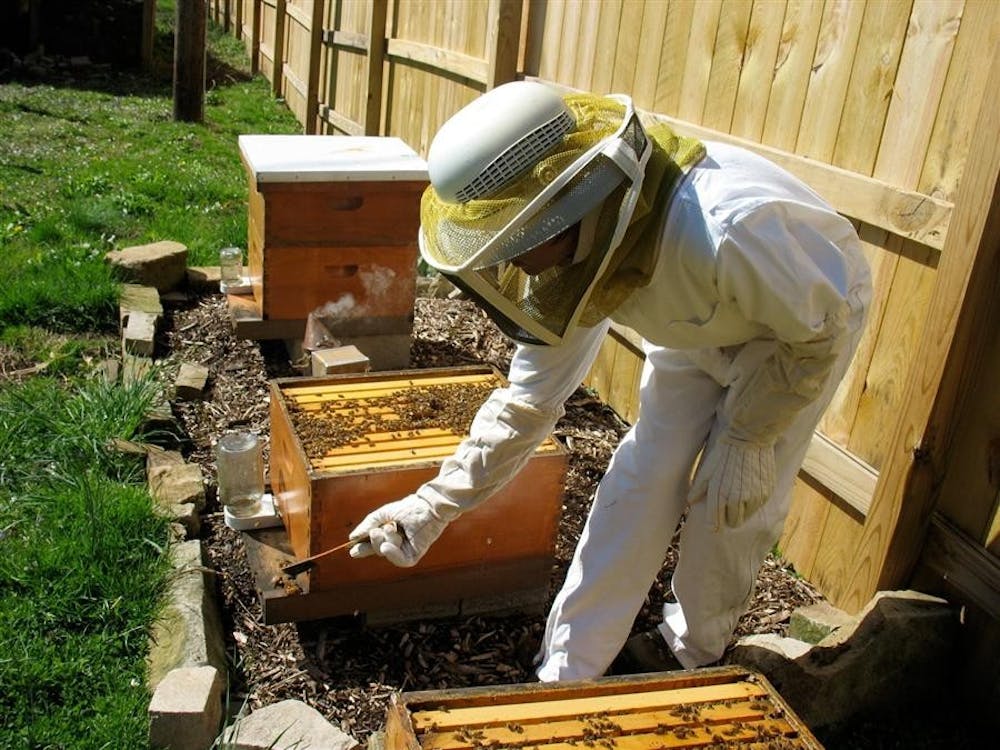
Every part of her body is covered. A bright blue turtleneck shields her neck and arms, a white hat and veil cloak her face and hair. The final touch is a white, full-body suit reminiscent of a painter’s uniform or a straight jacket.
For weeks she’s been waiting for a sunny day to open her two hives for the first time of the season.
Beekeeping isn’t a time-consuming hobby – Goodrich only spends approximately 15 minutes a week with the bees after her initial inspection – but good weather is crucial.
Weeks of rain and clouds have prevented her from checking the hives for signs of disease.
Finally it’s perfect: sunny and a high of 60 degrees.
Since her first experience with bees four years ago, she’s moved to the south side of Bloomington and dotted her one-acre property with gardens.
She planted a robust orchard full of apple, pear, apricot, persimmon and crab apple trees in addition to spring and summer gardens. She even married and had a daughter.
Two-year-old Morgan wanders into the kitchen, baby doll in hand. She drifts over to a pink, doll-sized stroller and tucks in the baby.
“We’re going to go out to the beehive okay?” Goodrich tells Morgan, shoving strips of burlap into her pockets. “Can you stay inside for a little bit?” Morgan just looks up at her adoringly.
Goodrich pops in a movie and grabs the smoker, a metal watering can stuffed with burning burlap. Then she walks out her creaky backdoor down the sloping lawn where her beehives wait undisturbed.
***
Bees are scaling and descending, entering and exiting the older of Goodrich’s two hives as she begins to scrape away burr comb, a waxy substance.
The hives are nothing fancy, just wooden crates that look more like desk drawers than bee condominiums. Each hive is made up of two boxes—called honey supers—with a half dozen frames inserted inside to collect honey.
Smoke from burning burlap showers the hive to distract the inhabitants. For now the bees are docile; they’re used to company.
“I’m building up my confidence,” she says laughing. “They’re being pretty good right now.”
She moves around the hive, lifting out a frame, inspecting it, placing it on the ground.
A couple more puffs of smoke. Every couple of minutes she’ll step back, not far, but enough to give the bees some space. It’s the novice beekeepers dance. Two steps in, pause, rotate a little, three steps back. Repeat.
In the yard Milo, the family’s sandy-colored cat, skulks near the hives. He is impervious to the flying, stinging insects circling his head.
He starts to dance, too. Move in closer, bound back when a bee zings off his fur, re-approach.
The bees still give Goodrich the creeps.
She’s only been stung four times, but there’s still something about them that causes a surge of adrenaline each time she unglues the sticky hive and lifts out the bee-coated frames. Sometimes she’ll talk to them or ask them how they’re doing.
“Watch out,” she coos to a bee in the way of her scraper. “You better move.”
Morgan appears, her tiny body framed against the bright green door.
“Morgan, honey, stay inside. You can stay up there with Milo.” But the toddler is fixated.
***
Goodrich knew there was an elusive Bloomington bee club out there. If you look close enough, Brown County is full of bee-culture.
Take Susan Brackney, a local author and prominent journalist. She’s been keeping bees in her backyard since 2003. She even wrote a book called “Plan Bee” and has a bee Webcam.
The WonderLab Museum of Science, Health and Technology features a working hive, tended by volunteer beekeepers, for kids to learn about honeybees.
At least two Indiana vendors sell honeybee products at the Bloomington Farmers Market, and future keepers can learn from pros at area “Bee School.” And then there’s the 10 O’clock Bee Line Beekeepers Club.
They don’t try to be secretive, but most Bloomington natives have never heard of them.
Founders Tony Gaudin and Mark Partridge, both Brown County residents, started the club—based out of a Yahoo! Groups—about a year ago.
They meet once a month at in Nashville, Ind., but their online message board buzzes with bee news. They talk about everything from the triumphs and perils of their own hives to bees in the news and the Obamas’ White House beehive.
Maybe one day Goodrich will join them.
***
As birds chirp overhead, Goodrich moves over to her second and newest hive. She doesn’t know what to expect. These bees are strangers to her, the next-door neighbors she’s meeting for the first time.
A gift from Goodrich’s sister Jami, they moved here from the WonderLab about a year ago. She accidentally knocks the hive, causing it to teeter on the cinderblocks elevating it off the ground.
“That’s earthquake!” she says, joking with the bees.
She lifts off the lid of the honey super, begins to inspect, and pauses.
“This hive’s dead.”
She sighs, her countenance changes. This has never happened before.
“This is really sad, this is terrible.”
The remaining bees are frozen in place. They look like they could fly away at any second. Some are stuck in the honeycomb, little yellow and black bodies wedged into crevasses with only their butts peaking out.
“These, these are babies,” she says solemnly. “They couldn’t get fed. They didn’t get fed.”
It’s not uncommon for beekeepers to lose a hive. With Colony Collapse Disorder sweeping the country and wiping out colonies of bees, death is an all too common occurrence.
But it doesn’t make the reality any easier to grasp. She never got to know them.
Goodrich doesn’t know what caused the death of her hive, but she doesn’t think its Colony Collapse.
There was no sign of mites, another common problem for beekeepers. Her only possible culprit is a wasp that had been haunting—and possibility stinging—the bees.
“Sometimes you just have to say, that’s what it is,” she said a week later. “There was nothing I could point to.”
***
Morgan climbs through the back of a wooden kitchen chair. Her blond hair glows from the sunlight filtering in through the kitchen window. Goodrich is standing in the kitchen pulling spoons out of her forest green cabinets.
She brings over a tray of honeycomb straight from the hive and sets it in the middle of the round kitchen table. She scrapes off the caps of the honey, revealing a dark amber liquid. She scoops a little with a tiny spoon and hands it to Morgan.
The 2-year-old thrusts it into her mouth, sucking on the spoon like a lollipop. Morgan goes back in for more, digging out honey and sucking off every last drop. She almost scoops up a honeybee stuck to the comb.
“She learned how to say ‘honey’” really fast,” Goodrich said.
It’s early afternoon—lunchtime in the Goodrich house—but all Morgan can focus on is the honey.
“You want some rice?” Goodrich asks plaintively. Morgan only points to the pot of honey sitting on the bright yellow countertop. Two spoons clenched in her right hand, she looks more like a tiny dictator than a toddler.
For Goodrich, honey is only a perk to the health and pollination benefits of owning bees. In fact last year she bottled and sold her honey to raise money for a non-profit.
Goodrich rushes around the house, gathering up library books to return later that afternoon. When it comes to the bees, all she can do is wait.
Soon she will borrow another truck and drive the hour and a half to Hunter’s Honey Farm. She’ll feel the vibrations of millions of beating wings rush over her hands as she watches a new stream of bees glide into the hive.
She’ll welcome the new queen to her kingdom. And, she’ll wait, hoping that her new neighbors will learn to call her hive their home.
Kelley School of Business professor leads secret life as beekeeper
Get stories like this in your inbox
Subscribe



