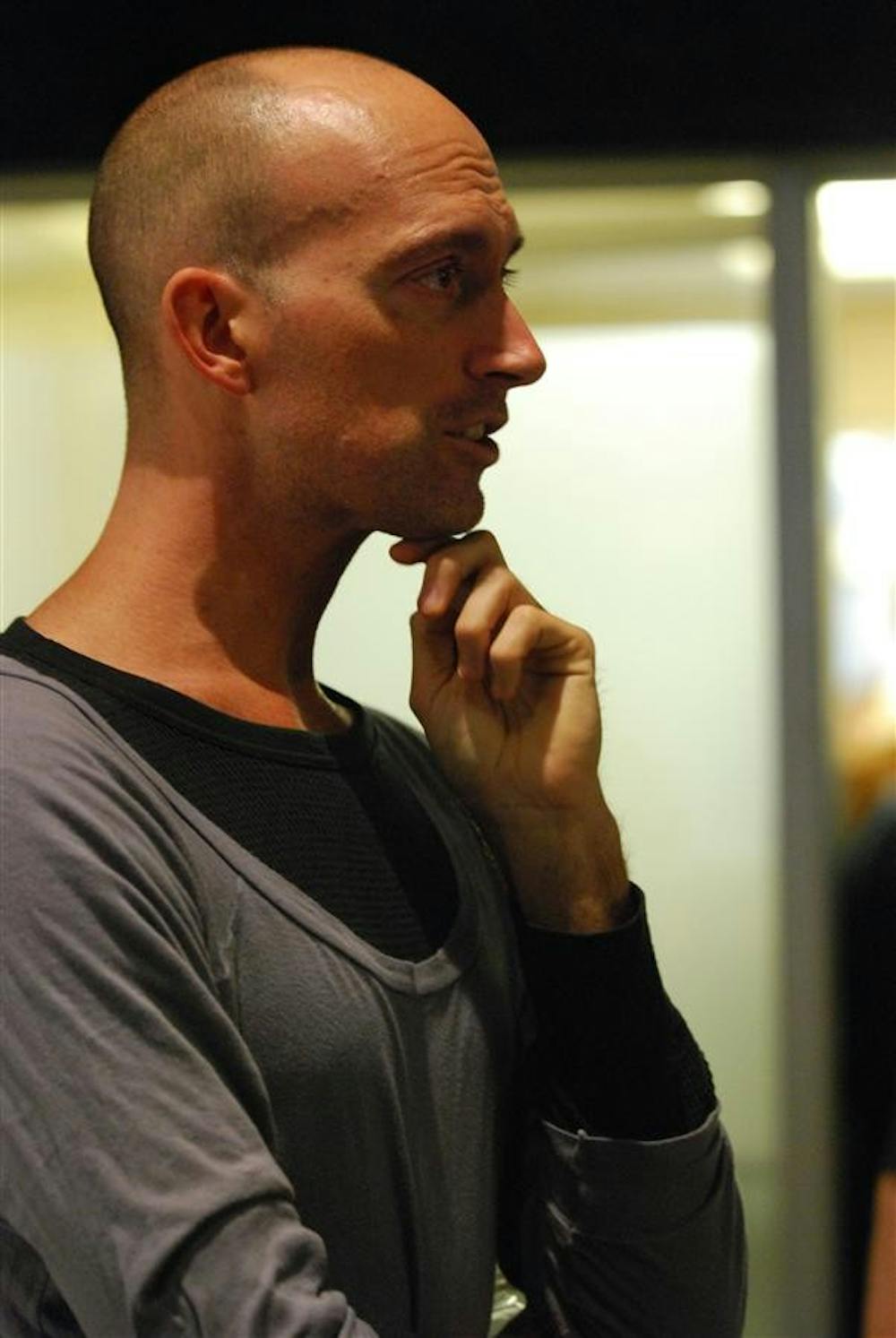
Fritz Haeg wants to break all the rules in a world where front lawns have become a staple of suburban life.
“Everyone has a front lawn – it’s a unifying thing,” Haeg said. “It’s an industrialized thing. There is no room for self expression in the front lawn.”
Haeg, an architect and an artist, gave a lecture titled “Welcoming the Wild” on Friday at the School of Fine Arts to discuss his evolving projects, Edible Estates gardens and Animal Estates.
The lecture was in conjunction with the ongoing SoFA gallery exhibit the “Canary Project: Works on Climate Change 2006-2009.”
The Canary Project addresses the issue of climate change through the use of varying forms of art. The exhibit, which opened Sept. 4 and will conclude Oct. 9, features photographs of Haeg’s Edible Estates project in Maplewood, N.J.
The Edible Estates project was founded in 2005, when Haeg began work with what he said are avid and seasoned gardeners in different parts of the country to turn front lawns into edible landscapes. The plants used for each garden were usually donated, and volunteers helped with the labor.
“We divided the country into nine squares to use as prototypes, to show that you can grow a garden in each geographic area,” Haeg said. “We wanted to plant where there was a vivid contrast to the area around the garden. They are meant to be models and cheap, so that people can look at them and feel they can do the same.”
Haeg said he keeps track of each garden’s progress, from the first landscape design to the garden’s growth years later.
“The gardens are turned over to the owners, and they keep journals and send pictures,” Haeg said. “I just make museum displays and communicate with the public.”
The photos and firsthand accounts, along with essays by various authors, have been put into a book titled “Edible Estates: Attack on the Front Lawn.” Haeg said a new edition of the book will be released in spring 2010 to include the most recent gardens.
Canary Project co-founder Edward Morris introduced Haeg to the audience and explained that Haeg’s passion and focus on sustainability for food production is what drove Morris and co-founder Susannah Sayler to connect with the artist. But he pointed out that Haeg is not necessarily working toward the same goal as the Canary Project.
“Fritz’s work is not about climate change,” Morris said. “He will withstand the efforts of the Canary Project to box him in.”
Bloomington resident Cheri Glaser said she was inspired by Haeg’s project, but she attended the lecture because of the differences she saw in their shared passion for gardening.
“He seems flexible and creative,” Glaser said. “I’ve been building gardens for years, too. He’s more of an artist, I’m more of a ‘dig-in’ girl, a get-your-hands-dirty person. And I’m concerned about the environment.”
Haeg’s more recent project, Animal Estates, stemmed from what he said is a love of animals he has had since childhood and his training as an architect.
With the help of researchers, Haeg builds homes, or habitats, for animals that once inhabited cities such as New York, where the project debuted in 2008.
The habitats are displayed in exhibits and museums to help raise awareness.
Haeg said he believes Edible Estates and Animal Estates are closely related because they stem from the goal of bringing nature to everyday lives.
He said he believes college students can play a role in this as well.
“It’s about paying attention to where we live,” Haeg said. “I like the idea of students taking charge on campus, questioning the administration about where their food comes from.”
Graduate student Sharon Lindenfeld said she attended the lecture as an artist but came away with much more.
“I want to make a garden now,” Lindenfeld said. “I have no talent for it, but one day I will have one.”
Garden project calls for ‘getting dirty’
Get stories like this in your inbox
Subscribe