WE SAY IBM’s failure of our welfare system only means so much.
Because of an increasing number of complaints, the Indiana Family and Social Services Administration issued a “corrective action plan” June 7 that threatens to cancel its contract with IBM to help manage Indiana’s welfare system.
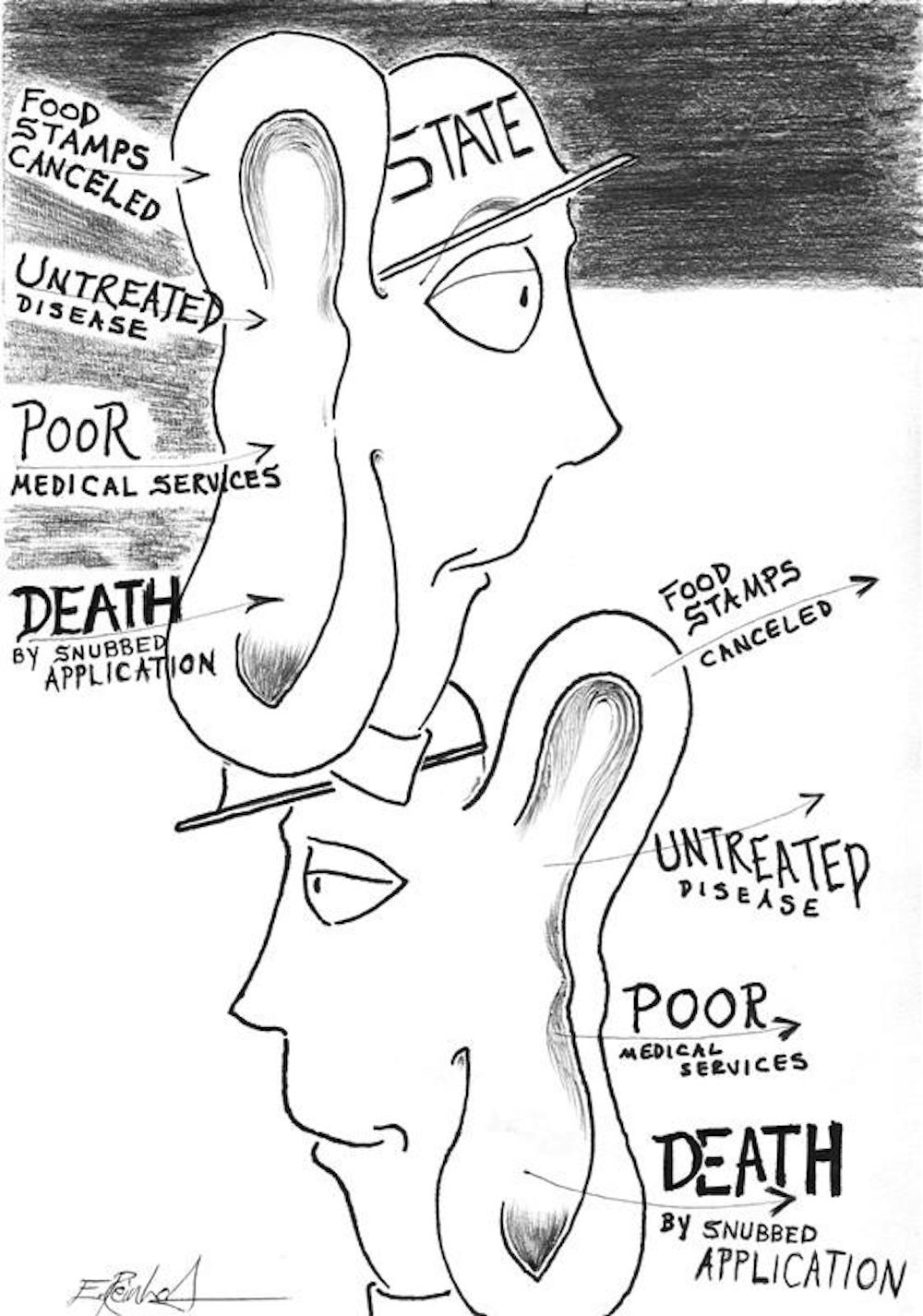
Legislators establish the criteria for who’s eligible for government assistance. However, those who actually authorize applicants’ aid determine who receives it. And unfortunately, since IBM has been given the reins of Indiana’s welfare system, it has severed eligibility for Hoosiers to Medicaid. Charles Warren, chairman of the Indiana Institute for Working Families’ advisory committee, said applications were rejected for flimsy reasons such as lost paperwork.
The Family and Social Services Administration has issued IBM requirements that must be met in order to maintain the contract, including instructions to speed up the approval of applications and reduce errors – whether that be lost paperwork or denying Hoosiers aid they deserve.
If improvements aren’t made, cancellation of the 10-year contract could take place as early as this fall.
Gov. Mitch Daniels pitched the privatization of the welfare system as a savings of $1 billion through technology because “the system allows applicants for public assistance to apply over the telephone or a computer as well as in person during extended hours, but applicants no longer are assigned caseworkers,” according to an article in The Indianapolis Star.
All across the country, even at the federal level, policymakers have been watching closely. Indiana’s success – or failure – is viewed as the harbinger for any future attempts at recreating savings in welfare systems by eliminating the need for government case workers and reducing administrative costs. The only other state to attempt privatizing its welfare was Texas, which failed in 2007, about the same time Indiana made a contract with IBM.
The failure of IBM (and it has been a failure) in the recent months shouldn’t be attributed to privatization in general, but to IBM. From the start, only two companies, Accenture and IBM, bid for the contract. There was little competition for the bid, and Accenture was the contractor that failed Texas.
Privatization isn’t incompatible with welfare, either. Ninety-four percent of the Family and Social Services Administration’s budget goes to contractors, and IBM only makes up two percent of that budget. No, this was a failure of IBM, whose complicated system confused too many Hoosiers.
Poor performance and a failure of technology doesn’t mean that case workers will be the only effective solution in the future. Poor technology can only lead us as far as to say that we currently have poor technology.
On notice
Get stories like this in your inbox
Subscribe