
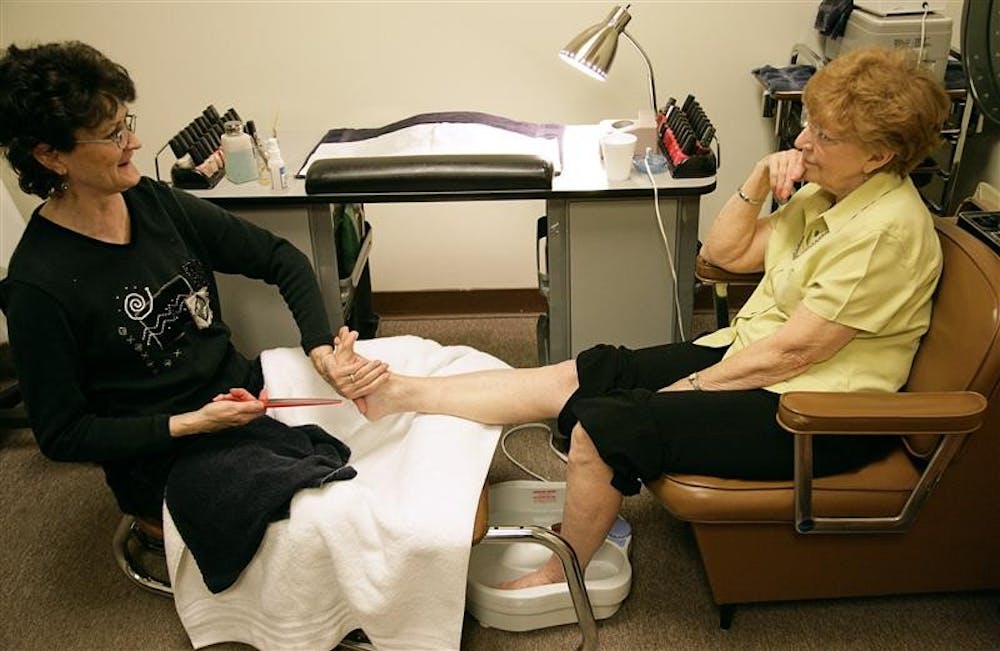
At 10 a.m. Friday, Deborah Deckard finished up a manicure for one of her clients at the salon in Macy’s in College Mall. The rest of her workday will likely include a series of manicures, pedicures, haircuts and dye jobs.
No big surprises here, especially compared to her previous jobs in the Middle East where sporadic bombings from neighboring cities would shake the walls.
Deckard returned to Bloomington this November after serving for a year and a half on her second tour of duty for the National Guard at the Forward Operating Base in Mosul, Iraq. In 2004, Deckard was in Kabul teaching members of the Afghan army how to properly maintain and repair AK-47s.
As she settled back into her routine at the salon, Deckard recognized that the transition from military life to civilian life is extremely difficult – and that coming home is not always a relief.
“When you first get back, you’re really hyped because you want to see your family – obviously that’s the biggest thing,” Deckard said. “So at first you don’t notice that there’s anything wrong. It doesn’t usually hit you until you’ve been home for a few days or a week. You could be around a lot of people and suddenly you want to back off and sort of withdraw.”
Deckard said she is sometimes overwhelmed with anxiety about facing the day as she gets ready for work in the morning. Even worrying about what clothes to wear and what to eat are foreign concepts after living in the structured and regimented environment of the military.
“It’s totally different when you come back,” Deckard said. “The transition is very difficult because your life is so simple over there, other than worrying about, of course, staying alive.”
Deckard said she knew what she would be doing every day in Iraq and Afghanistan. Someone planned her meals, laundry and daily routine, which contained very little variety. A day at the salon represents many unknowns, and Deckard said she often finds herself craving the consistency, structure and simplicity of military life.
“I’m happy to be back at work. I’m happy to see my clients and co-workers, but sometimes the transition is a little bit more than I wanted it to be,” Deckard said.
For Deckard, the most difficult part of being overseas was missing out on important events. Between her two tours of duty, Deckard missed her stepdaughter’s wedding, the birth of her first granddaughter, her first wedding anniversary and the death of a close friend she had known since junior high school.
“Even though death is all around you over there, it’s a different sense of death than when you hear of a death back home because you haven’t done the visual for closure,” she said.
Deckard said she does not regret her decision to join the National Guard. She said she believes Iraq and Afghanistan are worthy causes. Deckard was constantly in contact with villagers in Afghanistan living in areas of extreme poverty. Some lived in cardboard shacks with dirt floors.
In the winter, many were unable to afford adequate clothing.
“You see a small child running around in the snow with no shoes and no coat. It just breaks your heart,” she said. “You can hardly stand it.”
Deckard said Iraq’s climate was constantly sweltering, unlike in Afghanistan, where there are four seasons. It wasn’t unusual to experience temperatures in excess of 130 degrees. In many areas there was no electricity and thus no way to refrigerate food. Frequent sandstorms cloaked the land with a gritty veil that made it impossible for Deckard to see her own hand.
“When you have an opportunity to go to a third-world country, which I think everybody should do, I think you realize how fortunate you are at home,” Deckard said. “You might complain that you lost electricity for three or four hours, but what would it be like if you never had electricity? What if you had electricity and all of a sudden they took it away from you?”
After returning from Afghanistan and Iraq, Deckard said she often encounters people with negative attitudes about America’s involvement in both countries. She said she understands these opinions, but she said she believes there is a widespread tendency to ignore the positives.
While she was there, Deckard saw schools and hospitals open their doors to villagers who had never before had access to education or medical care. She saw women in Afghanistan participating in democracy for the first time.
“They’ve been at war for thousands of years,” Deckard said. “That’s all they know, and that’s what they hand down to their children. You hope that with the education they are going to learn about history and that there are other options in life.”
Although she loves being home with her friends and family, Deckard said she sometimes wishes she could go back.
“I have doubts. Can I still do this? Do I really want to still do this?” she said. “After you’ve been in a position where you’ve felt like you’ve done so much or helped another country and you’ve done some positive things, you come back here and you think ‘Am I really doing enough?’ You don’t feel like you’re giving what you should be giving anymore because there, you’re doing so much.”
Living a double life
Get stories like this in your inbox
Subscribe



