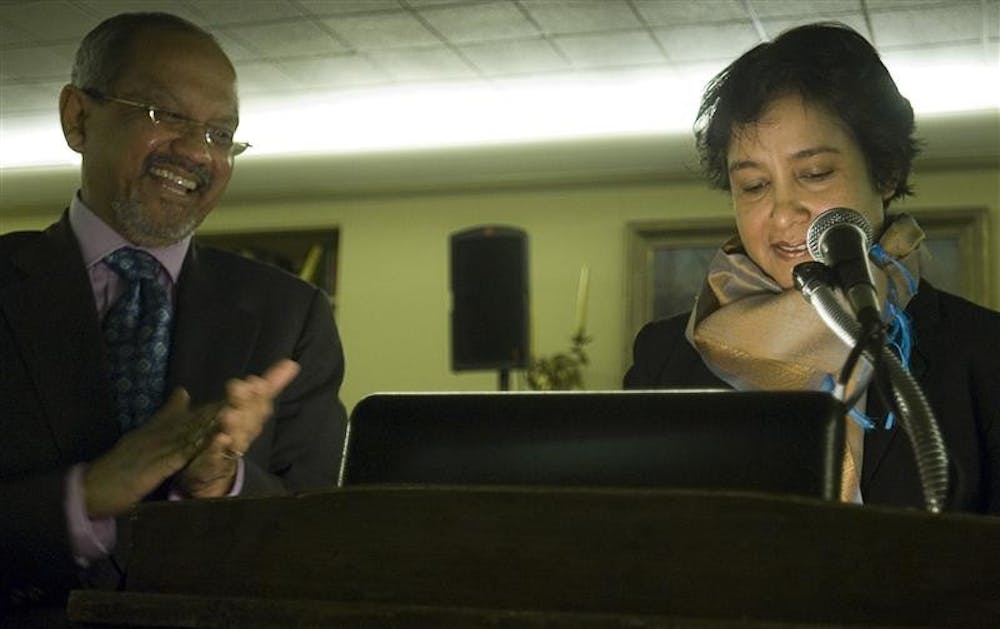
Taslima Nasrin, author and women’s rights activist, described the vast inequalities and injustices fellow Bangladeshi women continue to endure in a speech Friday.
Women are barred from being educated, inheriting property and taking legal action against their husbands, all of which are abuses sanctioned by Islamic law and tradition, Nasrin said.
A blend of men and women representing many countries and religions crowded into the Faculty Room at the Indiana Memorial Union on Friday evening to hear Nasrin’s lecture, “My Life: A Struggle for Equality.”
Nasrin delivered a provocative speech focused on her life story and the oppression of women in Islamic countries around the world.
“If a dog is beaten in the street, people say, ‘We should not do this.’ But when a woman is beaten by her husband, no one says anything,” she said.
Driven into exile for 14 years because of her views, Nasrin still faces threats from the Bangladeshi government and some Muslims who strongly oppose her views.
She has continued to publish books and poetry while living in hiding in various locations.
“I have no home,” Nasrin said. “I am homeless everywhere.”
She did not know her opinions would drive the Bangladeshi government to throw her out of the country. But even if she had known, Nasrin said she would have done the same thing.
“It is very difficult not to be able to walk in the streets, but it is my life. I have to accept it. Society is not ready to allow different views,” Nasrin said of her experience living in exile.
Though she does not believe her dream of equality and justice will be realized in her lifetime, Nasrin said she will keep fighting until she dies, no matter what the cost.
“I dream of a beautiful world where no women are oppressed,” she said. “I have been writing to make my dream come true; my pen is my weapon in such a fight for a secular humanity. ... If there is no right to freedom of speech in an Islamic society, is there any real hope of progress for that society?”
The audience seemed to share Nasrin’s views about the atrocities committed against women in Bangladesh and other eastern countries, but the room filled with uneasy whispers when she announced she is an atheist.
Accusing someone of having no religion is one of the worst insults in Islamic countries, said Steven Raymer, associate professor of journalism and India studies. Though her parents attempted to raise her as a Muslim, Nasrin said she rejected Islam because she disapproves of the way the Koran portrays women.
Essential to equality and justice, she said, are the secularization of government, separation of church and state and the rejection of Sharia, the Islamic legal system.
“In order to fight for women’s rights, I had to criticize Islam,” she said.
This is because oppression of women in Islamic countries is systemic, deeply embedded in the laws, culture and traditions, she said.
Her lecture called for a secularization of Islamic law and society, with views rooted in firsthand experiences of censorship, oppression and abuse.
Graduate student Jaime Kucinskas attended the lecture specifically to learn about oppression and inequality from an important figure with direct knowledge.
“It is difficult to comprehend the extent of inequality, both cultural and institutional, in other parts of the world,” Kucinskas said.
Kucinskas first became interested in the topic when she served in the Peace Corps in Bangladesh in 2005.
Kucinskas was forced to return to America after six months to escape bombings by Muslim fundamentalists who were targeting women’s schools like the one in which she worked. She hopes to return someday and see more justice and equality for Bangladeshi women.
After the lecture, Nasrin read one of her poems inspired by a Bangladeshi woman who was publicly stoned to death for suspected adultery. The poem is both an exposure of a brutal and misogynistic execution and a plea for women to unite and speak out against such practices.
Softly but powerfully, Nasrin read, “They are throwing stones at Noorjahan, stones that are striking my body. I feel them on my head, forehead, chest, back. ... Are these stones not striking you?”
Bangladeshi author speaks on time in exile
Get stories like this in your inbox
Subscribe