
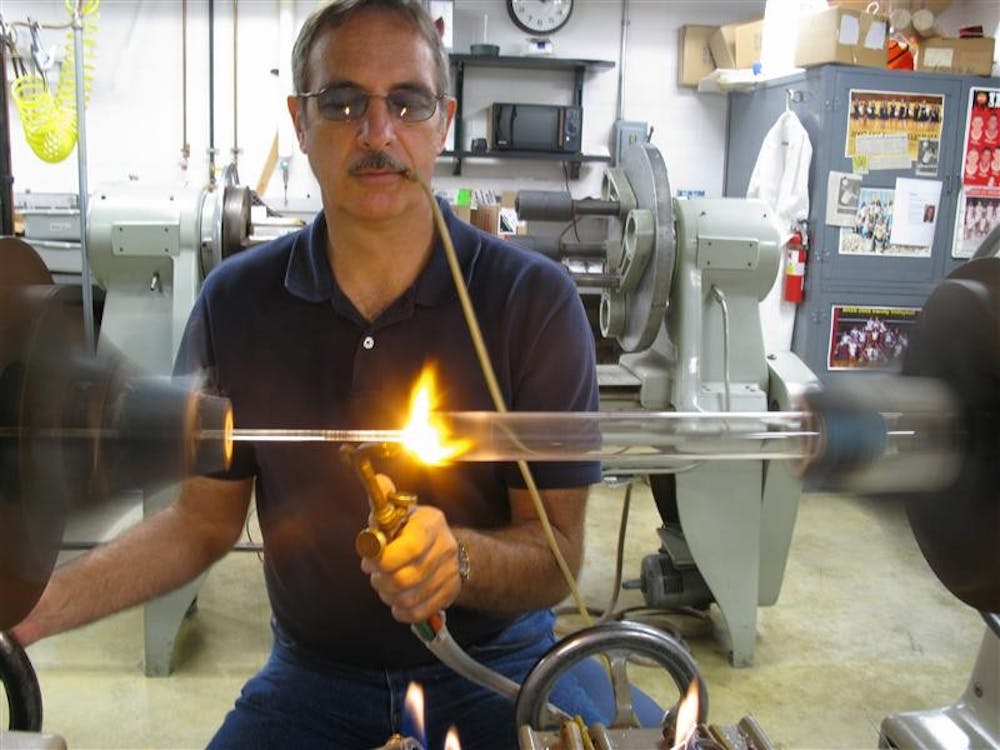
Deep in the recesses of the chemistry building, Don Garvin is equipped with ovens, lathes and other tools to make glass objects for researchers in the classrooms above.
Garvin is one of only three university glassblowers in the state and the only one for the IU system. Notre Dame and Purdue have staff glassblowers as well. Garvin serves the chemistry, biology, psychology, physics, geology and other departments on all eight IU campuses.
“The research side, they may have some experiment that they’re wanting to run and they need a piece of glass that doesn’t exist,” Garvin said. “It’s kind of like building a puzzle and solving a puzzle. You kind of say, ‘OK, we’re at step A, we know we need to get to step D, but we have no idea what B and C are.”
As he walks from a work bench to a lathe, Garvin’s sneakers scuffle across the floor. In one corner, air whooshes through vents and in another water gurgles through pipes. The shop appears relatively quiet, but Garvin said students, faculty and friends stop by throughout the day.
“People come in and are either picking up jobs or dropping off jobs or are inquiring about things,” he said. “So there’s always somebody coming through the door.”
IU’s decades of glassblowing
Garvin has been at the glass shop since 1986, and the IU Glass Shop has been around since the late 1930s, according to the IU Archives.
According to the “Development of Chemistry at Indiana University in Bloomington 1929-1991” by Harry G. Gay, one person had the most influence on the shop.
“It arose in one man,” Day wrote. “Earl Sexton.”
Sexton, who is about to turn 93 in February, still lives in Bloomington with his wife. His home is filled with glass vases, figurines and even a couple of glass spider webs. He said he remembers working at the glass shop when it first began.
The shop made equipment including cannulas, or medical tubes, for animals, Sexton said.
“I guess we made them a little bit better than the factory was making them,” he said.
And it’s true. Both Sexton and Garvin said objects made at the glass shop have been patented and put in catalogues throughout the years.
Paper plans to glass pieces
The glass pieces can take from a day to a week to make, Garvin said. He has various scraps of paper with rough sketches of objects, which researchers and faculty members bring to him. After looking at the drawing, he decides what kind and size of glass tubing to use as well as how he’ll go about making the object.
The process can involve spinning the object on a lathe, working manually over a burner and even setting the glass pieces in an oven. Garvin has worked with temperatures up to 1050 degrees.
As Garvin took out a handful of laminated photos and flipped them, he described a particularly memorable glass. About eight years ago, a member of the Mohican tribe came to IU to give a concert. When the man arrived with a glass flute, he had a bit of a problem. He went to Garvin and they opened the flute case.
“It was in a hundred little pieces,” Garvin said.
Over the course of several days, Garvin went to work reconstructing the flute and finished just in time for the concert.
Because university glassblowers are relatively rare, both Garvin and his adviser Dan Mindiola said the service is a great recruiting tool for both students and faculty.
Glass making and repair costs are more expensive at universities that don’t have glassblowers, Mindiola said.
The chemistry department and University subsidize the shop’s costs, he said.
Equipment costs are rising, Mindiola added, which means if the shop loses customers, it could be discontinued in the future. However, he doesn’t think that will happen any time soon – Garvin receives requests not only from people at IU, but also from other universities around the country and even overseas.
“This facility is highly regarded outside of the University,” Mindiola said, attributing this to Garvin’s glassblowing skills.
Professional glassblowing
While one would think an inherent love of glass would draw a person to blowing glass as a career, Garvin said he simply heard about the position while working in the chemistry building stockroom. The glassblower before him, Don Fowler, was looking for an apprentice, so Garvin decided to give it a go. Garvin said Fowler’s guidance ignited Garvin’s interest in glassblowing.
Sexton experienced a similar job path – he also heard about the position while working in another area of the chemistry department. But after explaining how he arrived at the glass shop, he sat quietly for a moment and began to tell a story about going to a carnival when he was a child.
“There was a glassblower there,” Sexton said. “I can still see and still think about that ... my mother could hardly get me away from that booth. Now, whether that had any impact on me, I do not know. But I still think about that, though.”
The career path for a glassblower is not the average one, Mindiola said, adding that the career is like those passed from generation to generation. He said he jokes about Garvin being a “dying breed.” In fact, Garvin, who is about 10 years from retirement, said he is thinking about asking the department for an apprentice.
“It’s not one of these careers you take a couple courses in at a technical university and get a degree in,” Mindiola said.
Garvin usually makes scientific tools, but sometimes fine arts students come to him for help, and he himself made a few artistic pieces. On a shelf next to his “25 year service” certificate rests a glass swan.
“We’ve made some things in the past, you know, some ships, some little figurines, and put some things in bottles and just kind of dabbled and played around with it a little bit,” he said.
The future of the glass shop remains to be seen, but Garvin said he enjoys the companionship with clients and variety that being a glassblower brings.
“What’s fun is you get to establish a relationship with faculty members,” he said. “And then students, you see them come in their first year (of grad school) and then by the time they get their doctorate, you’ve spent hours with these people.”
IU’s only glassblower creates instruments, artwork for classes
Get stories like this in your inbox
Subscribe



